


- Published
- Reading time
- 7 min
Filed under Corporate TrainingL&D Strategy
Most companies say their people are their biggest asset. But when it comes to actually helping those people get better at their jobs, the effort is often a few scattered courses, a yearly compliance module and a training budget nobody really tracks. That’s the gap learning and development (L&D) is meant to close.
So here’s a practical guide to L&D. You’ll get a simple definition, why it matters, how L&D differs from HR and from training, the types of programs L&D teams typically run, the roles involved, and a step-by-step way to build an L&D strategy. You can also download a free one-page L&D strategy template, no email needed.
Short on time? Jump to the definition, see the 6-step strategy or download the template.
Updated November 2026.
In This Article
What is Learning and Development (L&D)?
Learning and development (L&D) is the part of an organization responsible for building employees’ knowledge, skills and capabilities so that they can do their current jobs well and grow into future ones. It covers everything from onboarding and compliance training to leadership programs, coaching and career development.
A few common questions, answered quickly:
- What does L&D stand for? Learning and development. You’ll also see it called training and development (T&D), talent development or people development.
- Is L&D part of HR? Usually, yes. In most companies L&D sits inside HR or People, though in larger organizations it can be its own function reporting to a chief learning officer.
- What does an L&D team actually do? It finds out what skills the business needs, designs and delivers learning to build them, and measures whether it worked.
Why L&D Matters
Skills go out of date faster than ever, and companies genuinely feel it. In LinkedIn’s 2025 Workplace Learning Report, 49% of L&D professionals said their executives are worried employees don’t have the right skills to deliver the business strategy. The same report found that career progress is people’s number one motivation to learn.
In practice, good L&D tends to pay off in a few concrete ways:
- Faster ramp-up – new hires get productive sooner with structured onboarding.
- Fewer mistakes and incidents – especially in safety, compliance and customer-facing roles.
- Better retention – people stay where they can see a path to grow.
- Internal mobility – you can fill roles from inside instead of always hiring.
- Stronger managers – which, in turn, improves everyone else’s performance.
L&D vs. HR vs. Training
These terms get used interchangeably, but they’re not quite the same thing:
| What it covers | Typical focus | |
|---|---|---|
| HR | The whole employee lifecycle: hiring, pay, policy, relations, performance | Running the people side of the business |
| L&D | Building skills and capabilities over time | Performance now and growth for the future |
| Training | A specific session or course to teach a specific skill | One skill, one audience, one moment |
So training is one of the tools L&D uses, and L&D is one of the functions HR typically looks after.
The L&D Cycle
Most L&D work follows the same loop, whether it’s a one-hour microlearning module or a year-long leadership program:
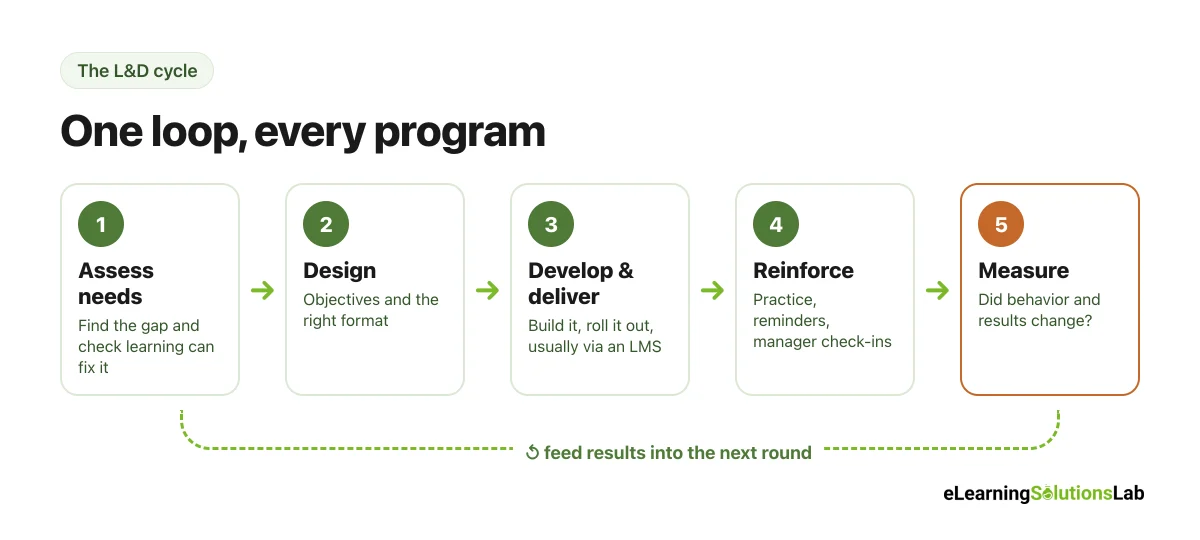
- Assess needs. Find the performance gap and whether learning can actually fix it. Our skills mapping guide helps here.
- Design. Set objectives and choose the right format, for instance eLearning, live sessions, coaching or on-the-job practice.
- Develop and deliver. Build the content and roll it out, usually through an LMS.
- Reinforce. Follow up with practice, reminders and manager check-ins so that the learning really sticks.
- Measure. Check whether behavior and results changed, then feed that back into the next round.
Many teams use a formal model for this, like ADDIE or SAM. The model matters less than simply not skipping the first and last steps, which is where most L&D programs tend to fall down.
Types of L&D Programs
| Program | What it’s for | Typical formats |
|---|---|---|
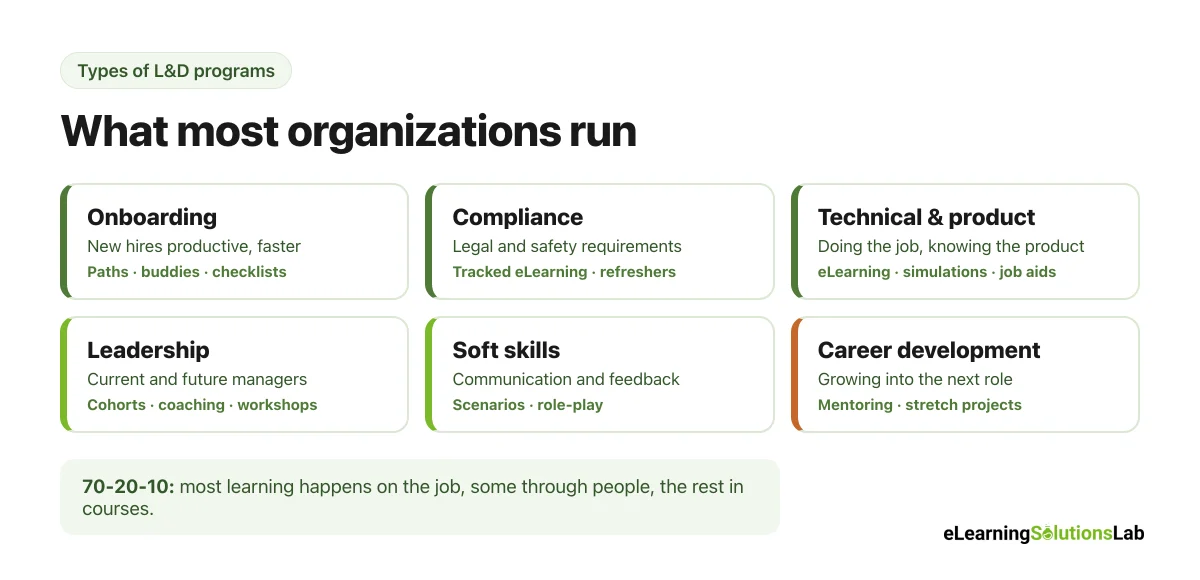
| Onboarding | Getting new hires productive and confident | Learning paths, buddies, checklists |
| Compliance | Meeting legal and safety requirements | eLearning with tracking, refreshers |
| Technical and product skills | Doing the job and knowing what you sell | eLearning, simulations, job aids |
| Leadership and management | Developing current and future managers | Cohorts, coaching, workshops |
| Soft skills | Communication, feedback, collaboration | Scenarios, role-play, live sessions |
| Career development | Growing into the next role | Mentoring, stretch projects, learning plans |
Most organizations run a mix. A useful rule of thumb is the 70-20-10 idea: most learning happens on the job, some through other people, and a smaller share through formal courses. It’s a guideline rather than a law, but it’s a good reminder that L&D is truly more than a course catalog.
L&D Roles
| Role | What they do |
|---|---|
| L&D manager / head of L&D | Owns the strategy, budget and priorities |
| Instructional designer | Designs courses and learning experiences around clear objectives |
| eLearning developer | Builds the courses in authoring tools |
| Learning experience designer (LXD) | Shapes the whole learner journey, not just the content |
| Facilitator / trainer | Runs live sessions, in person or virtual |
| LMS administrator | Runs the platform, enrollments and reports |
Smaller companies often have one person covering several of these roles. And that’s fine, given that you can bring in outside help for the specialist work. Our learning experience designer guide covers one of the fastest-growing roles in more detail.
How to Build an L&D Strategy (6 Steps)
An L&D strategy is simply a plan that connects what people learn to what the business needs. Here’s how you can build one:
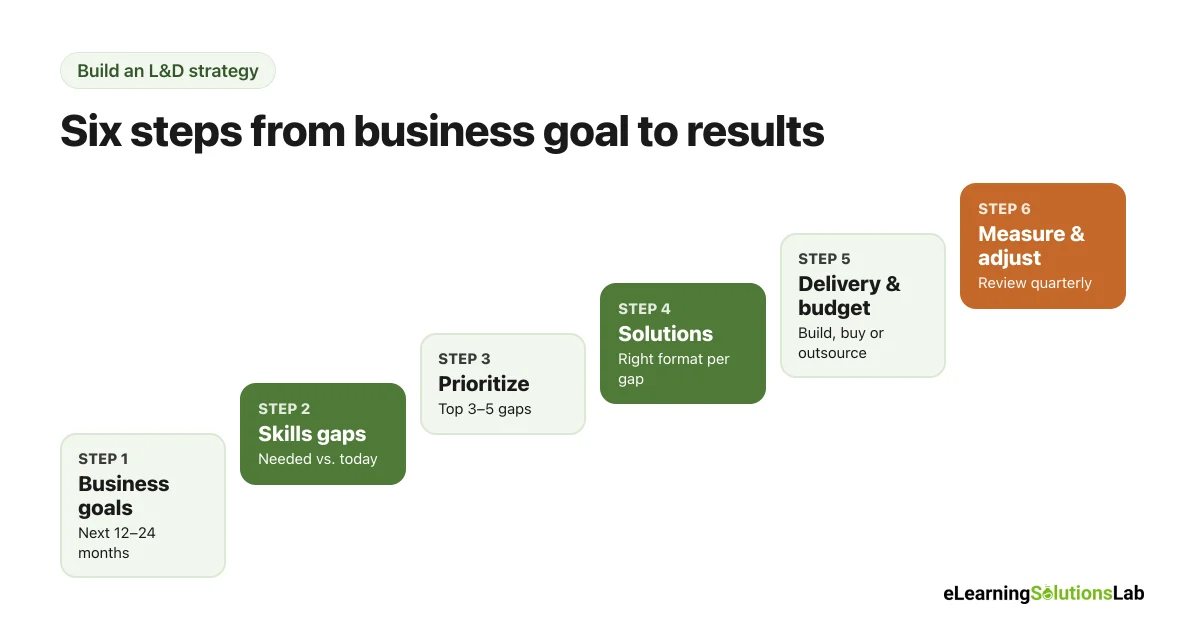
- Start with business goals. Talk to leaders about the next 12 to 24 months. What’s changing, and what has to go right?
- Find the skills gaps. Compare the skills those goals need with the skills you have today. A skills matrix makes this visible.
- Prioritize. You can’t fix everything at once. Pick the three to five gaps with the biggest business impact.
- Choose the right solutions. Match each gap to a format: eLearning, workshops, coaching, job aids, mentoring or a mix.
- Plan delivery and budget. Decide what you’ll build, buy or outsource, and which platform and tools you’ll use.
- Measure and adjust. Agree upfront what success looks like, then review every quarter.
To give you a concrete example, at eLearning Solutions Lab, we don’t simply start an L&D project by building courses. We start by asking which number the business wants to move, for instance time to competency for new hires or repeat errors in a process, and only then decide whether a course, a job aid, coaching or a combination will actually move it. Usually that conversation cuts the training list in half and makes what’s left far more useful.
How to Measure L&D
You have to measure more than completions. Completion rates tell you people clicked through, not whether anything changed. Here are the metrics that typically matter:
| Metric | What it tells you |
|---|---|
| Time to competency | How fast new hires or movers become productive |
| Behavior change | Whether people actually do things differently on the job |
| Business KPIs | Errors, sales, safety incidents or customer scores linked to the program |
| Internal mobility | How many roles you fill from inside |
| Retention | Whether people who learn tend to stay longer |
| Engagement and completion | Useful, but only as early signals, not proof of impact |
The Kirkpatrick model is the most common framework for this, and our eLearning ROI guide shows how to put a number on the results.
The Key Areas L&D Usually Covers
“What are the areas of L&D?” is a common question, and the answer varies by organization. In practice, most L&D teams work across these areas:
- Onboarding – getting new hires productive. See employee onboarding and training.
- Compliance and safety – required training, tracked and documented.
- Technical and job skills – systems, products and processes.
- Soft skills – communication, teamwork, customer service.
- Leadership and management – from first-time managers to senior leaders. See leadership development eLearning.
- Career development – paths, mobility and growth plans.
- Learning culture – making learning part of everyday work.
You don’t have to cover all seven at once. Start with the areas closest to your biggest business problems, given that that’s where L&D can genuinely show results fastest.
Free L&D Strategy Template (PDF)
Free download – no email needed
L&D Strategy Template
A printable PDF that walks you through the six steps: business goals, skills gaps, priorities, solutions, delivery and budget, and the metrics you’ll track.
In one line: learning and development is how an organization builds the skills it needs, and it works best when every program starts from a business goal and ends with a measurable change on the job.
Need help turning your L&D plan into real programs?
At eLearning Solutions Lab, we help L&D teams go from strategy to finished courses, with consulting, instructional design and custom eLearning development.
Start with our eLearning consulting, or let us build the content with our custom eLearning development team.
Related Reading
- Learning and development tools – the software L&D teams use.
- Skills mapping – find the gaps before you train.
- Do I need an LMS? – when a platform makes sense.
- The Kirkpatrick model – four levels of training evaluation.
- Staff augmentation for L&D – extra capacity without new hires.
The Author

Book A Discovery Call
Our Learning Advisors are happy to walk you through your project step-by-step — content, timeline, and fixed pricing.
Get Your Free QuoteNo obligation — just a focused conversation. Proposal within 24 hours.
You may also like
The Four Stages of Competence: Examples and How Training Moves People Forward
Think back to learning to drive. At first, you didn't know how much you didn't…
Training Curriculum Development: 8 Steps, Components and a Sample Map
A single course can teach a skill. But most roles need much more than one…