


- Published
- Reading time
- 9 min
Filed under Instructional Design
The Kirkpatrick Model is the four-level framework for evaluating training programs: Reaction, Learning, Behavior, and Results. Donald Kirkpatrick created it in the 1950s, and it’s still the most widely used way to find out whether a training program actually worked, from how learners felt about it to what changed in the business.
Most guides stop at defining the four levels. This one shows you how to use them. For each level, you’ll get sample survey questions, metrics worth tracking, and the mistakes that can make your evaluation data useless.
Updated November 2026.
In This Article
What is the Kirkpatrick Model?
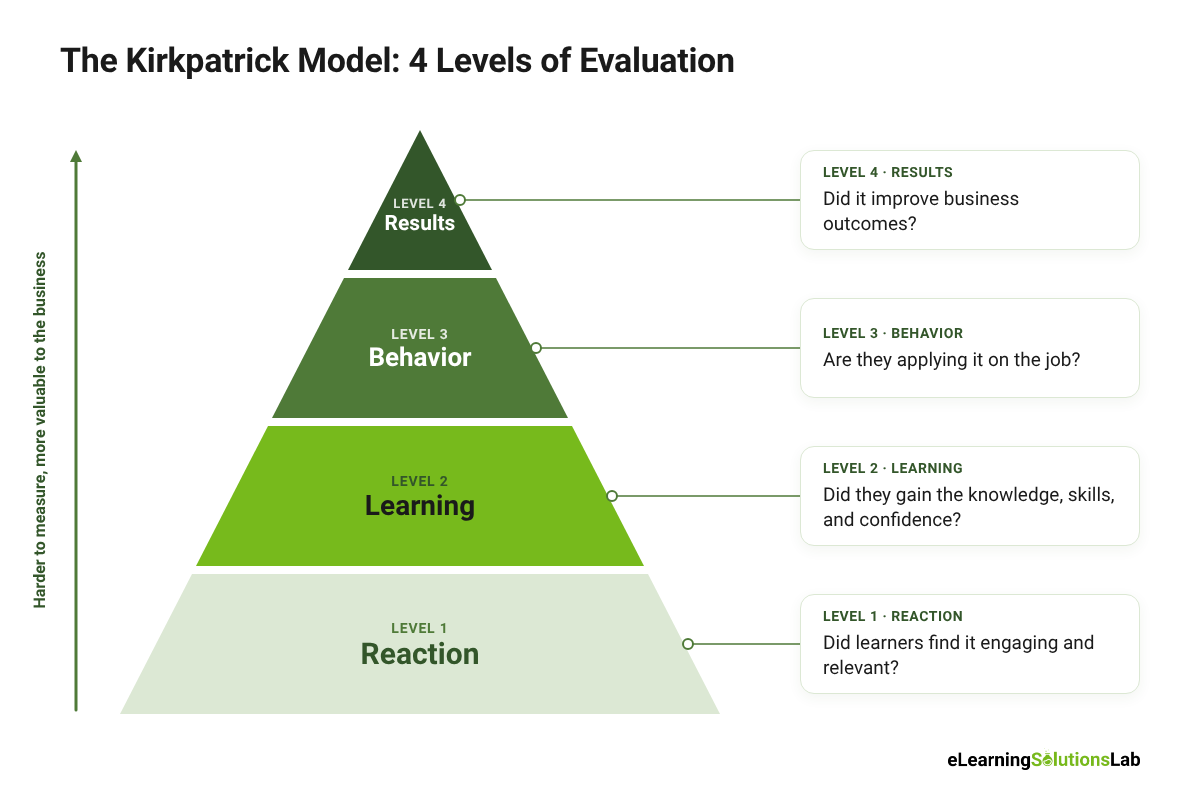
The Kirkpatrick Model is a framework for evaluating training programs at four levels. Each level answers a different question:
- Reaction: Did learners find the training engaging and relevant?
- Learning: Did they gain the knowledge, skills, and confidence the training aimed to build?
- Behavior: Are they applying what they learned on the job?
- Results: Did that change in behavior improve business outcomes?
Each level builds on the one before it. Learners who disengage are less likely to learn. If they don’t learn, they can’t change how they work. And if their behavior doesn’t change, the business won’t see results. Measuring at all four levels shows you whether a training program worked, and where it broke down if it didn’t.
L&D teams, instructional designers, HR leaders, and educators use this evaluation model to:
- Prove impact to leadership and stakeholders.
- Improve programs by finding the level where results drop off.
- Justify budgets by connecting training to outcomes the business already tracks.
- Plan better training from the start, by deciding up front what success looks like.
The model works for any format: instructor-led sessions, eLearning, blended programs, coaching, and onboarding.
Who Created the Kirkpatrick Model, and When?
Dr. Donald Kirkpatrick developed the model in the 1950s while working on his PhD at the University of Wisconsin. He introduced the four levels in a series of articles in 1959, and later expanded on them in his book Evaluating Training Programs: The Four Levels.
Today, Kirkpatrick Partners carries on his work. Their updated version, the New World Kirkpatrick Model, keeps the four levels but changes how you plan with them. We cover it in detail later in this guide.
Why is the Kirkpatrick Model So Popular?
More than 60 years on, the Kirkpatrick Model is still the most widely used way to evaluate training. Here’s why:
- It’s simple. Four levels are easy to explain to a stakeholder in a single meeting.
- It’s flexible. It fits a 10-minute compliance module as well as a year-long leadership program.
- It speaks the business’s language. Level 4 connects training to sales, quality, safety, and retention, the metrics leaders care about.
- It gives everyone a shared vocabulary. When an L&D team says, “We have Level 2 data but no Level 3 data,” everyone knows what’s missing.
The 4 Levels of the Kirkpatrick Model
Each level measures something different, at a different time, with different tools. Here’s the overview:
| Level | What it measures | When to measure | Common tools |
|---|---|---|---|
| 1. Reaction | Engagement, relevance, and intent to apply | During and right after training | End-of-course surveys, polls, LMS completion data |
| 2. Learning | Knowledge, skills, attitudes, confidence, and commitment | Before and right after training | Pre/post-tests, scenario questions, skill demos with rubrics |
| 3. Behavior | Whether learners apply the training on the job | 30, 60, and 90 days after training | Observation checklists, manager surveys, work-system data |
| 4. Results | Impact on business outcomes | Baseline before training, then over the following months | Business KPIs from CRM, HRIS, quality, safety, and finance systems |
Below, we break down each level: what it measures, how to measure it, sample questions, metrics to track, and the most common mistake.
Level 1: Reaction
What it measures: How learners respond to the training. Did they find it engaging, relevant to their job, and worth their time?
Level 1 is the easiest level to measure, and the most often misused. Satisfaction alone doesn’t tell you much. The most useful Level 1 data focuses on relevance and intent to apply, because learners who see how training connects to their work are far more likely to use it.
How to measure it:
- A short survey at the end of the course (5 to 8 questions)
- In-session polls or pulse checks during longer programs
- Completion and drop-off data from your LMS (for eLearning)
Sample questions (rate 1–5 unless noted):
- “This training was relevant to my day-to-day work.”
- “I know exactly how I will use what I learned in the next two weeks.”
- “The examples reflected real situations I face on the job.”
- “I would recommend this training to a colleague.”
- Open-ended: “What’s one thing you’ll do differently after this training?”
Metrics to track:
- Average relevance score
- Percentage of learners who say they intend to apply the skill
- Course completion rate
- Net Promoter Score (NPS) for the training
Common mistake: Relying on “smile sheets” that only ask whether learners liked the trainer or the snacks. High satisfaction scores don’t predict learning or behavior change.
Level 2: Learning
What it measures: The degree to which learners gained the intended knowledge, skills, and attitudes. In the New World version of the model, Level 2 also measures confidence (“I believe I can do this”) and commitment (“I intend to do this”).
How to measure it:
- A pre-test and post-test on the same objectives, to show how much learners gained
- Scenario-based questions that test decisions
- Skill demonstrations or role-plays scored with rubrics
- Self-rated confidence before and after the training
Sample questions and tasks:
- Scenario: “A customer says your price is too high. Which response best follows the value-selling framework?” (multiple choice with realistic options)
- Skill demo: “Walk through the lockout/tagout procedure on this equipment.” (scored against a checklist)
- Confidence: “How confident are you that you can handle a price objection using this framework?” (1–5)
- Commitment: “How likely are you to use this framework on your next five customer calls?” (1–5)
Metrics to track:
- Average improvement from pre-test to post-test
- Pass rate on the final assessment
- Rubric scores on skill demonstrations
- Change in confidence and commitment scores
Common mistake: Testing only whether learners can recall facts. Someone who can recite a policy may still fail to apply it under pressure, so write questions that match the decisions people make on the job.
Level 3: Behavior
What it measures: The degree to which learners apply what they learned once they’re back on the job.
Level 3 is where many training programs fall apart, and it’s the level most organizations skip. Learning rarely transfers to the job on its own: behavior changes when the work environment supports it.
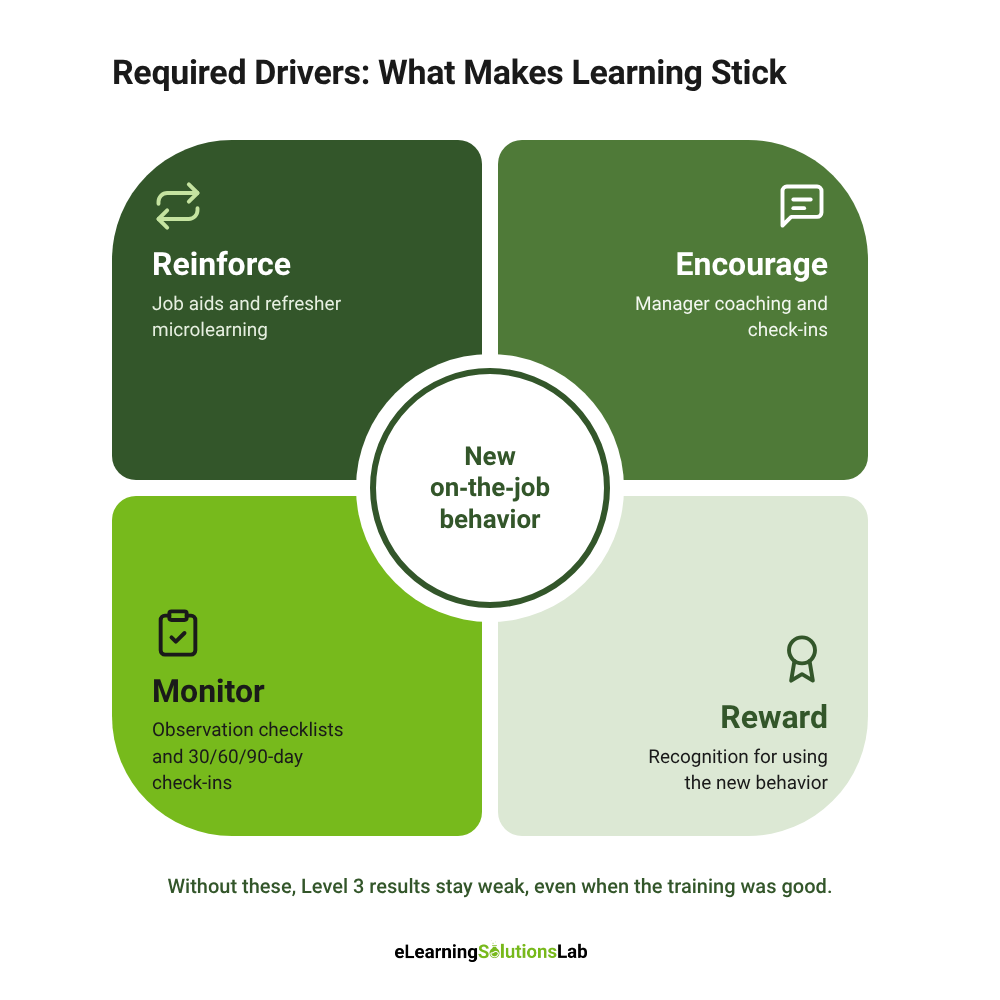
The New World model calls these supports required drivers: processes and systems that reinforce, encourage, reward, and monitor the new behavior.
Examples of required drivers:
- Manager coaching and check-ins after the training
- Job aids and checklists at the point of need
- Follow-up microlearning or refreshers
- Recognition for using the new behavior
- Updated processes or tools that make the new way the easy way
How to measure it:
- Observation checklists completed by managers or peers
- Manager surveys at 30, 60, and 90 days
- Learner self-reports (best combined with another source)
- Data from work systems: CRM entries, call recordings, quality audits, ticket logs
Sample questions (manager survey, 30–90 days after training):
- “How often does this team member use the discovery framework on customer calls?” (Never / Sometimes / Often / Always)
- “Which steps of the process are they applying consistently?”
- “What’s getting in the way of them applying the new skill?”
- For learners: “Which parts of the training have you used in the last 30 days? What stopped you from using the rest?”
Metrics to track:
- Percentage of learners using the target behavior correctly
- How often the behavior is observed
- Manager-rated performance on the critical behaviors
- Number of barriers reported, by type
Common mistake: Measuring behavior without planning for it. If no one coaches, reinforces, or checks the new behavior, Level 3 results will be weak. That doesn’t mean the training failed; it means the support around it was missing.
Level 4: Results
What it measures: The degree to which training led to the outcomes the organization cares about, such as revenue, quality, safety, productivity, customer satisfaction, or retention.
The New World model adds leading indicators: short-term signs that critical behaviors are moving the business in the right direction. Final results can take months to show up, so leading indicators help you spot progress, or problems, early.
| Training program | Leading indicator | Desired result |
|---|---|---|
| Sales training | More qualified opportunities logged in the CRM | Higher conversion rate and revenue |
| Safety training | More near-miss reports and completed safety checks | Fewer recordable incidents |
| Customer service training | Higher first-contact resolution | Higher customer satisfaction and retention |
| Manager onboarding | More regular one-on-ones held with direct reports | Lower team turnover |
How to measure it:
- Pull data from systems the business already uses (CRM, HRIS, quality, safety, finance).
- Collect a baseline before the training so you have something to compare against.
- Track over 3 to 12 months, depending on how quickly the outcome changes.
How to isolate the effect of training:
Business results have many causes, so you need to separate what training contributed from everything else:
- Control groups: Compare trained and untrained teams over the same period.
- Trend lines: Compare actual results to what the pre-training trend predicted.
- Participant and manager estimates: Ask how much of the improvement they credit to the training, and how confident they are.
Metrics to track:
- The agreed business KPI (e.g., conversion rate, error rate, incident rate)
- Leading indicators for that KPI
- Change from baseline, compared with a control group or trend where possible
Common mistake: Choosing a Level 4 metric after the training is over. Agree on the business result with stakeholders before you design anything. That’s exactly why the New World model tells you to start at Level 4 and work backward.
The New World Kirkpatrick Model
The original model told you what to measure. It didn’t say much about how to plan training so the results actually happen. Over time, many organizations worked through the four levels in order, from 1 to 4: they collected Level 1 surveys, maybe a Level 2 test, then ran out of time or budget before reaching behavior and results.
Jim and Wendy Kirkpatrick of Kirkpatrick Partners introduced the New World Kirkpatrick Model to fix that. It keeps the same four levels but adds new elements to each one and changes the starting point: you plan from Level 4 down, then evaluate from Level 1 up.
What Changed at Each Level
| Level | Original model | New World additions |
|---|---|---|
| 1. Reaction | Learner satisfaction | Engagement, relevance to the job, and customer satisfaction |
| 2. Learning | Knowledge, skills, and attitudes | Confidence and commitment |
| 3. Behavior | Whether learners apply the training on the job | Critical behaviors and required drivers (reinforce, encourage, reward, monitor) |
| 4. Results | Business outcomes | Leading indicators and desired outcomes agreed with stakeholders up front |
Start With Level 4 and Work Backward
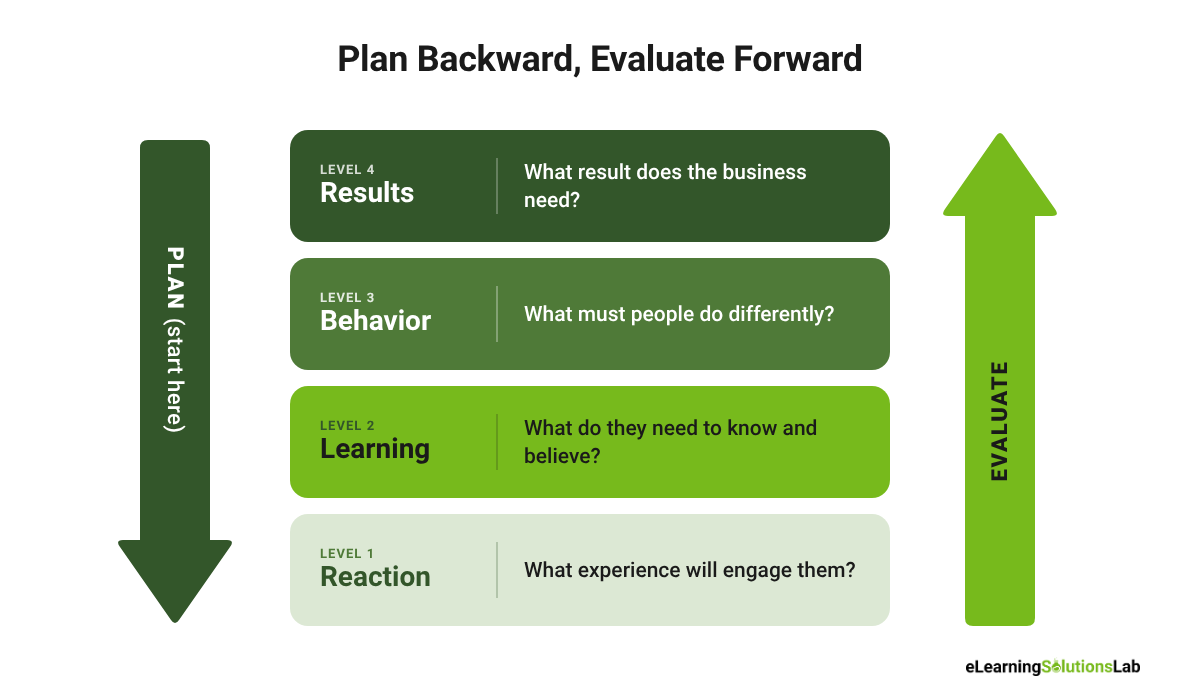
The biggest shift in the New World model is the order you plan in. Instead of designing training first and asking how to evaluate it later, you begin with the business result:
- Level 4: What result does the organization need? How will we know it’s improving?
- Level 3: What do people need to do differently on the job to drive that result? What support will they need?
- Level 2: What knowledge, skills, confidence, and commitment do they need to do it?
- Level 1: What kind of learning experience will engage them and feel relevant?
Planning this way makes sure every part of the training connects to a result someone cares about. It also tells you what to measure before the program launches, so you can collect baseline data.
Build a Chain of Evidence
The New World model also changes how you report results. Instead of presenting each level as a separate number, you connect them into a chain of evidence: a story that shows how the training led to the outcome.
For example:
Learners rated the training highly relevant (Level 1). They improved their scores by 30% and said they were confident using the new process (Level 2). Managers observed 75% of them using it consistently at 60 days, supported by weekly coaching (Level 3). Over the next quarter, error rates dropped by 18% (Level 4).
Each link makes the next one more believable. A strong chain of evidence is far more convincing to leadership than a satisfaction score or a single ROI figure.
To learn more, see Kirkpatrick Partners’ official overview of the Kirkpatrick Model.
The Author

Book A Discovery Call
Our Learning Advisors are happy to walk you through your project step-by-step — content, timeline, and fixed pricing.
Get Your Free QuoteNo obligation — just a focused conversation. Proposal within 24 hours.
You may also like
What is a Learning Experience Designer? Role, Skills, Salary and How to Become One (2026)
If you've seen "learning experience designer" on a job board and wondered…
The ADDIE Model: 5 Phases Explained With a Worked Example (and Free Template)
Almost every guide to the ADDIE model says the same thing: five phases, a short…