

Quick answer
To train retail staff, list the skills each role needs, set clear standards for each one, and teach them through shadowing, role-play, and short lessons on a Day 1, Week 1, and 30-60-90 day schedule. Sign off each skill when an employee can do it alone, then track results like time-to-competency, sales per transaction, and 90-day retention.
You don’t need special software to start. This guide includes a step-by-step training plan, an onboarding schedule, a copyable checklist, role-play scripts, a delivery methods comparison, a compliance quick reference for the US, UK/EU, and Australia, KPIs with formulas, and a free training kit.
Your newest hire’s first few shifts decide a lot. And in those early days, they can learn how to greet customers, whether to follow the returns policy, and what to do when anything goes wrong.
So without having a clear plan, they can pick up whatever habits the busiest person on shift has, and you’ll pay for it later in lost sales, shrink, and early resignations.
In this guide, we’ll show you a step-by-step training plan, what it looks like for a Day 1, Week 1, and 30-60-90 day onboarding schedule, and a training checklist you can use from your first shift.
It also includes role-play scripts for some of the tough situations, compliance quick references for the US, UK/EU, and Australia, and KPIs that show whether your retail staff training programs are actually working.
Short on time? Jump to the step-by-step training plan.
Updated October 2026.
In This Article
- What is retail staff training?
- Why retail staff training matters
- Types of retail staff training
- How to build a retail staff training plan
- Retail onboarding schedule: Day 1, Week 1, and 30-60-90 days
- Retail staff training checklist
- Role-play scenarios and scripts
- Training delivery methods compared
- Single store vs multi-location training
- Retail training compliance by region
- How to measure retail staff training
- Common retail training challenges (and fixes)
- Free retail staff training kit
What is Retail Staff Training?
Retail staff training is the process of teaching store employees the skills, knowledge, and behaviors they need to do their jobs well. It mainly covers customer service, sales, product knowledge, point-of-sale (POS) systems, loss prevention, and safety, starting at onboarding and continuing throughout employment.
Good retail training really doesn’t stop after an employee’s first week. It works best as an ongoing system that can bring new hires up to speed quickly and can keep experienced staff sharp as products, policies, and technology change.
Onboarding vs Ongoing Training
Most retail training falls into one of two stages:
| Onboarding training | Ongoing training | |
|---|---|---|
| Who | New hires, transfers, seasonal staff | All current employees |
| When | First day to first 90 days | Year-round, often weekly or monthly |
| Goal | Get employees confident and working independently | Build skills, refresh standards, roll out changes |
| Typical topics | Store policies, safety, POS basics, store layout, core products | Advanced selling, new products, updated procedures, leadership skills |
| Common formats | Shadowing, orientation sessions, checklists | Huddles, microlearning, role-play, refresher sessions |
Onboarding can build the foundation, and ongoing training will keep that foundation from slipping. Stores that invest only in the first week may often see the same mistakes return within months, especially when staff turnover is high or seasonal hires join during busy periods.
Who Needs Retail Training?
The reality is everyone on the store team must be trained, not just new sales associates:
- Sales associates and cashiers – customer service, transactions, and product knowledge.
- Stockroom and visual merchandising staff – inventory handling, safety, and display standards.
- Shift leads and supervisors – coaching, opening and closing procedures, and handling escalations.
- Store managers – scheduling, performance management, and leading training themselves.
Why Retail Staff Training Matters
Training fundamentally affects more than how fast a new hire learns the register. It also shapes whether employees stay, how customers are treated, and how much inventory walks out the door.
Retail staff training benefits the people and organization as a whole, in many different ways:
1. It Helps You Keep the People You Hire
Retail loses staff faster than almost any other industry. Retail and wholesale have the highest turnover rate at 26.7%, based on Mercer’s 2025 US Turnover Survey.
Monthly figures also show the same pattern: as of March 2026, the average total separations rate for the retail industry was 4.1% compared to 3.0% across all sectors, according to the U.S. Bureau of Labor Statistics.
Managers actually see training as a direct fix. In one 2025 survey of frontline leaders, 39% cited retention as their #1 issue, 89% believe better training would reduce turnover, and 83% of workers agree it’s essential to their success.
2. Most Frontline Workers Say Their Training Isn’t Good Enough
The gap here is wide, and retail is behind other industries. In a July 2026 Schoox survey, they found that among frontline workers aged 18 to 34, 66% feel their company does not provide the right retail staff training programs to help them execute better in their job.
Retail workers ranked last across every learning-related measure, including training relevance, leadership recognition, and learning’s influence on retention.
And that same survey also shows what employees want instead: 75% prefer hands-on learning and shadowing – which is a strong case for practical, on-the-floor training over long slide decks.
3. Staff Need to Know How to Handle Difficult Customers
Conflict on the sales floor has now become a routine. In a 2025 UK survey of retail, hospitality and food workers, 73% of workers report experiencing customer incivility on a daily or weekly basis, and 65% worry about how to actually handle escalating conflicts.
Workers typically asked for more preparation, with 82% calling for training to deal with violent situations.
4. It Reduces Shrink and Safety Incidents
Not all inventory loss comes from shoplifters. In the NRF’s most recent published breakdown (2022 data), process and control failures and errors made up 27.29% of shrink, and internal theft accounted for 28.85%. So that means a large share of loss comes from mistakes and gaps that better procedures and training can address.
External theft is also getting more aggressive. Retailers reported an 18% increase in shoplifting incidents in 2024 compared to 2023, and threats or acts of violence during theft events rose 17% in that same period. Staff genuinely need clear training on what to do, and what not to do, when they suspect theft.
5. Confident Employees Perform Better
Relevant retail staff training pays off in daily performance. When that training reflects real situations workers face, workers report greater confidence (90%), productivity (82%), and job satisfaction (81%).
Types of Retail Staff Training
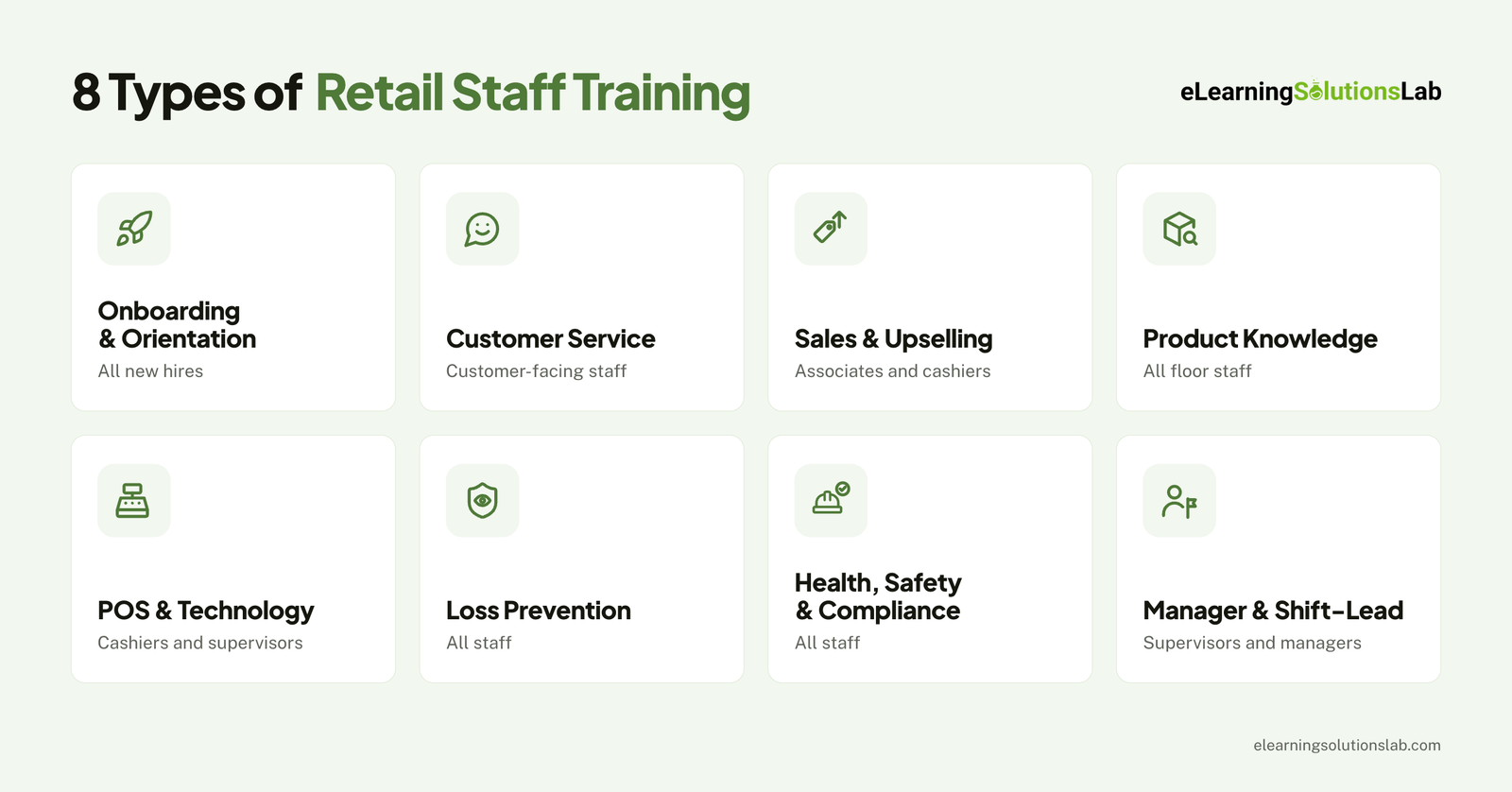
Every store needs a mix of these training types. Below, we cover who needs each type of retail staff training, when to deliver it, and the format that works best.
| Training type | Who needs it | When | Best format |
|---|---|---|---|
| Onboarding and orientation | All new hires, transfers, seasonal staff | Day 1 to 90 days | Checklist, shadowing, short orientation session |
| Customer service | All customer-facing staff | Onboarding, then monthly refreshers | Role-play, shadowing, huddles |
| Sales and upselling | Sales associates, cashiers | Week 1 onward | Role-play, scripts, peer coaching |
| Product knowledge | All floor staff | Onboarding, plus every new product launch | Hands-on demos, short lessons, product cards |
| POS and store technology | Cashiers, associates, supervisors | Day 1 to Week 1, plus system updates | Supervised practice, training mode, quick guides |
| Loss prevention | All staff (with deeper training for leads) | Onboarding, then quarterly | Instructor-led session, scenario practice |
| Health, safety and compliance | All staff | Day 1, then as the law requires | Instructor-led, documented sign-off |
| Manager and shift-lead training | Supervisors, assistant and store managers | At promotion, then ongoing | Workshops, mentoring, train-the-trainer |
 Onboarding and Orientation
Onboarding can cover everything a new hire needs to work safely and independently: store policies, store layout, scheduling and break rules, dress code, and who to ask for help.
Good onboarding is essentially spread across the first 90 days, not just packed into a single day. Having a written checklist will make sure nothing gets skipped when a different manager is on shift.
Customer Service Training
This type of training covers greeting customers, reading their needs, handling complaints, and recovering when something goes wrong. Customer service is a fundamental skill customers notice first, so it requires regular practice – not compressed into a single lesson.
Role-play works especially well here, including sample practice with frustrated or aggressive customers.
Sales and Upselling Training
Sales training can teach staff how to suggest related products, explain the value of a higher-priced option, and close a sale without pressure. The goal here is helpful recommendations, not just pushy tactics. Simple scripts can give new staff a starting point, and they can adapt the wording as they gain confidence.
For larger teams that need consistent selling skills across every shift, eLearning sales training lets staff practice on their own time between role-play sessions.
Product Knowledge Training
Staff can’t sell or recommend what they don’t understand. Product training mainly covers features, benefits, common customer questions, and how products compare.
Hands-on time with the products works better than just reading spec sheets. Refresh this training whenever new stock or seasonal ranges arrive. If you carry a large or fast-changing range, a structured product training program keeps every launch from becoming a scramble.
POS and Store Technology Training
New hires genuinely need to be confident with the register before they’re alone on a till. Cover sales, returns, exchanges, discounts, voids, gift cards, and what to do when the system goes down. If your POS has an actual training or practice mode, you can use it so that mistakes don’t affect real transactions.
Also, you can cover any handheld scanners, inventory apps, or scheduling tools staff use.
Loss Prevention Training
Loss prevention training will teach your retail staff how to spot and deter theft, follow cash-handling procedures, and avoid process errors that cause inventory loss.
It must also be clear about what staff should not do. Many retailers don’t allow employees to confront or chase suspected shoplifters, since their safety is, of course, more important than the stock.
Health, Safety and Compliance Training
This type of retail staff training includes workplace safety, manual handling, emergency procedures, and any legal requirements for your location.
Examples of these include rules on selling age-restricted products like alcohol and tobacco, and anti-harassment training. Requirements may typically vary by country, state, and region, so you have to keep written records of who completed what and when. If you’d rather not build these courses in-house, eLearning safety training services can create them with sign-off and completion tracking built in.
Manager and Shift-Lead Training
Supervisors are often promoted for being just great on the floor, not necessarily for their leadership skills. Manager training can cover coaching staff, giving feedback, handling escalations, scheduling, and opening and closing procedures.
Shift leads usually deliver most of the day-to-day training, so teaching them how to train others has a huge impact across the whole team. For multi-store retailers, leadership development eLearning gives new supervisors the same foundation wherever they’re promoted.
How to Build a Retail Staff Training Plan (Step by Step)
A training plan, as we know, should turn those statements of “show them the ropes” into a repeatable process that every manager can follow. You don’t need special software for this; even a spreadsheet or document and these seven steps can help you out.
Step 1: List Every Role and the Skills Each One Needs
You can start by writing down each role in your store, like sales associate, cashier, stock associate, visual merchandiser, shift lead, and store manager. Next to each role, you need to list the tasks the person must be able to do on their own.
For example, a sales associate might need to:
- Greet and assist customers
- Process sales, returns, and exchanges
- Answer common product questions
- Restock and face shelves
- Follow opening and closing procedures
Then, pull these tasks from your job descriptions, and ask your best current employees what they actually do day to day (real-life scenarios).
Step 2: Define What “Good” Looks Like
For each task you’ve listed, write a short, observable standard so that your trainers and employees agree on what success means (and why it matters).
Avoid vague goals like “provides good service” – instead, write something that you can check.
| Task | Vague goal | Clear standard (example) |
|---|---|---|
| Greeting customers | Be friendly | Greet every customer within 30 seconds of entering the section |
| Processing returns | Know the returns process | Complete a return with receipt in under 3 minutes, with no manager help |
| Product knowledge | Know the products | Explain the top 3 differences between our two best-selling models |
These standards become the sign-off criteria in Step 6. The times above are examples, so set standards that fit your own store.
Step 3: Choose How Each Skill Will Be Taught
You can match each skill to the delivery method that suits it best:
- Shadowing works for routines and store-specific habits.
- Role-play works for customer service, sales, and conflict.
- Short lessons or videos work for policies, product facts, and compliance basics.
- Supervised practice works for POS, cash handling, and equipment.
- Instructor-led sessions work for safety and anything that needs a documented sign-off.
Most of these skills require two methods: one to learn and one to practice. For instance, someone might watch a short lesson on returns, and then process three returns with a trainer watching.
Step 4: Build a Timeline
Decide when each of these skills gets taught. Having a common structure is crucial; here’s an example:
- Day 1 – Safety, policies, store tour, and POS basics.
- Week 1 – Shadowing, core products, and supervised transactions.
- Days 30, 60, and 90 – Increasing independence, selling skills, and final sign-off.
Start with the essentials first. A new hire needs emergency procedures and register basics before proceeding to advanced upselling. You’ll find the full schedule in the onboarding schedule section below.
Step 5: Assign Trainers and Buddies
You can name a person responsible for each part of the plan. In a small store, for example, that might be the owner and one experienced associate. Whereas in a larger store, shift leads usually handle daily training while the manager simply oversees progress.
Then, pair every new hire with a buddy, an experienced employee they can shadow and ask questions without actually feeling judged.
You can choose buddies for their patience and habits, not just their sales numbers, and give them dedicated time on the schedule to train.
Step 6: Sign Off Each Skill
When an employee meets a standard from Step 2, your trainer will observe it and sign it off with the date. You can use a simple checklist with 3 columns here: skill, date completed, and trainer initials.
Essentially, sign-off does two jobs. First, it shows the employee clear progress, and it gives you a record, which is especially important for safety and compliance training that you may need to prove later during an audit or inspection. Our guide on how to track employee training shows how to turn these sign-offs into a tracker with expiry alerts.
Step 7: Review and Update the Plan Regularly
A training plan goes stale quickly as products, systems, and policies change. You have to review it at least every quarter, and also whenever:
- You introduce a new product line, POS update, or policy.
- A recurring mistake shows up, like frequent register errors or customer complaints.
- New hires give feedback about what was confusing or missing.
You can ask each new hire at their 30-day check-in what they wish they’d learned sooner. Their answers are essentially the fastest way to improve the plan.
Retail Onboarding Schedule: Day 1, Week 1, and 30-60-90 Days
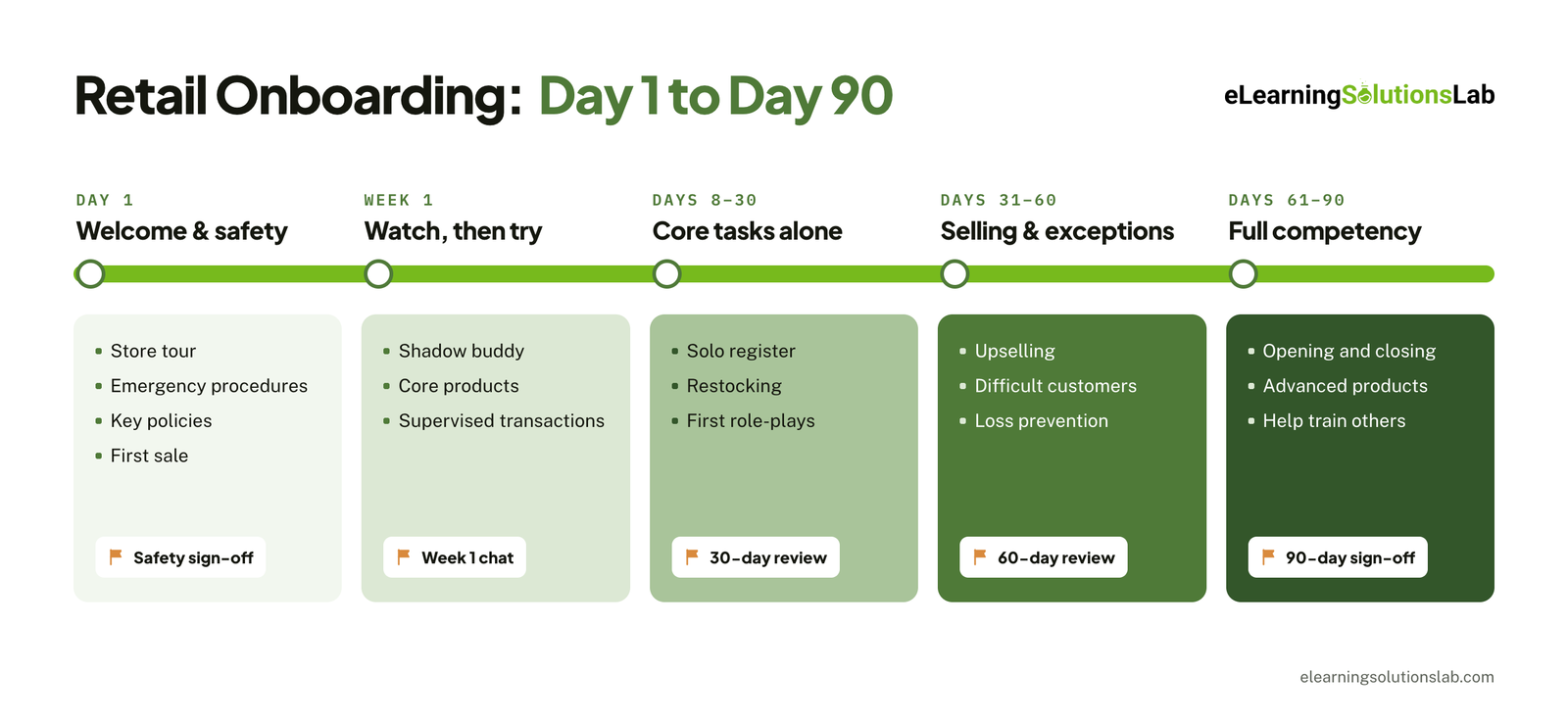 New hires remember very little from a packed first day. Spreading training across 90 days lets each skill build on the last, and it gives you clear checkpoints to catch problems early. Use the schedule below as a starting point, then adjust it for your store’s roles and hours.
| Stage | Focus | Key activities | Checkpoint |
|---|---|---|---|
| Day 1 | Welcome and safety | Store tour, emergency exits and procedures, key policies, meet the team and buddy, POS log-in and basic sale | Safety and policy sign-off |
| Week 1 | Learning by watching | Shadow the buddy, learn core products, supervised transactions and returns, first customer greetings | End-of-week chat with the manager |
| Days 8-30 | Core tasks alone | Run the register solo, restock and face shelves, handle common questions, first role-play sessions | 30-day review and core skills sign-off |
| Days 31-60 | Selling and exceptions | Upselling and add-ons, difficult customers, returns outside policy, loss prevention basics | 60-day review with observed role-play |
| Days 61-90 | Full competency | Opening and closing tasks, advanced product knowledge, helping train newer staff | 90-day sign-off and development goals |
Day 1: Keep It Light and Safe
Focus on what the new hire needs to be safe and comfortable. That means emergency exits, how to report an incident, the few policies they can’t get wrong, and who to ask for help. Finish with one or two simple sales on the register so they leave with a small win.
Week 1: Watch, Then Try
Let the new hire shadow their buddy for most of the week, then gradually take over transactions with the buddy watching. Keep product training to the core range, the items customers ask about most.
Days 30, 60, and 90: Check In and Sign Off
Hold a short, scheduled review at each checkpoint. Go through the checklist, sign off what’s done, and agree on what to focus on next. These reviews also tell you early if someone is struggling, or thinking about leaving.
Pro tip
Seasonal staff rarely stay 90 days, so give them a compressed version: Day 1 safety and policies, then a 1-week fast track covering the register, core products, and the difficult customer script. Sign off only what they need for their role.
Retail Staff Training Checklist
Use this checklist to make sure every new hire covers the same essentials, no matter who’s on shift. The trainer initials and dates each item once the employee can do it on their own, not just when it’s been explained.
| Category | Skill or task | Date | Trainer initials |
|---|---|---|---|
| Safety | ☐ Knows emergency exits, meeting point, and alarm procedures ☐ Can report an incident or injury ☐ Uses safe lifting and ladder practices |
||
| Policies | ☐ Understands dress code, breaks, and scheduling rules ☐ Can explain the returns and exchange policy ☐ Knows the age-restricted sales policy (if relevant) |
||
| POS | ☐ Processes a sale, return, exchange, and void ☐ Applies discounts and gift cards ☐ Counts and closes a till accurately ☐ Knows what to do if the system goes down |
||
| Customer service | ☐ Greets customers to the store standard ☐ Handles a complaint using the store’s approach ☐ Knows when and how to call a manager |
||
| Product and sales | ☐ Explains the core range and top sellers ☐ Suggests a relevant add-on during a sale ☐ Finds stock in the store and stockroom |
||
| Loss prevention | ☐ Follows cash-handling procedures ☐ Knows the store’s response to suspected theft ☐ Knows what not to do (confront, chase, or touch) |
||
| Store operations | ☐ Restocks and faces shelves to standard ☐ Completes opening tasks ☐ Completes closing tasks |
The free training kit includes this checklist as an editable file, with space for the employee’s signature at the 90-day sign-off.
Role-Play Scenarios and Scripts
Role-play is the safest way to practice the moments that go wrong on the sales floor. Run each scenario in a 10-15 minute session: the trainer plays the customer, the employee responds, and then you swap roles and talk about what worked.
The scripts below are starting points. Encourage staff to put them in their own words once they know the steps. For teams that need to practice between sessions, scenario based eLearning lets employees choose a response and see the outcome without a live customer.
Scenario 1: The Angry Customer
Setup: A customer bought a jacket last week, and the zip has broken. They’re loud and frustrated, and there’s a line behind them.
Steps: Listen without interrupting, acknowledge the problem, ask one clarifying question, then offer a solution.
Sample script:
- “I’m sorry that happened, especially so soon after you bought it.”
- “Can I see the receipt or the card you paid with? Then I can sort this out for you right now.”
- “I can swap it for a new one today, or give you a refund. Which would you prefer?”
What good looks like: A calm voice, no arguing about whose fault it is, and a clear choice of next step for the customer.
Common mistakes: Defending the product, quoting policy before acknowledging the problem, or calling a manager straight away when the employee could resolve it.
Scenario 2: Upselling Without Pushing
Setup: A customer is buying a pair of leather boots.
Steps: Ask about how they’ll use the product, then suggest one add-on that solves a real need.
Sample script:
- “Are you planning to wear these in the rain much?”
- “This protector spray stops water marks on leather. Most people who buy these boots pick one up.”
- “No problem at all, enjoy them!” (if the customer says no)
What good looks like: One relevant suggestion, explained by its benefit, and a friendly response to a “no.”
Common mistakes: Listing several add-ons, suggesting something unrelated, or repeating the offer after the customer declines.
Scenario 3: Suspected Theft
Setup: An employee sees a customer put an item into their bag in a quiet aisle.
Steps: Stay safe, use customer service to deter, never accuse, and follow your store’s reporting procedure.
Sample script:
- “Hi there! Can I help you find anything today?”
- “Let me know if you’d like a basket for those.”
- Then, out of earshot, tell the manager or security what was seen, where, and when.
What good looks like: A friendly, visible presence that removes the chance to steal unnoticed, followed by a quick factual report.
Common mistakes: Accusing the customer, blocking the exit, chasing them, or touching their bag. Follow your store’s policy, which in most retailers means staff should never put themselves at risk.
Scenario 4: A Return Outside Policy
Setup: A customer wants to return an item 45 days after purchase. The policy is 30 days.
Steps: Explain the policy kindly, offer what you can do, and escalate only if your store allows exceptions.
Sample script:
- “I can see why you’d want to bring it back. Our returns window is 30 days, so I can’t give a refund on this one.”
- “What I can do is offer an exchange or store credit, if that helps.”
- “Let me check with my manager whether there’s anything else we can do.” (only if exceptions are allowed)
What good looks like: The employee stays friendly, explains the rule without blaming the customer, and offers an alternative.
Common mistakes: Saying “it’s not my decision,” making promises the manager might not keep, or bending the rule differently for different customers.
Training Delivery Methods Compared
There’s no single best way to deliver retail staff training. Most stores combine two or three methods, matched to the skill and the time available. Here’s how the main options compare.
| Method | Cost | Time off the floor | Best for | Main drawback |
|---|---|---|---|---|
| Shadowing and on-the-job training | Low | None (learning happens on shift) | Store routines, POS, customer interactions | Quality depends on the buddy, and bad habits spread |
| Instructor-led sessions | Medium | High | Safety, compliance, group role-play | Hard to schedule around shifts |
| Pre-shift huddles | Free | 5-10 minutes | Daily focus, promotions, quick refreshers | Too short for new skills |
| Microlearning | Low to medium | Low (3-5 minute lessons) | Product facts, policy refreshers, reinforcement | Doesn’t replace hands-on practice |
| eLearning and an LMS | Medium to high | Medium | Consistent training across stores, compliance records | Setup effort and cost |
Shadowing and On-the-Job Training
Shadowing is how most retail staff learn, and it’s the method frontline workers prefer. The risk is that new hires copy whatever their buddy does, good or bad. Pairing shadowing with your checklist and written standards keeps it consistent.
Instructor-Led Sessions
Classroom-style sessions suit topics where you need everyone to hear the same message and sign a record, like safety or harassment prevention. Keep them short, and schedule them before opening or during quieter periods.
Microlearning
Short lessons that staff complete on a phone or store tablet fit neatly around shifts, and they’re ideal for reinforcing what was taught on the floor. Our microlearning examples show what these lessons can look like, and microlearning services can build a library for your product range and policies.
eLearning and an LMS
Online courses and a learning management system make sense once you have several stores, or when you need reliable records for compliance. Short demonstration clips also work well here, and video based eLearning is a natural fit for showing a POS process or a display standard.
A single small store usually doesn’t need a platform yet. If you’re unsure, our guide to the question do I need an LMS walks through the signs, and our roundup of affordable LMS systems covers lower-cost options for growing retailers.
Single Store vs Multi-Location Training
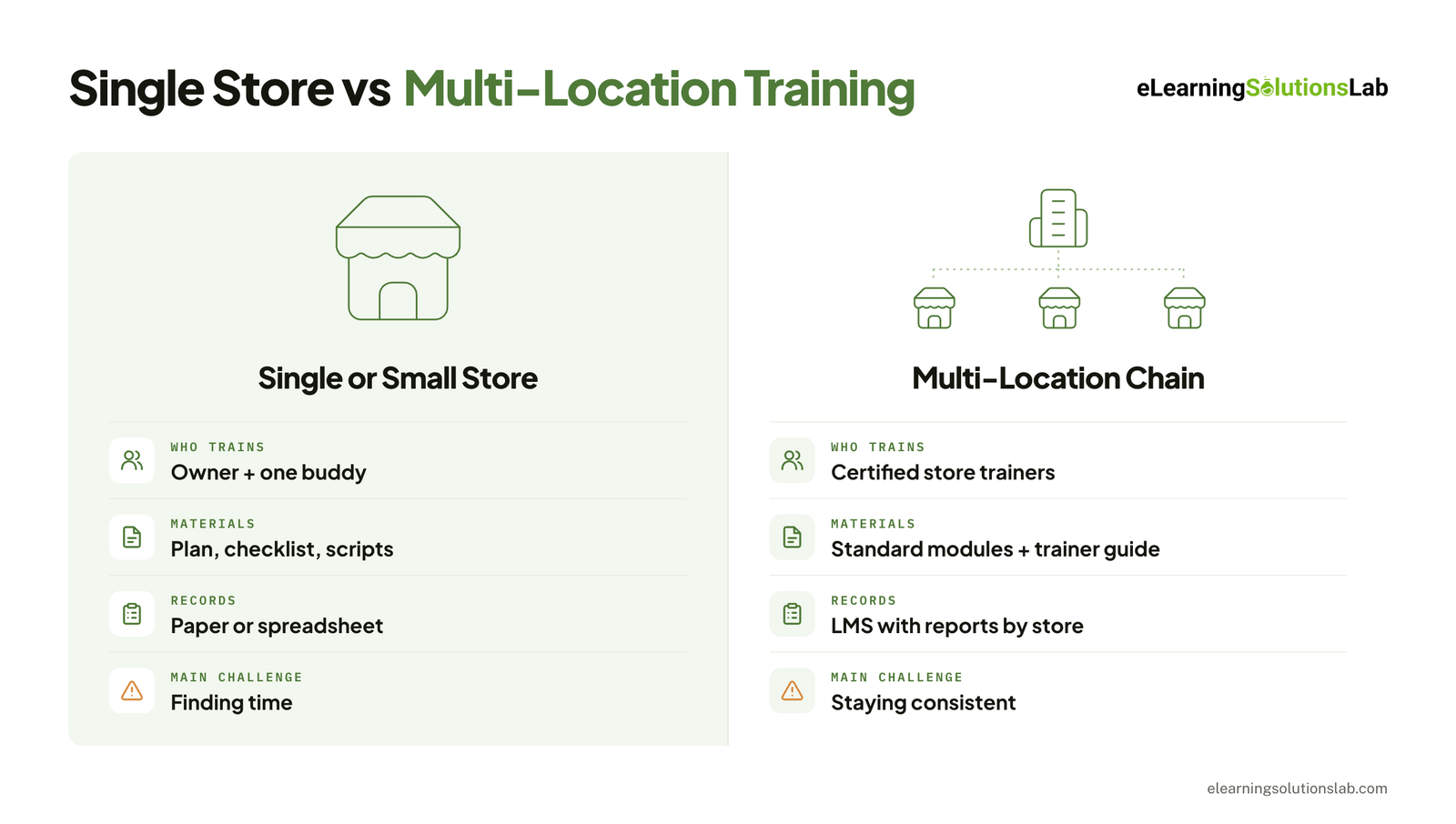
The same training plan looks very different in a single shop and in a chain of 50 stores. The goals don’t change, but who delivers the training, and how you keep it consistent, does.
| Single or small store | Multi-location chain | |
|---|---|---|
| Who trains | The owner or manager, plus one experienced buddy | Shift leads and certified store trainers, supported by head office |
| Training materials | A written plan, checklist, and scripts | Standard modules, a trainer guide, and central updates |
| Records | Paper checklist or a spreadsheet | An LMS or HR system with reports by store |
| Consistency | Easy, since one person sets the standard | The biggest challenge, so it needs audits and store visits |
| Budget | Mostly time | Time, content development, and software |
 For a Single or Small Store
Keep the plan simple and personal. The owner or manager sets the standards, one trusted employee acts as the buddy, and a printed checklist tracks progress. Block out training time on the roster so it doesn’t get squeezed by busy shifts, and hold the 30-60-90 day reviews even when you’re short on time.
For a Multi-Location Chain
Consistency is the main goal. Build the core modules once at head office, then use a train-the-trainer model so every store has at least one certified trainer. Check quality with regular store visits or mystery shoppers, and roll out updates centrally so a new policy reaches every store in the same week.
Franchise networks face the same challenge, with less direct control over each store. Our guide to eLearning for franchises covers how to keep standards consistent across independent owners. And if your teams speak different first languages, multilingual eLearning helps every employee understand the same content, which also matters where the law requires training in an employee’s primary language.
Retail Training Compliance by Region
Most retail compliance training falls into four areas: health and safety, age-restricted sales, harassment prevention, and workplace violence. What’s required depends on your country, state, and the products you sell. The overview below covers the main rules to check in each region, and a clear compliance training plan helps you map each requirement to a role and a renewal date.
United States
There’s no single federal retail training law. Instead, requirements come from OSHA standards, state laws, and product-specific rules.
- Workplace violence prevention: In California, SB 553 has required nearly all employers to have a written workplace violence prevention plan since July 1, 2024. Employees must be trained when the plan is introduced and every year after that, and training records must be kept for at least one year. In New York, the Retail Worker Safety Act took effect on June 2, 2025. It requires retailers with at least 10 retail employees to provide interactive workplace violence prevention training, including de-escalation, emergency procedures, and how to use security alarms.
- Harassment prevention: Several states, including California, New York, Illinois, Connecticut, Delaware, and Maine, require harassment prevention training for some or all employers.
- Age-restricted sales: The federal minimum age for buying tobacco and vaping products is 21. Alcohol seller training rules are set by each state, and some states require it while others make it voluntary.
United Kingdom and European Union
- Health and safety: UK employers must provide the training needed to keep staff safe under the Health and Safety at Work etc. Act 1974. In the EU, the Framework Directive on safety and health at work (89/391/EEC) sets a similar duty for employers.
- Sexual harassment prevention: Since October 26, 2024, UK employers have had a duty to take reasonable steps to prevent sexual harassment of their staff. Government guidance says this includes harassment by customers, and tribunals can raise compensation by up to 25% when the duty is breached. Regular training, with records of who attended, is one of the main steps employers are expected to take.
- Violence against shop workers: The Crime and Policing Act 2026, which received Royal Assent on April 29, 2026, makes assaulting a retail worker a standalone offence in England and Wales. Scotland already has a similar offence under the Protection of Workers Act 2021. Make sure staff know how to report abuse and incidents, since new offences only help when incidents are recorded.
- Age-restricted sales: Shops selling alcohol in England and Wales need an age verification policy, and many retailers use a “Challenge 25” approach. Staff training on refusals is the main way to show the policy is followed.
Australia
- Work health and safety: State and territory WHS laws require employers to give workers the information, training, and instruction they need to work safely, including managing psychosocial hazards like customer aggression.
- Positive duty on sexual harassment: Since December 2022, employers of all sizes have had a positive duty under the Sex Discrimination Act to prevent workplace sexual harassment. Regulators treat regular training as a key part of meeting this duty.
- Responsible Service of Alcohol (RSA): Staff selling packaged liquor usually need RSA training. In Victoria, it’s mandatory for staff working under a packaged liquor licence, and they have one month from their first sale to complete it. In New South Wales, bottle shop staff need a valid RSA competency card.
| Requirement | United States | UK and EU | Australia |
|---|---|---|---|
| Health and safety | OSHA standards (e.g., hazard communication, forklifts) | Health and Safety at Work Act (UK), Directive 89/391/EEC (EU) | State and territory WHS laws |
| Harassment prevention | State laws (CA, NY, IL, CT, DE, ME) | UK duty to prevent sexual harassment (since Oct 2024) | Positive duty under the Sex Discrimination Act |
| Workplace violence | California SB 553, New York Retail Worker Safety Act | Crime and Policing Act 2026 (England and Wales), Protection of Workers Act 2021 (Scotland) | WHS psychosocial hazard duties |
| Age-restricted sales | Federal tobacco age of 21, state alcohol seller rules | Age verification policy for alcohol, Challenge 25 (common practice) | RSA training for packaged liquor staff |
Please note
This section is a general overview, not legal advice. Requirements change often and vary by state, country, and the products you sell, so check the rules for every location where you employ people, and involve HR or legal before finalizing your compliance training.
How to Measure Retail Staff Training
Completion alone only shows that training happened. To know whether it worked, track a few store KPIs before and after training. Set a baseline in the month before you launch, then compare the same numbers 30, 60, and 90 days later.
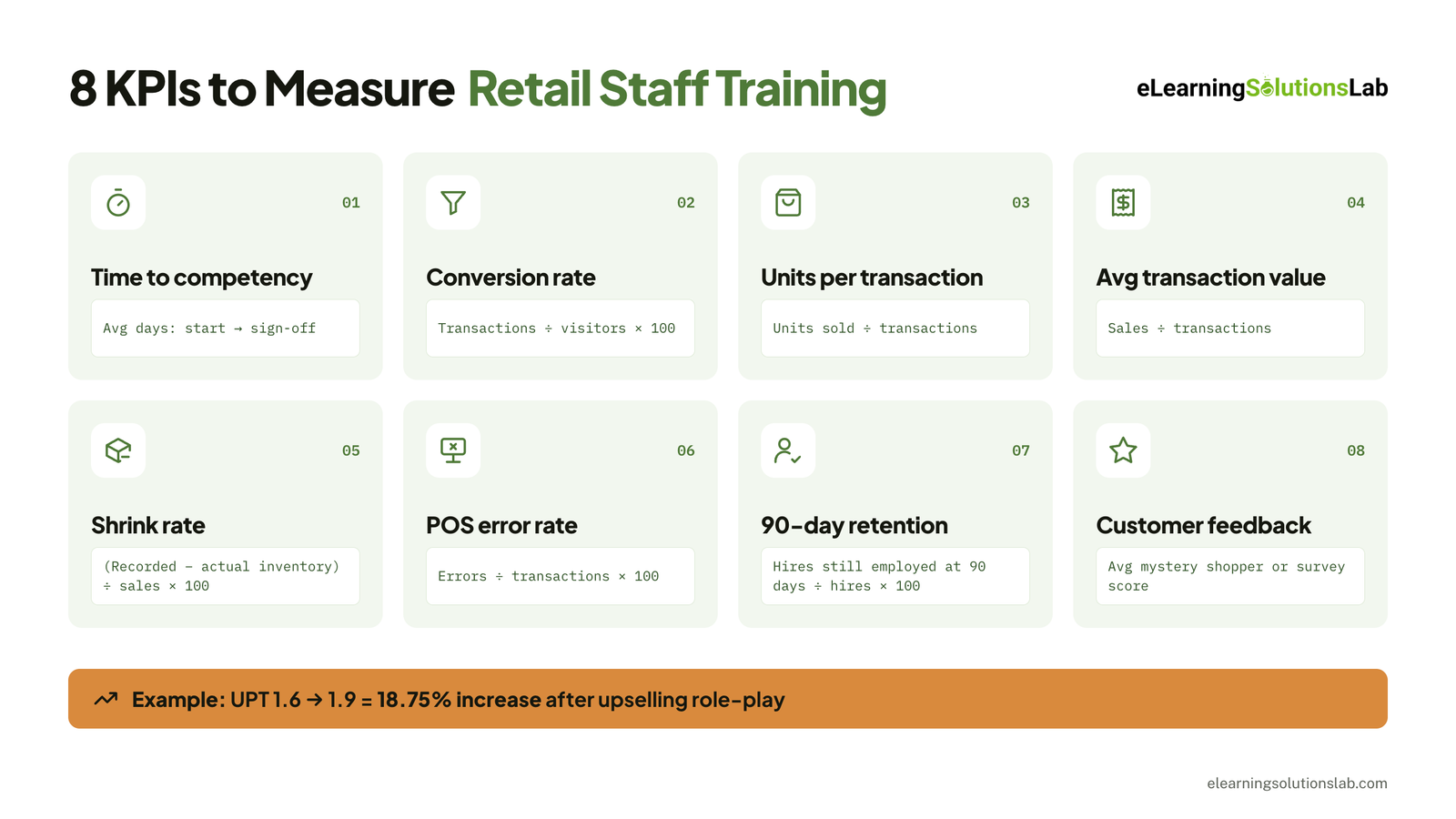
| KPI | Formula | What it tells you |
|---|---|---|
| Time to competency | Average days from start date to full checklist sign-off | How quickly new hires become productive |
| Conversion rate | Transactions ÷ store visitors × 100 | Whether service and selling skills turn visitors into buyers |
| Units per transaction (UPT) | Units sold ÷ number of transactions | Whether add-on and upselling training is working |
| Average transaction value (ATV) | Total sales ÷ number of transactions | The value of each sale, including upsells |
| Shrink rate | (Recorded inventory value − actual inventory value) ÷ sales × 100 | Whether loss prevention and process training reduce loss |
| POS error rate | Voids, till discrepancies, or mistakes ÷ transactions × 100 | How well register training sticks |
| 90-day retention | New hires still employed after 90 days ÷ new hires × 100 | Whether onboarding helps people stay |
| Customer feedback score | Average mystery shopper or customer survey score | How customers experience the service |
A Simple Before-and-After Example
Say your store’s UPT averages 1.6 in the month before you launch upselling role-play. Two months later, it averages 1.9.
- Change in UPT: (1.9 − 1.6) ÷ 1.6 × 100 = an 18.75% increase
To be more confident the training caused the change, compare against a store or shift that hasn’t been trained yet, and check that nothing else changed at the same time, like a big promotion or a new product launch.
Look Beyond Store Averages
Break your numbers down by shift, store, and trainer. A healthy store average can hide one shift where new hires leave in their first month, or one trainer whose staff consistently score lower. Our guide to eLearning ROI shows how to put a dollar value on these improvements when you need to justify a training budget.
Common Retail Training Challenges (and Fixes)
Even a good training plan runs into the same problems in most stores. Here’s how to handle them.
1. No Time to Train Around Shifts
Training gets pushed aside when the store is busy. Schedule it on the roster like any other task, use quieter periods before opening, and break topics into short sessions that fit a 15-minute window.
2. High Turnover Means Constant Retraining
When people leave quickly, managers stop investing in training, which makes people leave even faster. A written plan and checklist cut the effort of training each new hire, and the 30-day check-in helps you spot people who are struggling before they quit.
3. Seasonal and Part-Time Staff
Seasonal hires need to be useful quickly, and part-timers can go days between shifts. Give seasonal staff a fast-track plan focused on the register, core products, and safety, and give part-timers short refreshers they can complete at the start of a shift.
4. Frontline Staff Don’t Have Desks or Work Email
Most retail employees never sit at a computer. Use a store tablet, printed quick guides, or training they can open on their own phone. Our guide to mobile learning solutions covers the options for reaching deskless teams.
5. Training Gets Out of Date
New products, prices, and policies make yesterday’s training wrong. Name one person to own the training materials, update them whenever something changes, and use pre-shift huddles to share updates the same day.
6. Staff Find Training Boring
Long slide decks and policy readings don’t stick. Use more role-play, short challenges, and friendly competitions between shifts. Gamification in sales training, like leaderboards for add-on sales, can make practice feel less like homework.
Free Retail Staff Training Kit
To put this guide into action, get our free retail staff training kit. It turns the plan, schedule, checklist, scripts, and KPIs in this article into editable files you can use from your next new hire’s first shift, with no software needed.
In one line
Write down what each role must do, teach it on the floor over 90 days, sign off each skill, and track a few store KPIs so you know your retail staff training is paying off.
Ready to scale retail training across every store?
At eLearning Solutions Lab, we build short, mobile-friendly retail courses for product knowledge, customer service, safety, and compliance, all designed for staff who learn between shifts. Design, development, and QA are handled by one team.
Need somewhere to deliver and track it? Levantra LMS, our cloud based LMS, groups learners by store or region, gives managers a view of their own teams, and issues verifiable certificates for every completion.
See our custom eLearning development servicesBook a Levantra LMS demo
Related Reading
- How to track employee training – fields, formulas, and a free tracker template.
- Compliance training plan – how to map mandatory training to roles and deadlines.
- Product training program – how to keep staff up to date on every launch.
- Microlearning examples – short lessons that fit around retail shifts.
- eLearning ROI – how to measure and prove the value of your training.
- eLearning for franchises – keeping standards consistent across locations.
The Author

Book A Discovery Call
Our Learning Advisors are happy to walk you through your project step-by-step — content, timeline, and fixed pricing.
Get Your Free QuoteNo obligation — just a focused conversation. Proposal within 24 hours.
You may also like
LMS Requirements Checklist: What to Include, How to Weight It, How to Verify It and
Having a useful LMS requirements checklist does three things: it ranks what…
Employee Onboarding and Training: A Practical Guide (+ Free 90-Day Plan)
A new hire's first week usually sets the tone for everything that follows. And…