

A new hire’s first week usually sets the tone for everything that follows. And too often, it is accompanied by a stack of forms and vague team introductions.
Effective employee onboarding and training can help fix that by giving new hires a clear path from day one to full productivity. In this guide, you’ll learn how onboarding, orientation, and training can fit together, the four phases of a strong program, and how to measure whether your program actually works.
Updated October 2026.
In This Article
- What is employee onboarding and training?
- Onboarding vs. orientation vs. training
- Why onboarding and training matter
- Employee onboarding and training timeline
- Key components of a new-hire training program
- US onboarding essentials vs. global adaptations
- Onboarding remote and distributed employees
- Free 90-day onboarding plan and checklist
- How to measure onboarding and training success
- Common onboarding mistakes to avoid
What is Employee Onboarding and Training?
Employee onboarding and training is a structured process of welcoming new hires and giving them the knowledge, skills, and connections they need to do their job well.
Onboarding usually covers the full journey, for the first 90 days or longer, in which training is the skill-building part of it.
In practice, onboarding answers “How do I fit in here?”, while training answers “How do I do this job?” So a new hire needs both. Someone who actually knows the company culture but not enough tools will struggle, and so will someone who knows the tools but has no idea who to ask for help.
Onboarding vs. Orientation vs. Training
These three terms are often used interchangeably, but they actually mean different things:
| Orientation | Onboarding | Training | |
|---|---|---|---|
| Purpose | Welcome new hires and cover the basics | Integrate new hires into the company, team, and role | Build the skills and knowledge needed to do the job |
| Duration | A few hours to a few days | Typically 90 days, sometimes up to a year | Ongoing, starting in week one and continuing throughout employment |
| Timing | Day 1 or week 1 | Before day one through full productivity | Throughout onboarding and beyond |
| Owner | HR | HR, hiring manager, and team (shared) | Hiring manager, L&D, or subject-matter experts |
| Format | Group sessions, presentations, facility or virtual tours | A structured program combining paperwork, meetings, check-ins, and training | E-learning, workshops, shadowing, on-the-job practice |
| Typical content | Company history, mission, policies, benefits overview, introductions | Preboarding, culture, relationships, goals, 30-60-90 day plans | Role-specific skills, tools and systems, compliance, soft skills |
| Success metric | Completion and new-hire satisfaction | Time-to-productivity and early retention | Skill proficiency, completion rates, and performance |
In other words, orientation is just one event, onboarding is the entire process, and training runs through the process.
Why Onboarding and Training Matter
A new hire’s first few months will shape how long they stay, how quickly they contribute, and what they tell others about your company. Yet most of the organizations we’ve seen get this stage wrong – like only 12% of employees strongly agree their organization does a great job of onboarding new employees.
1. It improves retention.
New hires will decide early whether a job is worth keeping. In an Insight Global survey of more than 900 full-time employees and contractors, 80% said that they’d stay longer in a job if they had a better onboarding experience.
Weak training would create the same risk, as Paychex found that 52% of employees feel undertrained after onboarding, and 80% of those employees would plan to leave soon.
2. It shortens time-to-productivity.
Getting fully up to speed would really take much longer than most companies plan for. Gallup has found that new employees typically take around 12 months to reach their full performance potential within a role. Structured training and clear 30-60-90 day goals genuinely help new hires spend less of that year guessing.
3. It builds engagement from day one.
Managers actually make the biggest difference here. So when managers take an active role in onboarding, employees are 3.4 times more likely to strongly agree their onboarding experience was exceptional.
4. It reduces compliance risk.
Onboarding is where the required paperwork, policy acknowledgments, and mandatory training get done. Having a consistent process will make sure nothing is missed, which certainly matters even more when you hire across states or countries.
The bar is achievable here. In Qualtrics’ 2025 Employee Experience Trends research, onboarding outperformed every other major moment in the employee journey, with 43% of respondents saying the experience exceeded expectations. Companies that truly invest in onboarding are already setting themselves apart – essentially.
Employee Onboarding and Training Timeline
Onboarding works best when it truly follows a clear timeline. So each phase has its own goal, from making new hires feel welcome before they can start to giving them full ownership of their role by day 90.
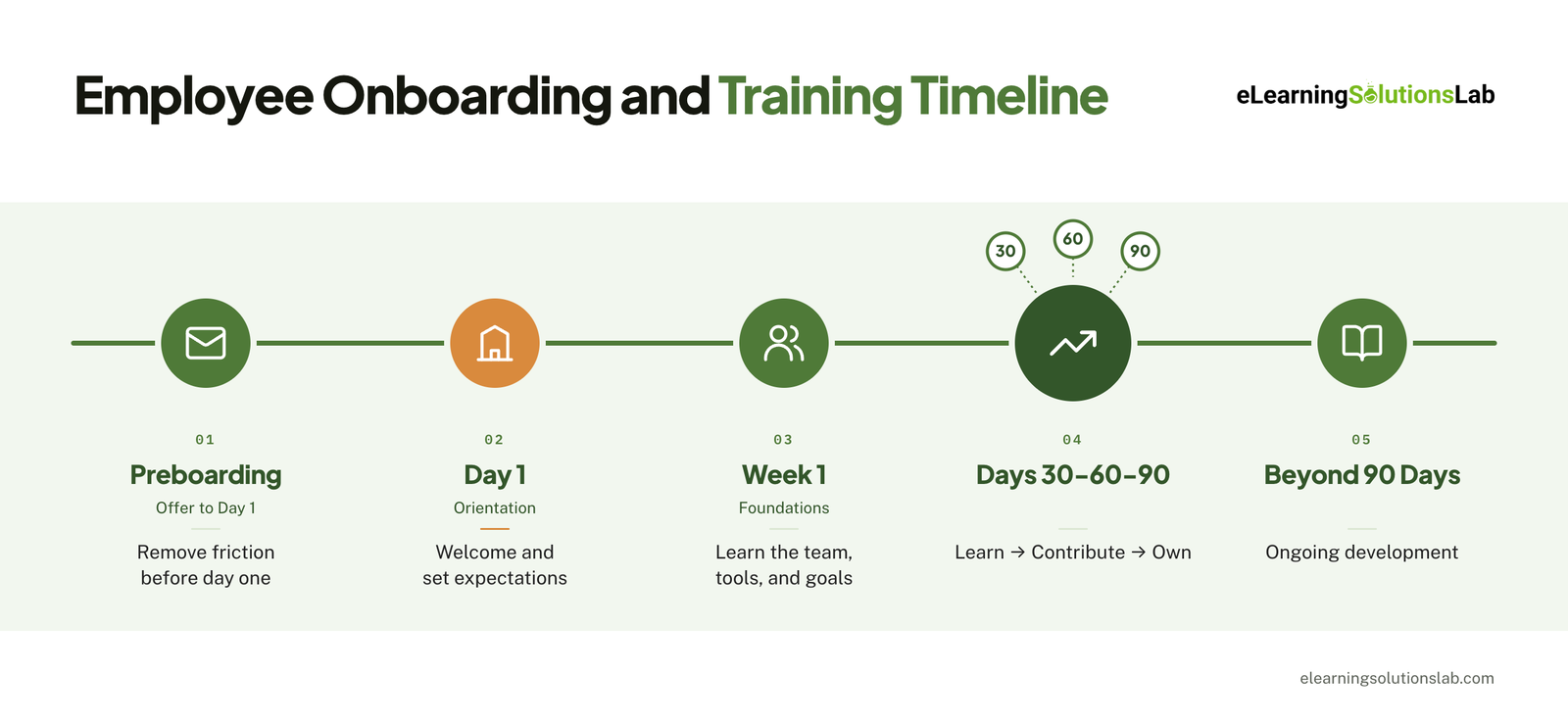 Preboarding: From Offer Accepted to Day 1
Preboarding begins right at the moment a candidate accepts your offer. The goal here is simple: to remove any friction so that day one is about people and work, not just about paperwork and password resets.
You can use this window to:
- Send a welcome message from your hiring manager, with the start date, schedule, dress code, and who to ask for on arrival.
- Complete paperwork early – collect tax forms, direct deposit details, and policy acknowledgments digitally. In the US, new hires must complete Section 1 of Form I-9 by their first day. Other countries would have their own forms, which are actually covered later in this guide.
- Prepare equipment and accounts – ship laptops to remote hires, set up email and software access, and test logins in advance.
- Assign a buddy and make an introduction before their start date.
- Share a first-week agenda so that the new hire knows what to expect.
Day 1: Orientation
Day one should leave new hires feeling welcome at work and clear about what comes next. You need to avoid packing in too much information.
A strong first day should include:
- Personal welcome from the manager and the team.
- Company overview that covers your company’s mission, values, how teams fit together, and how work gets done.
- Key policies and benefits that are all kept at a high level, with links to the details.
- Workstation or tools setup, with IT on hand to help.
- Lunch or a virtual coffee with their buddy.
- Short end-of-day check-in with the manager to answer any of their questions.
Week 1: Foundations
Your new hires’ first week should shift from welcome to orientation in the work itself. New hires should finish it knowing their team, their tools, and what success actually looks like in the role.
Focus on:
- Core systems training on the tools they’ll use every day at work.
- Meetings with key colleagues, which include stakeholders outside the immediate team.
- Required compliance training programs like safety, data security, and anti-harassment courses.
- Shadowing teammates to see the role in action.
- Having a first small task, something low-risk that can deliver early wins.
- Clear goals for the first 30, 60, and 90 days – which are agreed with their managers.
Days 30, 60, and 90: Role Training and Ramp-Up
This is the time duration where most of the job-specific training happens. Having a 30-60-90 day plan would give both the new hire and their managers a shared view of progress.
First 30 days: Learn
- Complete role-specific training and core certifications.
- Shadow and co-work on real tasks.
- Understand team processes, priorities, and quality standards.
- Check-in: What’s going well, and what’s still unclear?
Days 31–60: Contribute
- Take on independent work with regular feedback.
- Apply training in real situations and close any skill gaps.
- Start building relationships across your organization.
- Check in to review early results and adjust training if it’s needed.
Days 61–90: Own
- Take full ownership of core responsibilities.
- Contribute ideas and improvements.
- Set goals for the next six months.
- Formal 90-day review, including assessing performance, confirming the culture and technical fit, and gathering feedback on their onboarding experience.
Beyond 90 Days: Ongoing Development
Onboarding obviously has its end date, but training programs don’t. Most of your employees need far longer than 90 days to actually reach their full performance, so you need to keep the support going:
- Continue regular one-on-ones and development conversations.
- Offer advanced training, stretch projects, and cross-team learning.
- Collect your six-month or one-year onboarding survey to improve your program for future hires.
- Invite experienced new hires to serve as buddies for the next group.
For new hires on a management track, leadership development eLearning gives them a consistent foundation before they start leading others.
Key Components of a New-Hire Training Program
A complete new-hire training and onboarding program covers more than just job skills. It would prepare your people to do the work, follow the rules, use the tools, and fit into the team. Most effective training programs usually include these six components.
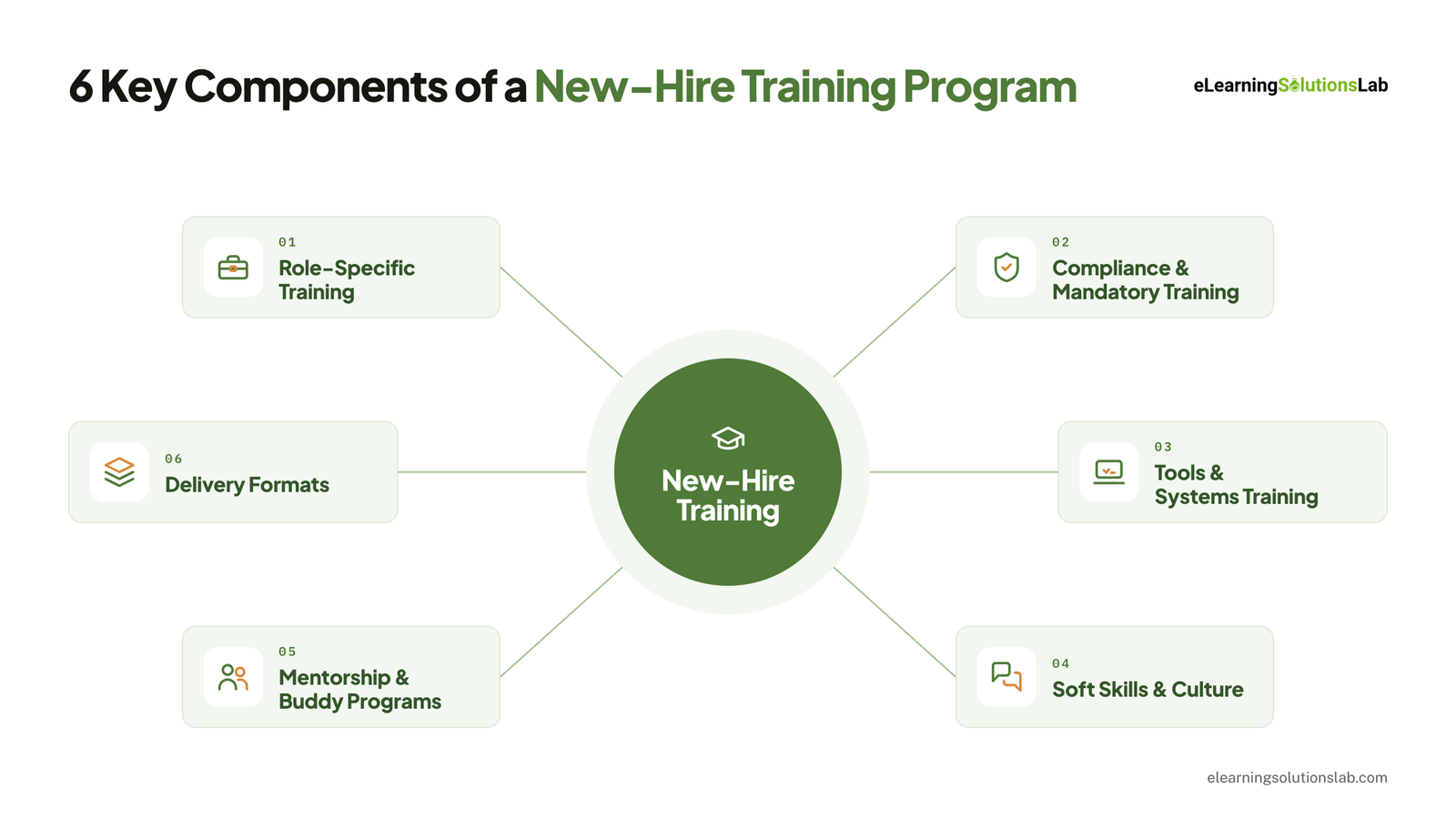 Role-Specific Training
This is the essential core of new-hire training: knowledge and skills needed to perform the job. It may look different for every role. For instance, a sales rep has to learn about the product, pricing, and sales process, while a warehouse associate needs to learn about equipment, safety procedures, and picking workflows. And another scenario would be a software engineer learning the codebase and deployment process.
To make role-specific training effective:
- Base it on the actual tasks the person will do in their first 90 days at work.
- Mix instructions with hands-on practice on real or realistic work scenarios.
- Break it into stages that match your 30-60-90 day plan.
- Have experienced team members help build and deliver the content.
For roles that rely on knowing what you sell, a structured product training program keeps new hires up to date as your range changes. And if you’re onboarding store teams, our guide to retail staff training walks through a full frontline plan.
Compliance and Mandatory Training
Compliance training would cover both the legal and regulatory requirements that apply to your business, industry, and location. Common topics would include workplace safety, anti-harassment and discrimination, data privacy and security, and industry rules such as those in healthcare or finance verticals.
Requirements would vary by location. In the US, several states, including California, New York, and Illinois, for instance, require sexual harassment prevention training. Outside the US, the rules differ again, which is why global teams would definitely need a localized compliance plan.
You need to track completion carefully, given that this training often needs records for audits. A clear compliance training plan helps you map each requirement to a role and a renewal date, and our guide on how to track employee training shows how to keep those records audit-ready.
Tools and Systems Training
New hires can’t be solely productive until they can use the tools. This would cover everyday software like email, chat, and project management tools, and role-specific systems, which include but are not limited to CRM, POS, or HR platforms.
You have to keep it practical. Short how-to guides, recorded walkthroughs, and a sandbox environment for safe practice would really work better than having a long system demo on day one. Short demo clips work especially well here, and video based eLearning is a natural fit for showing how a system works step by step.
Soft Skills and Culture
Culture training definitely explains how work actually gets done: how decisions are made, how teams communicate, and what the company values in practice. Soft skills training still needs to build abilities like communication, collaboration, time management, and giving and receiving feedback.
This core component is easy to skip, but it would often help you decide whether a new hire feels they belong. You have to weave it into team meetings, manager conversations, and real examples rather than just relying on a single slide deck. For skills like handling a difficult conversation, scenario based eLearning lets new hires practice their responses before they face the real thing.
Mentorship and Buddy Programs
A buddy is like a peer who helps your new hire with day-to-day questions they might hesitate to ask a manager. A mentor, on the other hand, offers longer-term career guidance. Both help you upskill and help new hires build relationships faster.
For a buddy program to work, you need to:
- Choose buddies who actually know the role and want to help.
- Set expectations, like weekly check-ins for the first 90 days.
- Give your buddies time in their schedule to do it well.
Choosing Delivery Formats
The best training and onboarding programs blend several formats:
| Format | Best for | Watch out for |
|---|---|---|
| In-person sessions | Culture, team bonding, hands-on skills | Hard to scale across locations |
| Live virtual sessions | Remote and distributed teams, Q&A | Time zones and screen fatigue |
| Self-paced eLearning | Compliance, product knowledge, tool basics | Low engagement if lessons run too long |
| On-the-job training | Role-specific skills and real tasks | Inconsistent without a checklist or clear standards |
Self-paced lessons work best when they’re short and focused on one task. These microlearning examples show what that can look like for onboarding topics like tools, policies, and product basics.
A learning management system (LMS) can help you assign, deliver, and track training at scale, especially for compliance records. An onboard LMS automates the steps that get missed when onboarding runs on email and spreadsheets, like assigning courses by role, sending reminders, and flagging overdue training. If you’re comparing platforms, our guide on how to choose an LMS covers what to look for.
But the tool matters less than the content and the people behind it. Start with a clear plan, then choose the technology that supports it.
US Onboarding Essentials vs. Global Adaptations
Most onboarding guides assume every new hire sits in the same country. Today, many teams hire across states and borders, and what’s required in one place may not apply in another. The answer isn’t to build a separate program for every country. It’s to use one onboarding framework, localized by location: a shared core that every new hire experiences, with local rules layered on top.
The table below compares the US approach with common variations elsewhere.
| Area | US approach | Common international variations |
|---|---|---|
| Work authorization | Form I-9: Section 1 by the first day of work, Section 2 within three business days. Some states and federal contractors also require E-Verify. | Right-to-work checks, visas, or work permits, with documents and timing set by each country |
| Tax and payroll forms | Federal Form W-4, plus state withholding forms where they apply | Local tax ID registration and enrollment in national social security or pension schemes |
| New-hire reporting | Employers report new hires to the state within 20 calendar days under federal law. Some states set shorter deadlines. | Registration with government agencies, often before or on the start date |
| Employment terms | At-will employment in most states, with offer letters common but detailed contracts optional | Written contracts or statements of terms are often mandatory. In the EU, key terms must be given in writing from the first day and no later than the seventh calendar day. |
| Probation periods | Not legally defined in most cases | Often regulated by law, with maximum lengths that differ by country |
| Mandatory training | Varies by state, such as harassment prevention training in California, New York, and Illinois, plus industry rules | Country-specific health and safety, anti-harassment, and data protection training |
| Data privacy | State laws, such as California’s privacy law, which covers employee data | GDPR in the EU and UK, and similar laws in many other countries, governing how employee data is collected and stored |
| Benefits | Employer-sponsored health insurance enrollment, often with a set enrollment window | Public healthcare systems, mandatory contributions, and statutory benefits such as 13th-month pay in some countries |
| Leave and holidays | No federal paid vacation requirement. Leave is set by company policy and some state laws. | Statutory minimum paid leave, such as at least four weeks per year in the EU, plus local public holidays |
| Language | English, with translations for multilingual workforces | Contracts and policies may need to be provided in the local language |
Building a Global Framework With Local Flexibility
A global onboarding program has two layers.
The global core stays the same everywhere:
- Company mission, values, and culture
- The 30-60-90 day structure and manager check-ins
- Core tools and systems training
- The buddy program
- Company-wide policies, such as the code of conduct and security basics
The local layer changes by country or state:
- Legal paperwork and government registration
- Mandatory compliance training
- Benefits enrollment and payroll setup
- Local holidays, leave rules, and working hours
- Translated materials and region-specific examples
To keep it manageable, assign a local owner for each country, such as an HR partner or the regional manager. Build a country-specific checklist that plugs into the main program, and review each one at least once a year, because employment rules change often.
If your teams speak different first languages, multilingual eLearning helps every new hire get the same core training. And eLearning localization services go a step further, adapting examples, currencies, and local rules so the content feels built for each market.
When to Involve Local Counsel or an Employer of Record
Hiring in a new country brings legal obligations that are easy to miss. It’s worth getting expert help when:
- You hire your first employee in a new country
- You’re unsure whether someone should be classified as an employee or a contractor
- Local law requires written contracts, works council consultation, or specific termination terms
- You don’t have a legal entity in the country
An employer of record (EOR) is a third-party company that legally employs workers on your behalf in a country where you don’t have an entity. It handles contracts, payroll, taxes, and statutory benefits, while you manage the day-to-day work and onboarding experience. For companies hiring only a few people in a new market, an EOR is often faster and simpler than setting up a local entity.
Please note
This section is a general overview, not legal advice. Employment requirements vary by location and change over time, so confirm the current rules with local counsel or official government sources before finalizing your onboarding process.
Onboarding Remote and Distributed Employees
Remote and hybrid new hires go through the same timeline as office hires, but without the hallway chats, desk visits, and lunch invites that help people settle in. And it shows. In an Enboarder survey of more than 1,000 employees in the US, UK, and Australia, 42% of remote new hires and 39% of hybrid new hires said they’d had a truly terrible onboarding experience. Remote new hires were also nearly 50% more likely to say company culture was shown poorly or not at all.
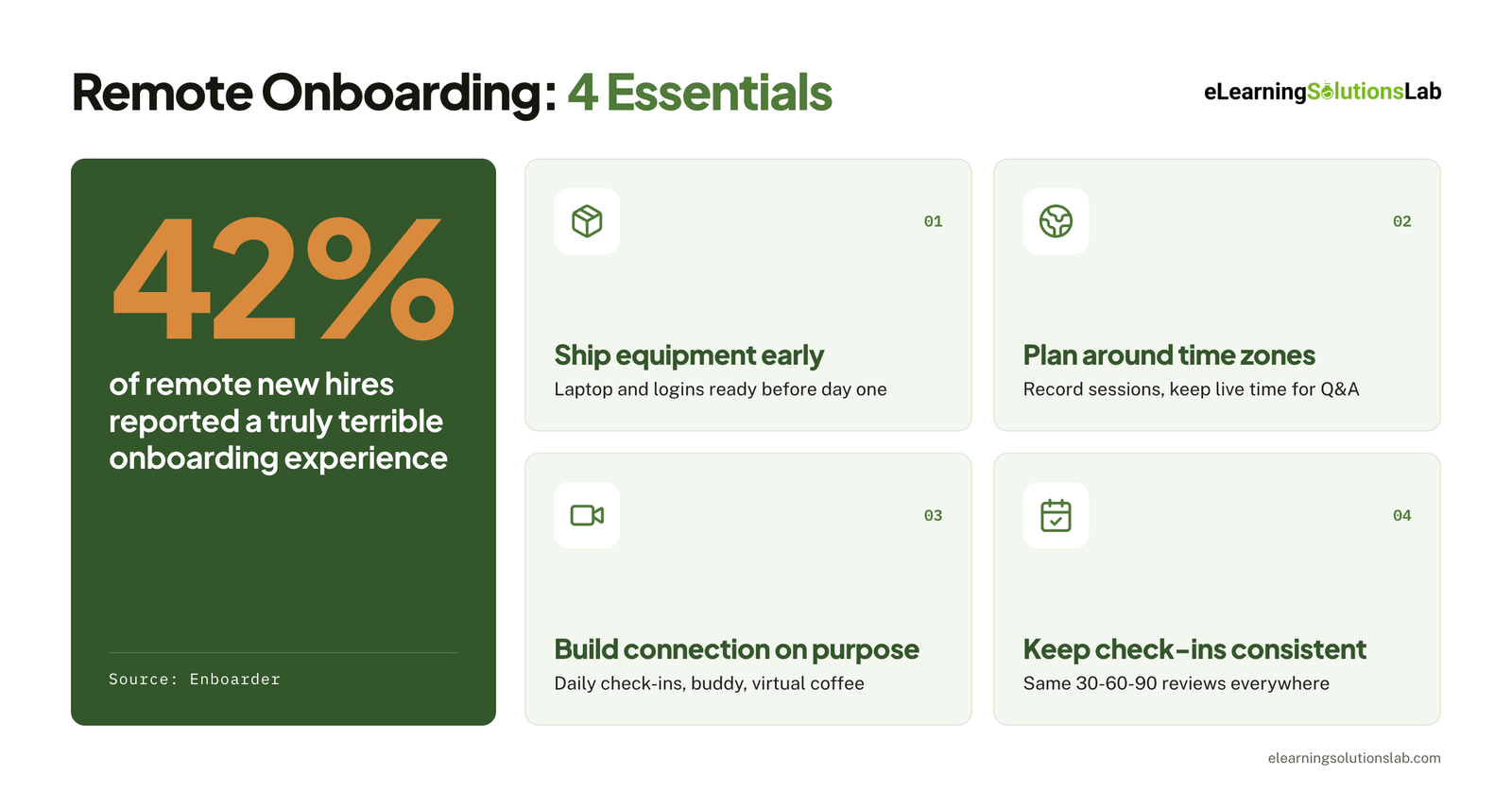 The fix isn’t a separate program. It’s the same plan, with a few extra steps built in.
Ship Equipment and Set Up Access Before Day One
Nothing stalls a remote first day faster than a laptop stuck in transit. Ship equipment early enough to arrive a few days before the start date, set up accounts in advance, and give the new hire a direct IT contact. A short “first login” guide helps them get set up without waiting on anyone.
Plan Around Time Zones
When your team is spread across regions, not every session can be live. Record key sessions like the company overview, keep written guides for common processes, and use on-demand training for anything a new hire can learn at their own pace.
Save live time for what needs it, like introductions, Q&A, and manager check-ins. Schedule these during overlapping working hours, and rotate meeting times so the same people aren’t always joining early or late.
Build Connection on Purpose
Remote new hires won’t bump into colleagues by chance, so plan the connections for them:
- Schedule a short daily check-in with the manager or buddy during the first week.
- Set up virtual coffee chats with key teammates and stakeholders.
- Add the new hire to team channels before day one, with a welcome post.
- Arrange an in-person meetup during the first 90 days if your budget allows.
Keep Check-Ins Consistent Across Locations
Use the same 30-60-90 day checkpoints for every new hire, wherever they work, and record the outcomes in one place. That way, managers can spot gaps early, and remote hires get the same support as everyone else.
The same goes for frontline and deskless staff, who often don’t have a work computer or email. Training they can open on a phone or a shared tablet keeps them on track, and our guide to mobile learning solutions covers the options for reaching these teams.
Free 90-Day Onboarding Plan and Checklist
Use this checklist to make sure every new hire gets the same essentials, whatever their role or location. Assign an owner to each task, and tick it off only once it’s actually done.
| Phase | Tasks | Owner |
|---|---|---|
| Preboarding | ☐ Welcome message sent with start date and first-week agenda ☐ Paperwork completed (Form I-9 Section 1 in the US, or the local equivalent) ☐ Equipment shipped and accounts tested ☐ Buddy assigned and introduced |
HR, IT, manager |
| Day 1 | ☐ Personal welcome from the manager and team ☐ Company overview and key policies ☐ Tools set up and working ☐ Lunch or virtual coffee with the buddy ☐ End-of-day check-in |
Manager, HR, IT |
| Week 1 | ☐ Core systems training completed ☐ Required compliance training assigned ☐ Meetings with key colleagues held ☐ First small task completed ☐ 30-60-90 day goals agreed |
Manager, L&D |
| Days 1–30 | ☐ Role-specific training completed ☐ Compliance training completed and recorded ☐ 30-day check-in held |
Manager, L&D, HR |
| Days 31–60 | ☐ Working independently on core tasks ☐ Skill gaps identified and training adjusted ☐ 60-day check-in held |
Manager |
| Days 61–90 | ☐ Full ownership of core responsibilities ☐ Formal 90-day review completed ☐ Six-month goals set ☐ Onboarding feedback survey collected |
Manager, HR |
Hiring outside the US? Add a country-specific tab for local paperwork, compliance training, and benefits enrollment, using the local layer from the global section above.
How to Measure Onboarding and Training Success
Completion alone only shows that onboarding happened. To know whether it worked, track a few metrics for every group of new hires and compare them over time.
| KPI | How to measure it | What it tells you |
|---|---|---|
| Time-to-productivity | Average days from start date to meeting the role’s agreed performance standard | How quickly new hires start contributing |
| 90-day retention | New hires still employed after 90 days ÷ total new hires × 100 | Whether onboarding helps people stay |
| First-year turnover | New hires who left within 12 months ÷ total new hires × 100 | Whether early problems lead to later exits |
| Training completion rate | Assigned onboarding courses completed on time ÷ courses assigned × 100 | Whether training fits into the new hire’s schedule |
| Compliance completion | New hires who completed mandatory training by the deadline ÷ new hires × 100 | Your audit and legal risk |
| New-hire satisfaction | Average score from short surveys at 30, 60, and 90 days | How new hires experience the program |
| Manager readiness rating | Manager’s rating of the new hire’s readiness at the 90-day review | Whether training prepares people for the actual job |
Set a Baseline and Review on a Schedule
Record your current numbers before you change anything, so you have something to compare against. Then review the metrics every quarter, and break them down by team, location, and manager. A healthy company average can hide one team where new hires leave in their first month, or one country where compliance training is always late.
Ask New Hires Directly
Your new hires know exactly where onboarding fell short. Keep each survey to a few questions, such as:
- Did you have everything you needed to do your job on day one?
- Is your role what you expected when you accepted the offer?
- What do you wish you’d learned sooner?
- Do you know who to go to for help?
When you need to show leadership what onboarding is worth, our guide to eLearning ROI shows how to put a dollar value on faster ramp-up and better retention.
Common Onboarding Mistakes to Avoid
Even well-planned programs run into the same problems. Here’s what to watch for.
1. Overloading the First Week
New hires remember very little from a packed first few days. Spread the content across the 90-day timeline, and save detailed policies and advanced training for later.
2. No Clear Owner
When onboarding is “everyone’s job,” tasks fall through the cracks. Name an owner for each phase, such as HR for paperwork, IT for equipment, and the manager for goals and check-ins.
3. Leaving Managers Out
Onboarding isn’t just an HR process. Managers have the biggest influence on how new hires feel about their first months, so give them a clear role, a checklist, and time in their schedule to do it.
4. Treating Remote Hires as an Afterthought
Remote new hires miss the informal moments that help office hires settle in. Plan connection on purpose with daily check-ins, a buddy, and scheduled introductions.
5. Using One Version for Every Country
A single US-based program will miss local paperwork, training, and benefits rules elsewhere. Keep a shared global core, and add a local layer for each country you hire in.
6. Stopping After Day One
A great first day doesn’t make up for a quiet first month. Keep the 30-60-90 day check-ins on the calendar, and ask for feedback so the program improves with every hire.
In one line
Start before day one, spread training across 90 days, give managers and buddies a clear role, localize the rules for each country, and track a few metrics so you know your employee onboarding and training is working.
Ready to build onboarding that works for every new hire?
At eLearning Solutions Lab, we build onboarding and new-hire training courses for compliance, tools, products, and culture, designed for office, remote, and frontline teams. Our custom eLearning development services cover design, development, and QA in one team.
Need somewhere to deliver and track it? Levantra LMS, our cloud based LMS, assigns onboarding paths by role or location, gives managers a view of their own teams, and issues verifiable certificates for every completion.
See our custom eLearning development servicesBook a Levantra LMS demo
Related Reading
- How to track employee training – fields, formulas, and a free tracker template.
- Compliance training plan – how to map mandatory training to roles and deadlines.
- Retail staff training – a step-by-step plan for frontline store teams.
- Onboard LMS – how an LMS can automate new-hire training.
- eLearning ROI – how to measure and prove the value of your training.
The Author

Book A Discovery Call
Our Learning Advisors are happy to walk you through your project step-by-step — content, timeline, and fixed pricing.
Get Your Free QuoteNo obligation — just a focused conversation. Proposal within 24 hours.
You may also like
LMS Requirements Checklist: What to Include, How to Weight It, How to Verify It and
Having a useful LMS requirements checklist does three things: it ranks what…
Retail Staff Training: Practical Guide with a Free Plan, Checklist and Scripts
Quick answer To train retail staff, list the skills each role needs, set clear…