

In This Article
-
- What is a product training program?
- Who needs product training and what each audience has to know
- Six-step build framework
- Curriculum blueprint: role and module matrix
- Delivery models compared
- The 90-day rollout timeline
- Rolling out across regions and partners
- How to measure a product training program
- Build, buy, or blend
- Where product training programs fail
What Is a Product Training Program?
A product training program is a structured, role-based system for teaching target people who sell, support, or use a product what it does, who it’s for, and how to handle it.
It can span internal teams, channel partners, and customers, and it runs on a repeating cycle that’s tied to product releases.
Here are differences between four terms that get used interchangeably in the industry:
Product knowledge training is the content layer; this includes facts about features, specs, and use cases – it’s actually a component of a program.
Product training program is the system around that content: which audiences learn what, in what depth, through which format, assessed how, and refreshed on what schedule.
Product enablement is the sales-specific slice that is tied to deal stages and usually owned by enablement or product marketing rather than simply L&D. If that slice is the one you’re scoping, elearning sales training covers it on its own terms.
Customer education can point the same content outward, like academies, certifications, and onboarding for the people who buy the product. The sequencing side of that sits in customer onboarding training.
Most organizations already have pieces of all four scattered around: a launch deck, a support wiki, a partner portal nobody updates. What they don’t have is the connective structure – one curriculum with defined audiences and a refresh cadence, so a release note reaches the field service team and the reseller in another region, not just the account executives who happened to be on the launch call.
Who Needs Product Training and What Each Audience Actually Has to Know
We cover six audiences here who actually need product training, and each one will need a different depth of the same materials.
| Audience | Must be able to | Depth | Refresh trigger | Metric it moves |
|---|---|---|---|---|
| Sales and SDRs | Connect a customer problem to the right product and package, and handle the five most common objections | Working – breadth over depth | Every release with a customer-visible change | Ramp time to first closed deal, win rate |
| Presales and solutions engineers | Run a live demo, scope a technical fit, and answer architecture questions unscripted | Deep, hands-on | Every release, plus roadmap previews | Demo-to-proposal conversion, technical loss rate |
| Support and customer success | Diagnose and resolve the top 20 issue types without escalating | Deep on failure modes, light on positioning | Every release, plus emerging ticket patterns | First-contact resolution, escalation rate, CSAT |
| Field service and implementation | Install, configure, and commission correctly the first time | Deep, procedural, certified | Any hardware or procedure change | Install error rate, repeat-visit rate |
| Channel partners and resellers | Position and sell as well as a mid-tier internal rep, and clear a certification bar | Working, with a hard certification gate | Quarterly, batched – not per release | Partner-sourced pipeline, partner win rate |
| Customers | Get to first value and actually use the features they paid for | Task-based, self-serve | Any UI or workflow change | Activation rate, time to value, ticket volume, retention |
Two considerations about this table:
First, depth is the variable. For instance, you don’t build six curricula – you can build one module library and set a depth level per audience. So having a sales rep and a solutions engineer can take the same competitive positioning module; the SE takes the technical appendix and a practice scenario, and the sales rep will take the one-pager and a quiz.
Second, refresh cadence can differ more than depth does. Internal teams can absorb release-by-release updates. Partners can’t; they like having a batch of updates quarterly, or they’ll ignore all of them. Customers are a third case again – they need the change surfaced in the product at the moment it affects them, not filed in a course they’d have to go looking for.
Six-step Build Framework in Product Training Program
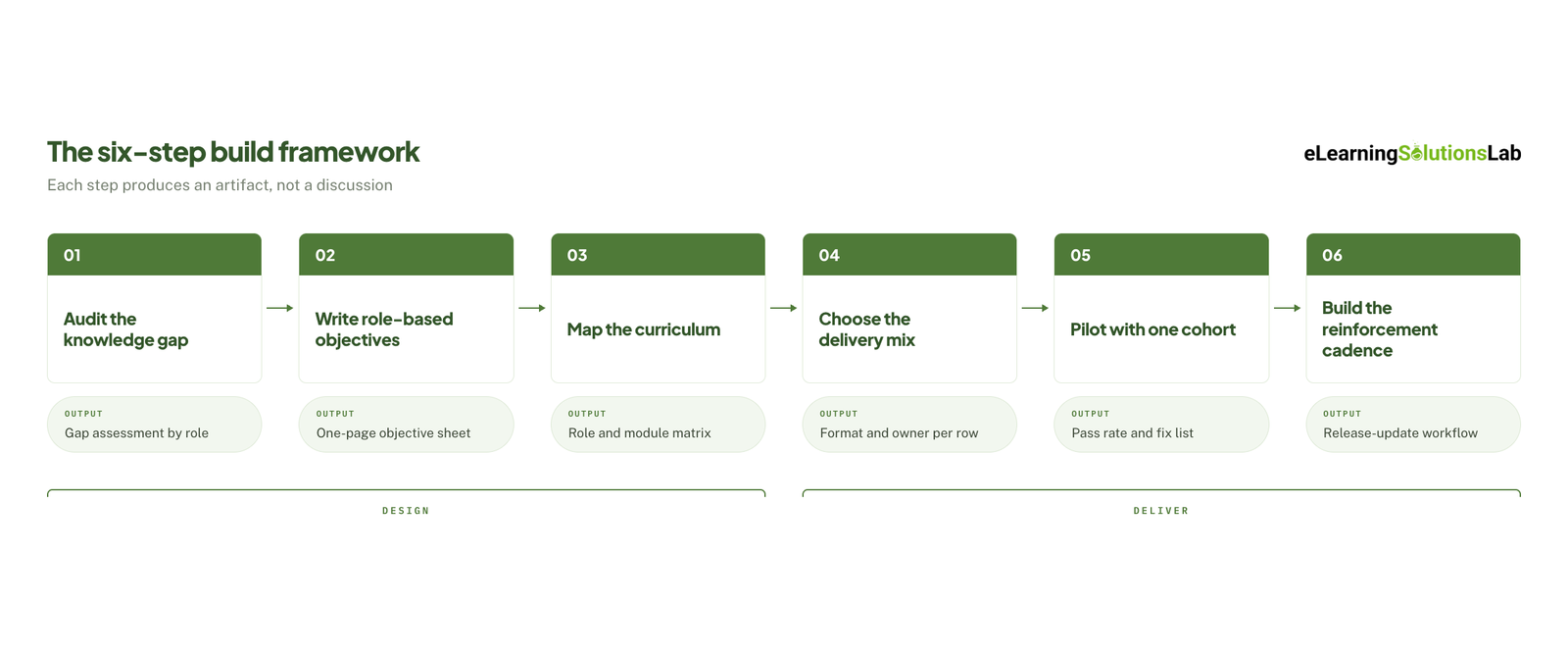
Here are six steps to create a product training program. Each one produces a named artifact, which is the point – finish all six and you have a program on paper before anyone builds a slide.
 Step 1: Audit the knowledge gap
You don’t survey people about what they think they need. Get the data by pulling the last 30 days of support tickets, to cite an example, and tag them by whether the resolution would require product knowledge the sales rep should have had.
You may review 10 recorded sales calls for questions that got a hedge, or you can run a 15-question baseline quiz across each audience and look at the item-level results.
Output: Gap assessment by role, which names 3 to 5 specific knowledge failures you’re fixing.
Step 2: Write role-based objectives
You can convert each gap into one sentence beginning “must be able to”, like must be able to explain to a customer why the integration requires a service account, without escalating.
The key is this: if you can’t picture someone doing it and someone else judging whether they did it right, the objective isn’t written yet. You have to cap it at five per role.
This is the step most programs skip and the one every later decision depends on, which is why it’s the first thing our instructional design services engagement works through before any content gets scoped.
Output: One-page objective sheet per audience.
Step 3: Map the curriculum
Now you have to decide which modules will serve which objectives, and at what depth per audience. This is where you can actually discover that you need 8 modules and not the 25 you’d have built by instinct.
You can work in a single table so overlap is visible – it includes the same competitive positioning module that usually covers a sales objective and a presales objective at different depths.
Output: Role and module matrix.
Step 4: Choose the delivery mix
Format is for every module decision. Facts and terminology typically go self-paced. And things like judgment, objection handling, and demo delivery will need practice with feedback, which is scenario based elearning services work rather than quiz content.
And anything hands-on with physical equipment might need supervised time and a certification gate. So you have to decide module by module against cost, audience size, and how fast the content will go stale – for instance, a module you’ll rewrite next quarter should not necessarily be a studio-produced video.
Output: Format and owner that’s assigned to every row of the matrix.
Step 5: Pilot with one cohort
One audience, one region, 10 to 20 people – an example of piloting with one cohort. You’re actually testing 3 things here: whether people finish it, whether they pass the assessment, and where they get stuck.
Have a watch time-to-complete against your estimate; for instance, if it runs 40% long, the content is bloated, not because the learners are slow. You can expect to rewrite at least two modules.
Output: Pass rate, median completion time, and fix list.
Step 6: Build the reinforcement cadence
Any product training program without a refresh rhythm will decay within two release cycles. So you have to decide now who updates content when a release ships, how often each audience recertifies, and what triggers an off-cycle update.
Then, you can assign an owner by name to every module in the matrix, like having unowned content is the single most reliable cause of program death.
Output: Release-update workflow and recertification schedule.
Curriculum Blueprint: Role and Module Matrix
Depth is genuinely marked in 3 ways: Full (complete module plus practice and assessment), Core (essentials and no appendix), Ref (reference material only, no assigned training).
| Module | Sales | Presales | Support | Field svc | Partners | Customers | Format | Duration | Owner | Assessment | Refresh |
|---|---|---|---|---|---|---|---|---|---|---|---|
| Product fundamentals and category context | Core | Core | Core | Core | Core | Ref | Self-paced | 30 min | Product marketing | Quiz | Annual |
| ICP, use cases, and the problem it solves | Full | Full | Core | – | Full | Ref | Self-paced plus discussion | 45 min | Product marketing | Scenario quiz | Semi-annual |
| Hands-on product use and demo | Core | Full | Full | Full | Core | Full | Guided sandbox | 2-4 hrs | Product or SE lead | Practical | Per release |
| Competitive positioning | Full | Full | Ref | – | Full | – | Self-paced plus battlecards | 45 min | Product marketing | Scenario quiz | Quarterly |
| Pricing, packaging, and licensing | Full | Core | Core | – | Full | Ref | Self-paced | 30 min | Revenue ops | Quiz | On change |
| Technical depth and troubleshooting | Ref | Full | Full | Full | Core | Ref | Blended plus lab | 4-8 hrs | Support lead | Practical plus cert | Per release |
| Objection handling and discovery | Full | Core | – | – | Full | – | Practice with feedback | 2 hrs | Enablement | Scored role play | Quarterly |
| Release and update training | Core | Full | Full | Full | Core, batched | In-product | VILT plus async recap | 20-45 min | Product marketing | Quiz | Per release |
How to adapt it?
You can build the module once, at the deepest level any audience needs, then strip it down. Troubleshooting is authored here for field service and support will take the same lab without any hardware section.
Presales will take the diagnostic logic and will skip the repair procedures. Partners will get the top 10 issues. One build, four depths – not just four courses.
Next is to treat the cells as decisions. Sales, as we know, doesn’t need technical troubleshooting, and putting it in front of them is how you get a program with just a 40% completion rate (pretty low). Every hour you don’t assign is an hour of credibility you keep.
The release row is the one that decides whether the whole matrix stays alive. It fires more often than everything else combined, so it has to be cheap to produce – short, templated, and shipped within days of the release, which is microlearning services territory rather than a course build.
Read the columns down, too, not just across. Add up any one audience and you have that role’s time commitment: a sales rep here is roughly 4 to 5 hours for initial certification, a field service engineer closer to 16. Those are the numbers you take to the manager whose team you’re pulling off the floor, and having them ready is usually the difference between a program that launches this quarter and one that gets deferred to the next.
The Owner Column Is Not Optional
Content with no name against it stops being updated after about two releases, and a stale module is worse than a missing one – people stop trusting the whole library because of it. If you can’t name a specific owner for a row, cut the row. A program of six maintained modules beats one of twelve that nobody is accountable for.
Delivery Models Compared
Format is actually a per-module decision – it’s which one will match what the module has to exactly produce. Facts may need exposure and a quiz. Judgment may need practice and feedback, and hands-on procedure will need supervision and a gate.
| Model | Best fit | Relative cost | Scale ceiling | Where it fails |
|---|---|---|---|---|
| Instructor-led, in person | Hands-on certification, high-stakes procedures, new-hire cohorts | High per learner | Low – capped by trainer and room | Impossible to repeat cheaply; dies the moment headcount spreads across regions |
| Virtual instructor-led (VILT) | Release training, cross-region cohorts, anything needing live Q&A | Medium | Medium – capped by session size and time zones | Turns into a webinar with cameras off; retention collapses without breakouts or a task |
| Self-paced eLearning | Fundamentals, pricing, terminology, anything factual | Low per learner after build | Very high | Teaches recognition, not performance; useless on its own for objection handling or demo skill |
| Blended cohort | Onboarding, partner certification, technical depth | Medium to high | Medium | Coordination overhead; the live half gets skipped and the async half becomes the whole program |
| AI role play and practice simulation | Discovery, objection handling, demo delivery | Medium | High | Scores the shape of an answer, not whether it’s true about your product |
| In-product and embedded enablement | Customer onboarding, feature adoption, UI changes | Low ongoing, high to instrument | Very high | Only reaches people already in the product; invisible to anyone who churned before logging in |
Choosing without overthinking it
There are 3 questions that will settle most rows in the table.
Does the learner need to do something or know something? Knowing goes self-paced. Doing needs practice with feedback, and where the thing being practiced is a conversation or a procedure, an elearning simulation gives you the rehearsal environment the rubric scores against.
How fast will this content go stale? Anything you’ll rewrite next quarter should actually be a deck and a recording, not a produced video. For the modules that turn over every release, rapid elearning services exist precisely because a six-week build cycle can’t keep up with a four-week release cycle.
How many people, across how many time zones? Past roughly 50 learners in more than 2 regions, live-only stops being viable regardless of how much better it is in the room. That’s usually the point where existing classroom material gets converted, and ilt to elearning services handle that conversion without losing the practice components that made the classroom version work.
Blended deserves one warning because it’s the right answer often enough to become the default answer. When that happens, the live component quietly stops happening – attendance drops, a session gets cancelled for quarter-end, and what’s left is the self-paced half doing a job it was never designed to do alone. If you go blended, the live component needs a calendar owner and a make-up path. The platform side of holding that together is covered in blended learning software.
The 90-Day Rollout Timeline
The build framework tells you what to produce. This tells you when, and what has to be true before you move on. Run it once for one audience in one region before anything goes wide.
| Window | What you do | Exit criteria |
|---|---|---|
| Days 1-30 Diagnose and design |
Run the gap audit. Write objectives for one audience. Fill the matrix. Capture the baseline on the metric you intend to move. Name owners. | A matrix with owners on every row, and a baseline number you can point at later |
| Days 31-60 Build and pilot |
Build only the modules the pilot cohort needs. Launch with 10 to 20 people in one region. Track completion weekly and collect feedback at day 45, early enough to fix difficulty. | Pass rate, median completion time, and at least two modules already rewritten |
| Days 61-90 Prove and extend |
Re-measure against baseline. Fix the fix list. Extend to the second audience. Stand up the release-update workflow so the program survives the next ship date. | A scale, adjust, or stop decision with evidence, and a working refresh cadence |
What deliberately does not ship in the first 90 days: localization, the partner tier, and formal certification. Each one multiplies the maintenance cost of content that hasn’t been validated yet, and translating a module you’re about to rewrite is the most common way to waste a first-year budget.
If the program will live in a platform you don’t have yet, procure it during days 1 to 30 rather than mid-pilot – best lms for training companies covers what to look for, and the reporting requirements in the measurement section below should drive that choice more than the feature list does.
Rolling Out Across Regions and Partners
This is the part that separates a program from a launch, and almost nothing written about product training covers it. The moment your audience spans more than one region or includes a partner network, three things change: content multiplies, cadence desynchronizes, and the people furthest from headquarters get the least maintained version of everything.
Decide what gets translated before you build it
Not everything should. Tier the library:
- Fully localized: anything tied to certification, safety, installation, or legal claims. If someone can fail an assessment in their second language for reasons unrelated to competence, localize it.
- Subtitled or captioned: demos, release recaps, walkthroughs where the visual carries most of the meaning.
- Source language only: internal reference material and anything that will be rewritten within two quarters.
The recurring cost is what catches people out. Every localized asset is not a one-time expense – it’s a line item at every release, in every language. A module that changes quarterly across six languages is twenty-four rebuilds a year. Design the source file for reuse before the first translation, which is the whole discipline behind elearning localization services, and keep terminology in a managed glossary so the same feature name doesn’t arrive three different ways. Where the volume is genuinely high, elearning translation services run on translation memory, which is what makes the per-release cost fall instead of repeat.
Sequence regions, and don’t start with headquarters
The instinct is to launch at HQ and roll outward. It usually backfires, because the HQ cohort has informal access to product managers and SMEs that nobody else has – they’ll succeed on shadow support the program doesn’t actually provide, and you’ll scale a design that only works within earshot of the product team.
Pilot in the region with the least informal access. If the material works there, it works everywhere. Then sequence outward by market size, not by convenience.
Split cohorts by time zone, not by org chart
Live sessions that span more than about six hours of time difference will always shortchange someone. Two options work: run the same VILT session twice at times that are reasonable in each half of the map, or go fully async for that module and reserve live time for regional Q&A. What doesn’t work is one session at a headquarters-friendly hour with a recording posted for everyone else – attendance data will look fine and knowledge will be unevenly distributed for a year.
The wider considerations for multi-region libraries, including right-to-left layouts and voiceover strategy, sit in multilingual elearning.
Treat partner enablement as a different product
Channel partners and distributors are not a remote branch of your sales team, and training them like one is why partner portals go stale. Three differences drive the design:
They have no obligation to complete anything, so certification has to unlock something they want – deal registration, margin tier, lead access, co-marketing funds. They sell other vendors’ products too, so you’re competing for attention and the material has to be shorter than what you give internal staff. And they can’t absorb per-release updates, so batch them quarterly into one session with a single recap asset.
Assume no LMS access on their side. Whatever you build for partners should work through a link, on a phone, without a login wherever possible, and the certification record should live on your side rather than theirs.
One More Regional Variable People Forget
Product claims are not portable. What a rep may say about performance, compliance, certification, or medical and safety benefit differs by market, and a single global objection-handling module can put a regional team on the wrong side of a regulator. Have regional legal review the claims layer once, then version only the affected slides rather than the whole module.
How to Measure a Product Training Program
Completion rates are not evidence. They tell you a course was opened, which is the one thing nobody outside L&D has ever asked about. Measure in two groups and expect the second to take a quarter longer to report.
Leading indicators tell you the program is running: completion, assessment scores, certification pass rate, median time-to-complete, and voluntary repeat attempts. Useful weekly, worthless as a defense at budget time.
Lagging indicators tell you it worked, and they’re the ones from the audience table: ramp time to first closed deal, win rate, average deal size, first-contact resolution, escalation rate, CSAT, install error rate, repeat-visit rate, activation rate, and partner-sourced pipeline. Pick one per audience. A program measured on nine numbers is measured on none.
The ramp-time ROI calculation
Ramp time is usually the cleanest place to build a cost case, because the inputs already exist in the CRM and finance already believes them.
Annual value = (days of ramp reduction ÷ working days per year) × annual quota contribution per rep × reps trained per year
Worked through: if a rep carries a $600,000 annual quota, the program cuts ramp by 15 working days, and you onboard 20 reps a year, that’s (15 ÷ 250) × $600,000 × 20 = $720,000 in earlier productive selling time. Against a $150,000 program cost, the return is (720,000 – 150,000) ÷ 150,000, or 380%.
For support and field service the same shape applies with different inputs – deflected tickets multiplied by fully loaded cost per ticket, or avoided repeat visits multiplied by cost per truck roll.
Design the comparison, not just the dashboard
A number without a comparison proves nothing. The honest version names its confounders: territory differences, seasonality, manager quality, a product that got easier to sell, and the simple fact that this quarter’s new hires may be stronger than last quarter’s.
Where a holdout group isn’t politically possible, compare cohorts instead – reps who ramped in the two quarters before launch against those who ramped after, using the same definition of ramp on both sides. Weaker evidence, but defensible, and far better than a completion rate. The full cost-case construction, including how to treat build cost versus maintenance cost over a multi-year horizon, is in elearning roi.
Pro Tip
Pick the lagging metric first and work backwards. If you can’t currently measure ramp time to first closed deal – or install error rate, or first-contact resolution – then building that measurement is the real first project, and the curriculum work should queue behind it. A program that launches without a baseline can never prove anything afterward, because the before state no longer exists.
Build, Buy, or Blend
Product training has one property that makes this decision different from most L&D purchases: nobody else can make your product content. An off-the-shelf library can teach selling skills, adult learning fundamentals, or general technical literacy, but the modules that matter here – your features, your pricing, your failure modes – are custom by definition.
That narrows the real question to who builds the custom part and how fast it can be maintained.
| Approach | Works when | Breaks when |
|---|---|---|
| Build in-house | You have dedicated design capacity and SMEs with protected time; product changes fast enough that external turnaround can’t keep up | The designer is also the LMS admin, the facilitator, and the reporting analyst. Maintenance is what dies first. |
| Buy off the shelf | For the generic layer only – selling skills, service fundamentals, compliance around the product | Anyone expects it to cover the product itself. It can’t, and a library bought for that reason goes unused. |
| Outsource the custom build | The first version is large, the internal team is thin, and you need eight modules live in a quarter | No internal owner is named for updates. You get a polished library that ages out in three releases. |
| Blend: outsource the build, keep the updates | Most cases. Partner builds the durable modules and the source templates; internal team owns release updates in those templates. | Source files and editable projects aren’t handed over. Put that in the contract before the first build. |
Two practical notes. The generic layer is worth buying rather than writing, and off the shelf elearning sets out where that boundary usually falls. For the custom layer, the cost drivers are interactivity level, assessment type, and number of languages more than module count, which elearning development costs breaks down in detail.
If the constraint is capacity rather than capability – you know exactly what to build and have nobody free to build it – that’s a staffing question, not a vendor one, and staff augmentation for ld is usually cheaper than a full project engagement. Where the build itself is the gap, custom elearning development services cover the production side.
Where Product Training Programs Fail
Five failure modes account for most of it, and each has a fix that costs less than the rebuild.
1. One-and-done launch training. The program is treated as an event tied to a release rather than a system with a cadence. Six months later the material describes a product that no longer exists. Fix: the refresh cadence and the release-update workflow ship as part of version one, not as a phase two.
2. The same content for every role. One deck sent to sales, support, and partners means everyone gets the wrong depth and most of them stop opening it. Fix: build once at the deepest level and strip down per audience, as the matrix does.
3. Features taught instead of customer problems. Reps who can list specifications still can’t say why anyone should buy it, and support staff who know settings still can’t diagnose a symptom. Fix: write objectives as customer situations, not as feature coverage.
4. No assessment, so nobody knows if it worked. Attendance and completion get reported for two quarters, then the budget line gets questioned and there’s nothing to show. Fix: one lagging metric per audience, baselined before launch.
5. Content ownership never assigned. The most reliable killer, and the quietest. Nobody notices for a release or two, then a rep quotes a deprecated integration limit on a customer call. Fix: a named owner per module, reviewed when anyone leaves the role.
None of these are content problems. They’re structural ones, which is why the matrix, the owner column, and the cadence matter more than the production quality of any individual module.
Want the program built, not just mapped?
We build the module library, the role-based depth levels, the scored practice, and the certification paths this framework calls for – in source files your team can update at every release, localized for the regions you sell in. Tell us the audiences and the metric, and we’ll come back with the curriculum and the build plan.
Related Services
- Custom eLearning development services – the product-specific modules nobody can buy off a shelf.
- Instructional design services – objectives and the curriculum matrix before anything gets built.
- Scenario based eLearning services – for the demo, discovery, and objection-handling modules.
- Rapid eLearning services – release training that ships inside the release window.
- Microlearning services – the update cadence that keeps the library alive.
- eLearning localization services – for multi-region and partner rollouts.
- ILT to eLearning services – when classroom product training stops scaling.
The Author

Book A Discovery Call
Our Learning Advisors are happy to walk you through your project step-by-step — content, timeline, and fixed pricing.
Get Your Free QuoteNo obligation — just a focused conversation. Proposal within 24 hours.
You may also like
Software for Training Companies: Best Tools and How to Choose (2026 Guide)
Short answer Training companies need a training management system (TMS) to…
How to Choose an LMS: A 7-Step Guide (With Free Scorecard)
Short answer To choose an LMS, define your goals and learners first, then…