

eLearning Solutions for FMCG
We build eLearning solutions that get your frontline, field, and sales teams fluent on every new SKU, promo, and planogram - across every market you sell in, so your sales reps sell smarter, merchandisers execute right the first time, and your latest launch doesn't die on the shelf because nobody knew how to pitch it.
- 5-7 week delivery
- 35+ languages
- SCORM 1.2 / 2004 / xAPI / cmi5
- WCAG 2.1 AA as standard
- You keep the source files
- Fixed, published pricing
CONTACT FOR A FREE QUOTE - WITHIN 3 BUSINESS HOURS
Get Your Free Proposal
Send a message or book a 30-minute discovery call directly below. We'll introduce you to a Learning Advisor with experience in your industry - no obligation, just mutual fact-finding to confirm we can help.
What To Expect
Fill out the form
Share your project scope and a Learning Advisor will be in touch within 3 business hours.
30-minute discovery call
We align on roles in scope, SKUs and markets, existing content, and timeline - no sales pressure.
Proposal in 24 hours
You receive a fixed-price proposal - no hidden fees, no surprises.
No time works for you? Email venchito@rainmakermastery.com and we’ll arrange a schedule.
What is eLearning for FMCG?
eLearning for the FMCG industry is online, self-paced training built specifically for fast-moving consumer goods teams – sales reps, merchandisers, promoters, distributors, and retail staff – covering product knowledge, planogram execution, promotions, trade schemes, and compliance.
FMCG covers fast-moving consumer goods: food and beverage, personal care, home and household care, beauty, and consumer health. These categories share three traits that break traditional training – product lines change constantly, most of the workforce is deskless, and the same program has to hold its standard across many markets and languages at once.
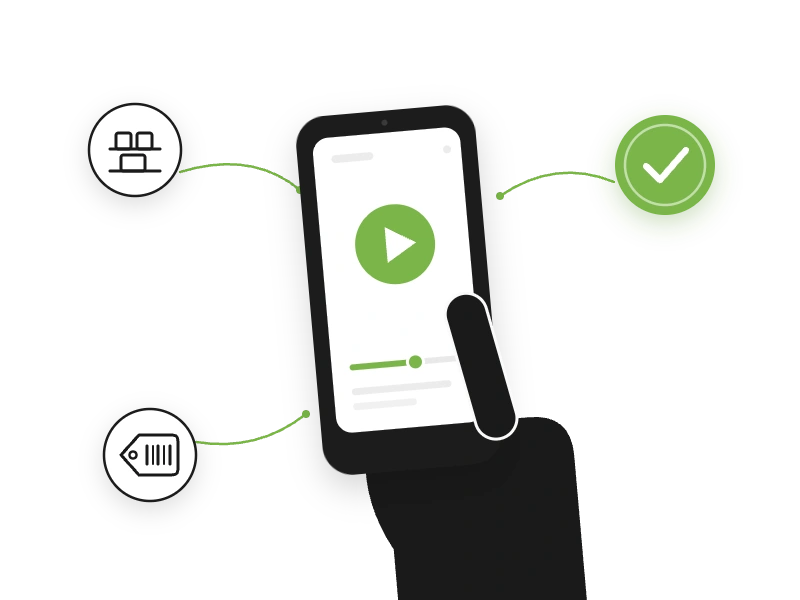
Because of that, FMCG eLearning is typically delivered as mobile-first microlearning your teams can complete on a phone between store visits, tracked in your LMS through SCORM or xAPI, instead of long desktop courses they will never open.
FMCG Categories We Build Training For
FMCG is not one category. What a beverage rep needs to know is nothing like what a beauty advisor or a household-care merchandiser needs. Here is where we build most often.
Food and Beverage
Constant SKU and flavour extensions, HACCP and food-safety handling, allergen accuracy, cold-chain and FEFO stock rotation, sampling and activation standards.
Personal Care
Ingredient and claim accuracy, regulated wording, pharmacy versus supermarket channel differences, regimen and cross-sell selling, pack architecture.
Home and Household Care
Safe handling and dilution demonstrations, safety data sheet basics, value-pack and bundle promo mechanics, shelf blocking and category story.
Beauty and Cosmetics
Beauty advisor consultation selling, shade and skin-type diagnostics, counter and display standards, seasonal campaign launches, high promoter turnover.
Consumer Health and OTC
Advertising and claim codes, pharmacist-facing detailing, contraindication and dosage accuracy, adverse-event reporting awareness, strict sign-off trails.
Distributor and Wholesale Networks
Third-party sales teams carrying many brands at once, order-to-cash and credit terms, trade scheme mechanics, coverage and journey-plan discipline.
Your Teams Are Learning on the Shelf - and It's Costing You Sales
FMCG training breaks in ways other industries never deal with. Your people aren't at desks - they're on shop floors, in the field, and behind counters, with no login to a course they'll never have time to open. Here's what's quietly costing you sales.
The floor never stops moving
A new SKU, a new promo, a new planogram - every week there's something your reps and merchandisers are expected to know cold, and no window to actually teach it. So "training" becomes a rushed group-chat message or a colleague explaining it wrong. The launch lands on the shelf faster than your people can learn to sell it, and when staff can't confidently talk about what's new, shoppers never hear about it either - so your marketing spend leaks out at the exact moment it should be converting.
Your best training never reaches the frontline
Head office builds a polished deck with everything the frontline should know. Then it gets emailed to regional managers, forwarded down the chain, and forgotten in an inbox before it ever reaches a single store. So the people facing your customers learn by winging it, picking up bits from whoever trained before them. Your brand ends up showing up differently in every store, and the customer experience you designed at the top barely resembles the one that plays out at the shelf.
Turnover eats your investment alive
You spend weeks getting someone up to speed, they leave for a competitor or a different aisle, and you start the whole cycle over from zero. In an industry where frontline churn runs high by default, that's not a one-off cost - it's a leak that never stops. Traditional onboarding is simply too slow and too expensive to survive that churn, because every departure resets the clock and every new hire is another manual, another shadow shift, another month before they're productive. The math only works if training is fast, repeatable, and doesn't depend on your best people stopping their own work to deliver it.
One program, twenty markets, twenty compliance headaches
What works in one region rarely transfers cleanly to the next. You're dealing with different languages, different food-safety and advertising regulations, and different retail realities all at once - and all of it needs to stay consistent with your brand. Most training approaches were never built to flex across that, so teams either bolt on a patchwork of local fixes or let standards drift market by market. Either way, you lose the one thing global rollout is supposed to give you: confidence that your product is being sold the same, correct way everywhere it's on a shelf.
You can't prove any of it worked
Completion percentages tell you people clicked, not that a rep can pitch the new SKU or a merchandiser can set the planogram. So when finance asks what the training returned, the honest answer is a shrug. Without assessment tied to the actual job task, and without a link between training data and shelf outcomes like sell-out, audit scores, or ramp time, your L and D budget stays a cost line instead of a lever - and it gets cut first when the year gets tight.
Your distributors sell your brand worst of all
A large share of your volume moves through people you don't employ - distributor salesmen, wholesalers, third-party promoters - and they carry a dozen brands at once. They rarely get access to your internal training, so they default to selling whatever they already understand. Your line gets deprioritized not because it's weaker, but because it's harder to explain. Fixing that needs training a partner can access without being on your payroll or your HR system.
How We Get FMCG Teams Shelf-Ready - Fast
You send us what you've already got - product decks, promo briefs, compliance PDFs, webinar recordings - and we turn them into SCORM-ready training your frontline actually finishes. Here's how that maps to what FMCG teams need.
Microlearning for the Flow of Work
Your reps and merchandisers don't have 45 minutes between store visits - they have five. We build bite-sized microlearning modules, videos, and interactive playbooks they can finish on a phone between calls, so a new SKU or planogram update gets learned on the move instead of ignored in an inbox.
Rapid eLearning for SKU Velocity
When your product line changes every week, training can't take a quarter to build. Our rapid development turns a new launch, promo, or process change into a finished course in days - so the training hits the floor at the same speed your products do.
Product and Sales Enablement Training
Product knowledge, objection handling, the pitch that actually moves units - built into scenario-based courses that ramp reps faster and shorten time to confident selling. Your teams walk into the store knowing what's new and how to sell it, not winging it aisle by aisle.
Scenario-Based and Gamified Learning
Passive slideshows get clicked through and forgotten. We build decisions, branching scenarios, points, and challenges that make training stick - because a merchandiser who's practiced the planogram executes it right the first time, and a rep who's rehearsed the objection handles it live.
Compliance and Safety Training
Food safety, handling standards, advertising rules, workplace safety - audit-ready, trackable courses that stay current as regulations change. Every course is WCAG 2.1 AA accessible and reports completion cleanly into your LMS, so "prove everyone was trained" stops being a fire drill.
Localization and Translation for Global Rollout
One program, every market. We localize courses into 35+ languages with AI or human voiceover - culturally adapted, on-brand, and re-tested in each language - so your training rolls out consistently across every region you sell in, without twenty separate patch jobs.
ILT and PowerPoint to eLearning Conversion
That in-person product training that only happens when a trainer flies in? That deck that never reaches the frontline? We convert your instructor-led sessions, decks, and recordings into self-paced digital courses that reach every store, every hire, every time. No scheduling, no travel, no bottleneck.
Performance Support at the Shelf
Not everything should be a course. For the things a rep needs mid-conversation - price ladders, promo mechanics, planogram diagrams, objection one-pagers, allergen tables - we build searchable job aids and mobile quick-reference guides they pull up at the point of need. Just-in-time support cuts the training load and stops wrong answers being given in front of a buyer.
Blended Learning for Cycle Meetings
Digital does not have to replace every session. We front-load the knowledge - product facts, mechanics, compliance - into self-paced modules so your national sales meeting or cycle briefing is spent on practice, role-play and coaching instead of slide-reading. Same trainer time, far more of it spent on the part that changes behaviour.
TRADE AND CHANNEL
Trade, Channel and Distributor Training
Product knowledge alone doesn't move volume. Most FMCG sales are won or lost on execution - the journey plan, the trade scheme explained correctly, the shelf set the way the category story intended. We build training for the commercial mechanics, not just the product.
Route to Market and Coverage
Journey-plan discipline, outlet classification, call frequency, perfect-store standards, and what a productive call actually looks like from greeting to order.
Trade Promotions and Schemes
Scheme mechanics explained so nobody misquotes them, claim and settlement process, margin maths, and the guardrails that stop a promo eroding your own price ladder.
Category Management and Planogram
The category story behind the planogram, shelf blocking and facings logic, compliance checks, and how to correct a badly set shelf without losing the retailer relationship.
Modern Trade and Key Accounts
Buyer-facing negotiation practice, joint business plan basics, listing and delisting conversations, and how modern trade selling differs from a general trade route.
Distributor Operations
Order-to-cash, credit terms, stock rotation and FEFO, returns and damages handling, and the system steps your partners get wrong most often.
Retail Audit and Execution Standards
What good looks like in photo form, audit scoring, share-of-shelf checks, out-of-stock escalation, and the corrective action expected before the rep leaves the store.
Different Roles, Different Training - Built for Each One
FMCG isn't one workforce. A sales rep, a merchandiser, and a distributor need completely different things - and generic training that treats them the same is exactly why most of it gets ignored. Here's how we train each role for the job they actually do.
| Role | What they're up against | What we build |
|---|---|---|
| Sales Reps | New SKUs and promos every week, tough retail buyers, quotas that don't wait | Product-knowledge, objection-handling, and pitch training in scenario-based modules that ramp reps faster and shorten time to confident selling |
| Merchandisers | Planogram changes, correct execution across dozens of stores, no time on-site to learn | Mobile microlearning and visual planogram walk-throughs they finish between stores, so the shelf gets set right the first time |
| Field Promoters & BAs | High turnover, short campaigns, brand consistency across every activation | Rapid-build, gamified modules that get temporary and seasonal staff on-message fast, without a trainer flying in |
| Distributors & Partners | Selling your brand alongside a dozen others, no direct oversight, easy to deprioritize | Self-paced product, order-to-cash, and enablement courses that keep third-party teams accurate and confident about your line specifically |
| Retail & Store Staff | Constant churn, deskless shifts, learning the product by winging it | Bite-sized, phone-first onboarding and product training that reaches every store and every new hire, no scheduling required |
| Area Sales Managers | Coaching a dispersed team, journey-plan discipline, inconsistent execution across territories | Coaching-conversation simulations, store-audit standards, and territory review playbooks that make field coaching repeatable |
| Brand & Category Managers | Launch briefs that get diluted on the way down, category story lost at the shelf | Launch-in-a-box modules, category story and trade-pitch training that keeps the brief intact from head office to the aisle |
How We Build It - Our Process
Six steps from your existing decks to a SCORM-ready course sitting in your LMS. Most FMCG programs run 5 to 7 weeks end to end, with rapid single-module builds turning around faster.
1. Discovery and audience mapping
A 30-minute call to pin down roles in scope, markets and languages, the business problem behind the request, and how success will be judged. Free, and no obligation.
2. Content intake and gap audit
You send product decks, promo briefs, SOPs, compliance PDFs and webinar recordings. We audit what is usable, what is out of date, and what is missing before a single slide gets built.
3. Learning design blueprint
Measurable objectives tied to the job task, module map, scenario outlines and assessment plan - approved by you and your compliance owner before production starts.
4. Build and localization
Production in Storyline 360 and Rise 360 with on-brand visuals, voiceover, and localization into the markets you sell in - built once, adapted per language rather than rebuilt.
5. QA, accessibility and LMS testing
Every course is checked against WCAG 2.1 AA, tested on entry-level Android as well as desktop, and published and test-loaded as SCORM or xAPI so tracking is proven before launch.
6. Launch, measure, hand over
You go live, we review the data with you at 30 and 60 days, and you receive every source file - the Rise 360 link and all Storyline projects - so the next update is yours to make.
AI IN FMCG LEARNING
Where We Use AI, and Where We Don't
AI is useful in FMCG training for exactly two things: cutting the time it takes to refresh content when a SKU changes, and giving reps somewhere safe to practise a conversation. We use it for both - with a human instructional designer and your compliance owner still signing off every word.
AI roleplay for objection handling
Reps practise the buyer conversation - price pushback, shelf space refusal, competitor comparison - against a responsive scenario, as many times as they want, before they do it in front of a real account.
AI-assisted rapid refresh
When a pack, price or claim changes, AI drafting plus a designer review turns a rebuild that used to take weeks into a version update measured in days - which is the only way training keeps pace with an FMCG line.
AI voiceover and translation
AI voiceover in 35+ languages at a fraction of studio cost, with in-language human review before release so the translation reads like a person wrote it, not a machine.
Where we don’t use it: we do not let AI write compliance, food-safety or claim wording unreviewed, and we do not ship AI-generated content into a regulated market without your sign-off. Speed is worth a lot in FMCG. It is not worth a mislabelled allergen or an unsubstantiated claim on a course your auditor can see.
Technology, LMS and Delivery
We are platform-neutral. We build the content, you keep your LMS - and we prove the tracking works in your system before you go live, not after.
Standards and packaging
SCORM 1.2, SCORM 2004, xAPI and cmi5. Completion, score, time and progress report cleanly, and where you need behaviour-level data we send xAPI statements to your LRS so you can see what learners did, not just that they finished.
Works with your LMS
Courses are tested to run in any modern SCORM-conformant platform - Moodle, Docebo, TalentLMS, Absorb, Cornerstone, SAP SuccessFactors, Workday Learning, 360Learning, LearnDash and others. No new platform, no migration, no licence to buy from us.
Built for weak signal
Lightweight media, compressed video, and downloadable job aids so a promoter in a provincial market on a mid-range Android is not stuck watching a buffer wheel. If your LMS app supports offline, our packages work with it.
WCAG 2.1 AA as standard
Captions and transcripts, keyboard navigation, screen-reader labels, colour contrast and text alternatives - included in the price, not quoted as an accessibility upgrade after the fact.
Authoring stack
Articulate Storyline 360 and Rise 360 as standard, with video and motion produced alongside. You get the working files, so any team that knows Articulate can pick the course up after us.
FMCG Compliance and Food Safety Topics We Cover
FMCG compliance is not one rulebook - it is food safety, marketing claims, workplace safety and trade conduct, all varying by market. We build the training around the standard your auditor actually cites, and keep one source updated so every region moves at once.
Food safety and handling
HACCP principles, good manufacturing and hygiene practice, temperature and cold-chain control, FEFO stock rotation, allergen awareness and cross-contact, recall and withdrawal procedure.
Claims and responsible marketing
What a rep can and cannot say at the shelf, health and nutrition claim substantiation, labelling accuracy, and responsible marketing rules for alcohol, tobacco alternatives and infant nutrition.
Workplace and field safety
Warehouse and backroom safety, manual handling, pallet and racking hazards, PPE, road and journey safety for field teams, incident reporting that actually gets used.
Trade conduct and ethics
Anti-bribery and gifts policy in a trade context, competition-law basics for pricing conversations, conflict of interest with distributors, and how to escalate a request that crosses the line.
Data privacy and shopper data
Handling shopper and retailer data lawfully across markets, consent at activations and sampling, and what field teams may photograph and share from inside a store.
Audit-ready by design
Versioned content, dated sign-off, scored assessment with a pass threshold you set, and completion records in your LMS - so proving who was trained on which version is a report you pull, not a scramble.
We build the training. Your regulatory or quality team remains the authority on which standard applies in which market, and signs off content before release – we design the course so that sign-off is quick rather than painful.
MEASUREMENT
How We Measure Whether It Worked
Completion rate is the weakest number in learning. We design assessment and data capture against all four Kirkpatrick levels from the blueprint stage, so the course can be tied to something your commercial director already tracks.
Level 1 - Reaction
In-course feedback, completion and drop-off points so you can see exactly which screen lost them.
Level 2 - Learning
Scored assessment against the objectives, pre and post comparison, and confidence rating on the specific pitch or task.
Level 3 - Behaviour
Manager observation checklists, store audit scores, planogram compliance photo checks and call-quality review after the course.
Level 4 - Results
Sell-out on the new SKU, numeric distribution, promo execution accuracy, audit pass rate, and ramp time for a new hire.
FMCG metrics worth putting on the dashboard: time to first sale for a new rep, percentage of reps certified before launch day, new-SKU sell-out in trained versus untrained territories, planogram compliance score, promo claim error rate, audit pass rate, and onboarding ramp time against your churn rate. We agree which ones matter in discovery, then design the assessment to feed them.
What a Typical FMCG Engagement Looks Like
Three shapes of FMCG project we get asked for most, with the scope, timeline and deliverables you would actually receive. Named client references and sample modules are available on request under NDA.
New SKU launch pack
Scope: 3 to 5 rapid modules of 10 to 15 minutes each covering product story, pitch, objection handling and shelf execution.
Audience: field sales, merchandisers, distributor reps.
Timeline: rapid build, launch-day ready.
You receive: SCORM packages, a scored certification quiz, a one-page shelf job aid, and the Storyline source files.
Frontline onboarding track
Scope: a 6 to 8 module induction path - company and brand, product basics, the perfect call, merchandising standards, food safety, systems.
Audience: new reps, promoters and store staff in a high-churn population.
Timeline: 5 to 7 weeks.
You receive: a sequenced learning path, checkpoint assessments, manager observation checklist and all source files.
Multi-market compliance rollout
Scope: one master compliance or food-safety course localized across several markets, with market-specific rule variations handled inside a single source.
Audience: everyone who touches product, including third-party partners.
Timeline: 5 to 7 weeks for the master, then per-language releases.
You receive: localized SCORM packages, an audit-ready completion trail and a version log.
Custom eLearning vs Off-the-Shelf vs LMS Content vs In-House
Four ways FMCG teams solve this. Here is an honest read on where each one wins.
| What matters in FMCG | Custom FMCG eLearning (us) | Off-the-shelf library | LMS vendor content | Build it in-house |
|---|---|---|---|---|
| Fit to your SKUs | Built around your actual products, planograms, promos and markets | Generic. No link to what your teams sell | Platform-first. Content is usually an add-on | Exact fit, if your team has the bandwidth |
| Speed to first course | 5-7 weeks, rapid modules faster | Instant, but not about your launch | Weeks to configure, content still missing | Months, competing with day jobs |
| Cost model | Fixed price per course, published, bundle savings | Per-seat subscription, forever | Per-seat licence plus content fees | Headcount, tooling and opportunity cost |
| Source files | Yours. Rise 360 link plus every Storyline file | None. You rent access | Locked to the platform | Yours, if documented |
| Localisation | 35+ languages, culturally adapted, re-tested in language | Limited language coverage | UI translated, content often not | Usually the first thing dropped |
| Accessibility | WCAG 2.1 AA as standard, not an upsell | Varies by title | Platform accessible, content varies | Depends on in-house skill |
| Measurement | Kirkpatrick L1-L4 designed in, xAPI where you need behaviour data | Completions only | Strong reporting, weak content signal | Whatever gets built |
| Best for | Product, promo, planogram, trade and compliance training tied to your line | Generic soft skills and broad compliance | Hosting, tracking and administration | Teams with a funded, staffed L&D studio |
Why FMCG Teams Choose eLearning Solutions Lab
You've got options - a big agency, an off-the-shelf library, or building it in-house. Here's where we're the better call for FMCG training specifically.
Fast enough to keep up with your product line
Most agencies quote in months. We deliver SCORM-ready courses in 5 to 7 weeks - fast enough that a new SKU or promo gets trained before it's already been replaced by the next one. Speed isn't a nice-to-have, it's the whole point.
Priced for how much FMCG training you actually need
Frontline training isn't one course a year - it's a constant stream of launches, refreshers, and compliance updates. Our prices are published below, fixed before you commit, and drop further on multi-course bundles, so you can build the volume FMCG requires without agency rates eating the budget.
Built for deskless, mobile, high-turnover reality
We don't design for people at desks, because your people aren't. Mobile-first, microlearning-led, and WCAG 2.1 AA accessible as standard - so training reaches reps between store visits, promoters on short campaigns, and new hires who might not be here next quarter.
Real learning design, not just prettier slides
Every course runs on a proven instructional-design methodology and learning science - active practice, scenarios, spaced retrieval - not a slideshow with a Next button. That's the difference between a merchandiser who clicks through and one who executes the planogram right.
Global rollout without the patchwork
35+ languages, culturally localized, compliance-aware, delivered from a single source. One program that holds its standard across every market - instead of twenty regional versions quietly drifting apart.
You own it - no lock-in
You get the source files: the Rise 360 link and every Storyline file. When a SKU changes or a rule updates, you're never held hostage to a rebuild - the training flexes as fast as your business does.
Measured against the shelf, not just completions
Assessment is designed against the job task, not the slide, and we agree the business metric in discovery - sell-out, audit score, ramp time - so the program can be defended when the budget conversation comes around.
Third-party and distributor teams included
Distributor salesmen, wholesalers and agency promoters sell a large share of your volume and rarely get your internal training. We build partner-facing courses that work outside your HR system, so your line stops being the hardest one to explain.
FMCG eLEARNING PRICING
Simple. Transparent. No surprises.
Fixed pricing. Fixed timelines. Every price is per course (30 to 60 minutes of seat time), and multi-course bundles bring the per-course rate down. You always know exactly what you're getting before you commit.
Rapid Build
Clean, guided courses for essential knowledge
$2,999
per course
– 30 to 60 min seat time
– Limited interactivity – click-to-reveal, tabs, drag-and-drop, scored quizzes
– Custom, on-brand visuals
– AI or human voiceover
– SCORM 1.2 / 2004 or xAPI / cmi5
– Kirkpatrick L1 to L2 built in
– WCAG 2.1 AA accessible
– Source files included
– 5 to 7 week delivery
Recommended
Professional Build
Full interactivity with a named on-screen facilitator
$4,500
per course
– 30 to 60 min seat time
– Full interactivity – branching scenarios with real consequences
– Custom animation plus named on-screen facilitator
– Feedback that teaches after every decision
– AI or human voiceover
– SCORM 1.2 / 2004 or xAPI / cmi5
– WCAG 2.1 AA accessible
– Source files included
– Priority project manager
Enterprise Build
Maximum depth - simulation and fully custom design
$7,500
per course
– 30 to 60 min seat time
– Simulation – adaptive branching plus software and process sims
– Fully custom design plus motion graphics
– Named facilitator plus scenario storytelling
– AI or human voiceover
– SCORM plus xAPI / cmi5
– WCAG 2.1 AA accessible
– Source files included
– Priority project manager
Localization is quoted per language on top of the course price. Bundles of three courses or more reduce the per-course rate – ask for the bundle sheet on your discovery call. Update retainers are available for teams shipping launches every month, or you can make the edits yourself with the source files we hand over.
Keeping Courses Current After Launch
In FMCG the course is never finished, because the product line never is. Here is what happens after go-live, which is the part most agencies leave vague.
You hold the source files
Every Storyline project and the Rise 360 link are yours on delivery. A price change or new pack shot can be swapped by your own team without a purchase order, and without waiting for our calendar.
Three ways to handle updates
Do it yourself with the files, buy edits at a fixed per-update rate, or put us on a monthly retainer if you launch constantly. No option locks you into the next one.
Version control across markets
One master, versioned and dated, with language files re-synced from it. When a rule changes, the correction moves through every market at once instead of surviving in one region and dying in another.
FMCG eLearning FAQs
The questions FMCG L and D, brand and commercial teams ask us most often before a project starts.
FMCG training in eLearning is online, self-paced learning built specifically for fast-moving consumer goods teams – sales reps, merchandisers, promoters, distributors and retail staff – covering product knowledge, planogram execution, promotions, trade schemes and compliance. Because FMCG product lines change constantly and most staff are deskless, it is typically delivered as mobile-first microlearning that people can complete on a phone between store visits, rather than long desktop courses.
You train deskless staff by delivering short, mobile-first modules they can finish on their own phones, in the flow of work. Instead of expecting reps and store staff to log into a long course they will never open, effective FMCG eLearning breaks training into bite-sized microlearning, videos, interactive playbooks and searchable job aids – so a new SKU or planogram update gets learned in five minutes on the floor, not ignored in an inbox.
With rapid eLearning development, a new SKU or promo course can be built in days rather than the months a traditional agency quotes. At eLearning Solutions Lab, full SCORM-ready courses are delivered in 5 to 7 weeks, and rapid-build modules for a single launch or process change turn around faster – fast enough that the training reaches the floor at the same speed your products do.
We keep it consistent by building one program from a single source and localizing it into each market, rather than letting each region build its own. Courses are translated and culturally adapted into 35+ languages with AI or human voiceover, then re-tested in each language – so your product story, pitch and standards stay identical in every market, and a single update reaches every region at once instead of drifting country by country.
Yes. eLearning suits FMCG compliance because courses can be made audit-ready, trackable and easy to keep current as regulations change. HACCP and hygiene practice, allergen awareness, cold chain and stock rotation, labelling and claim rules, responsible marketing and workplace safety are all built into courses that report completion cleanly into your LMS – so proving everyone was trained becomes a report you pull, not a fire drill. Your quality or regulatory team stays the authority on which standard applies in which market and signs off before release.
Yes – eLearning is often the only training model that survives high FMCG turnover. Because self-paced courses are repeatable and do not depend on a trainer’s availability, every new hire gets the same quality onboarding without your best people stopping their own work to deliver it. That makes ramp-up fast and consistent even when churn resets the clock constantly, which traditional in-person onboarding cannot afford to do.
FMCG eLearning is custom-built around your actual products, promotions and markets, whereas off-the-shelf libraries offer generic content with no connection to what your teams sell. Off-the-shelf works for broad topics like general soft skills, but it cannot teach a rep how to pitch your new SKU or a merchandiser how to set your planogram – which is exactly the training that moves FMCG sales.
Custom FMCG eLearning at eLearning Solutions Lab is priced per course of 30 to 60 minutes seat time: $2,999 for a Rapid Build, $4,500 for a Professional Build with full branching interactivity, and $7,500 for an Enterprise Build with simulation. Pricing is fixed before you commit, bundles of three courses or more reduce the per-course rate, and localization is quoted per language. Because FMCG training is a constant stream of launches, refreshers and compliance updates rather than a one-off, the model is built so you can produce volume without agency rates consuming the budget on the first few modules.
Yes. Every course is delivered SCORM-ready (SCORM 1.2, SCORM 2004, or xAPI and cmi5 where supported) and test-loaded before delivery, so it works in any modern LMS out of the box – Moodle, Docebo, TalentLMS, Absorb, Cornerstone, SAP SuccessFactors, Workday Learning, 360Learning, LearnDash and others. Completion, scores and progress report cleanly into your system, which is what makes compliance tracking across a large, distributed FMCG workforce straightforward.
We build partner-facing courses that can be shared outside your internal HR system – hosted in an extended-enterprise area of your LMS, in a partner portal, or issued as a standalone package a distributor can run in their own platform. Content is scoped so third-party teams get exactly what they need about your line – product story, pitch, trade scheme mechanics, order and stock handling – without exposing internal material, which is what makes it workable for wholesalers and agency promoters carrying several brands at once.
Beyond completion and quiz scores, we design assessment so training can be tied to commercial numbers you already track: time to first sale for a new rep, percentage of the field certified before launch day, new-SKU sell-out in trained versus untrained territories, planogram compliance and store audit scores, promo claim error rate, and onboarding ramp time. Where you need behaviour-level data we send xAPI statements to your LRS rather than relying on completion flags alone.
Yes, for two uses. AI-driven roleplay lets reps rehearse buyer conversations – price pushback, shelf space refusal, competitor comparison – as many times as they want before doing it live. AI-assisted drafting and voiceover cut the time to refresh a course when a pack, price or claim changes, and support localization into 35+ languages. What we do not do is ship AI-written compliance, food-safety or claim wording without an instructional designer and your compliance owner reviewing it first.
Yes. Courses are built mobile-first with compressed media and lightweight interactions, and tested on mid-range Android as well as desktop, because a promoter in a provincial market is not on office wifi. Where the training needs to work with no signal at all, we pair modules with downloadable job aids, and our packages work with the offline mode of any LMS mobile app that supports it.
Every course is built to WCAG 2.1 AA as standard, not as a paid add-on – captions and transcripts, keyboard navigation, screen-reader labels, sufficient colour contrast and text alternatives for images. For a workforce as large and varied as an FMCG frontline, that is both a legal safeguard in many markets and a straightforward completion-rate benefit.
You receive every source file on delivery – the Rise 360 link and all Storyline projects – so your team can swap a pack shot, price or claim without coming back to us. If you would rather not, we handle edits at a fixed per-update rate or on a monthly retainer for teams launching constantly. Updates are versioned and dated, and language files are re-synced from the master so a correction reaches every market at once.
Food and beverage, personal care, home and household care, beauty and cosmetics, consumer health and OTC, and the distributor and wholesale networks that carry them. The learning design stays consistent, but the content shifts hard by category – allergens and cold chain in food, claim wording in personal care and OTC, consultation selling in beauty, dilution and safe handling in household care.
Yes, and it is one of the most requested FMCG builds. Planogram training works best as visual walk-throughs plus practice – drag-and-drop shelf-setting exercises, before-and-after photo comparisons, share-of-shelf checks, and a scored scenario where the merchandiser has to spot what is wrong on a real-looking shelf. Paired with a mobile job aid for the store visit itself, it moves compliance far more reliably than a printed diagram sent by email.
No, and usually you should not. The strongest FMCG programs are blended: knowledge that can be self-paced – product facts, scheme mechanics, compliance – moves into modules people complete before they arrive, so the cycle meeting or national sales conference is spent on practice, role-play and coaching. Same trainer time and travel budget, far more of it spent on the part that actually changes behaviour at the shelf.
Get Your Free Proposal
When you fill out this form, we’ll introduce you to your personally selected Learning Advisor with experience in your industry, who will book a meeting with you to discuss your potential project.
There’s no obligation – just mutual fact-finding and information gathering to ensure there is mutual fit and that we can help you. That’s where the conversation starts.
We will get back to you within 3 business hours.
No time works for you? Email venchito@rainmakermastery.com and we’ll arrange a schedule.