

CONTACT FOR A FREE QUOTE - WITHIN 3 BUSINESS HOURS
Get Your Free Proposal
Send a message or book a 30-minute discovery call below. We will introduce you to a Learning Advisor with experience in your industry - no obligation, just mutual fact-finding to confirm we can help.
What To Expect
Fill out the form
Share your project scope and a Learning Advisor will be in touch within 3 business hours.
30-minute discovery call
We agree the sales roles in scope, the deals you are trying to move, target locales and timeline. No sales pressure.
Proposal in 24 hours
You receive a fixed-price proposal with a committed delivery window. No hidden fees, no surprises.
NDA before files move
We sign a mutual NDA before you send a single source file. Encrypted transfer as standard.
No time works for you? Email venchito@rainmakermastery.com and we will arrange a schedule.
What is Product Training eLearning?
Product training eLearning is the online delivery of courses that teach your sales, support, implementation teams, and customers how your product works and how to use it correctly – covering features, workflows, configuration, and common failure points.
It’s delivered through your LMS as self-paced, interactive modules built around real product behavior, so a distributed workforce can get up to speed on every release consistently, apply what they learn on the job, and reduce the errors and support tickets that come from misuse.
Why Product Training Is Harder Than It Looks
Most teams don't fail at product training because they lack knowledge - they fail because that knowledge never makes it into a form people can actually learn from. Turning what's in your experts' heads into clear, engaging learning that sticks across every team and every release is where most programs break down.
Raw content from SMEs
Your subject matter experts know the product better than anyone, but what they hand over tends to be dense specs, engineering docs, and slide decks built for reference, not for teaching. It's accurate and thorough, but almost never structured in a way a learner can follow. Someone still has to sit with those materials, figure out what matters for each audience, and rebuild it into a learning experience - without that conversion step, you ship information instead of building understanding.
Constant feature releases and version changes
Your product doesn't stand still, and neither can the training. Every new feature, UI update, and version change quietly makes existing modules inaccurate - and outdated training is often worse than none, because it teaches people the wrong thing with full confidence. Keeping content current means either a constant scramble to patch courses after each release, or a modular build designed to update fast. Most programs aren't built for that pace.
Generic modules that don't stick
Long, one-size-fits-all courses get clicked through, passed, and forgotten within days. When training is a wall of text with no interactivity, real product scenarios, or reason to care, learner engagement collapses and product knowledge gaps stay wide open. People may complete a module and still have no idea how to use the feature when it matters. Retention comes from practice and relevance - showing the product in action - not from more slides.
Role-specific needs across teams
Sales, support, implementation, engineering, and your customers all touch the product differently and need different things from training. A sales rep needs to articulate value and handle objections; a support agent needs to troubleshoot edge cases; a customer needs to complete core tasks without calling in. Training that flattens all of them into one generic course leaves every group half-prepared and forces them to fill the gaps on the job.
What Effective Product Training Actually Delivers
Product training moves the numbers your business already cares about. When your teams and customers truly understand the product, the effects show up in faster adoption, stronger sales, and fewer support fires. Here's what a well-built program returns.
Faster Product Adoption
When training mirrors how people actually use the product, teams get productive in days instead of weeks. New hires ramp faster, existing staff pick up new features without a dip in output, and customers reach their first win sooner. Every release your teams absorb quickly is revenue and momentum you don't leave on the table.
Stronger Sales Confidence and Conversion
Reps who deeply know the product stop reciting features and start selling outcomes. They articulate value clearly, handle objections without hesitation, and position your product as the obvious choice against competitors. That confidence turns more qualified leads into closed deals and lifts average deal size.
Fewer Errors and Support Tickets
A lot of support volume traces back to one thing: people never learned to use the product correctly. Training built around real workflows and common failure points prevents misconfiguration before it happens, so users self-serve instead of escalating. The result is a lighter load on your support team and a smoother experience downstream.
Shorter Learning Curves
Complex products punish users with steep, frustrating learning curves - especially in software. Step-by-step, scenario-based training flattens that curve by teaching the exact tasks people need in the order they'll need them. Learners spend less time stuck, make fewer costly mistakes, and reach competence with less hand-holding.
Consistent Messaging Across the Organization
When every department learns the product the same way, they talk about it the same way. Sales, support, marketing, and customer success stay aligned on what the product does, who it's for, and how to describe its value - no contradictions, no mixed signals reaching customers. That consistency builds trust externally and a more cohesive culture internally.
Measurable Revenue Impact
All of the above rolls up to the bottom line. Better-trained teams convert more, retain more, and cost less to support - and well-designed programs let you prove it with completion rates, time to competency, and ticket-reduction data. Product training stops being a cost center and starts reading as an investment with a traceable return.
How We Build Your Product Training: From Raw Content to LMS-Ready Course
No complex onboarding. No ambiguous timelines. You don't need a finished storyboard or a polished script to get started - you send us what you already have, and we handle the instructional design from there. Here's exactly what happens from the moment you hand over your product content to the day the course goes live in your LMS.
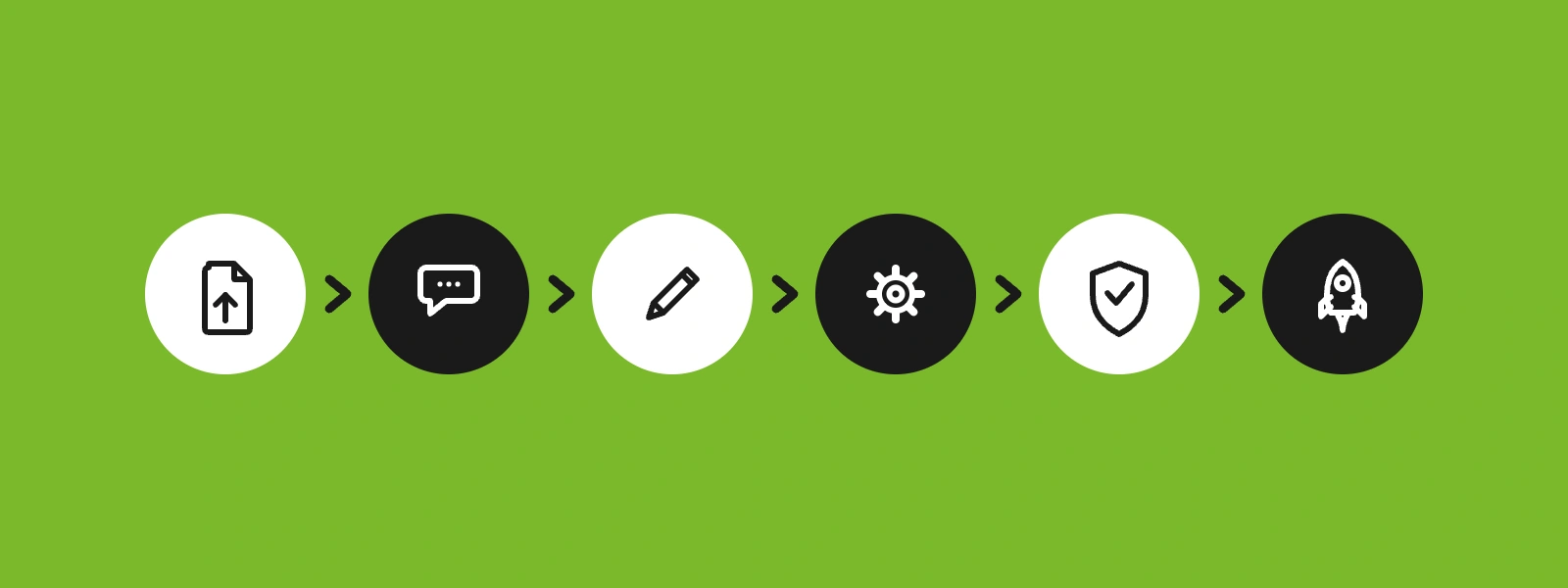
Step 1: Send Your Content - Day 1
You send us whatever documents your product knowledge already lives in: a feature spec, a PowerPoint deck, a PDF manual, a recorded demo or webinar, or just a topic outline. We work directly with raw source materials - the dense specs and demos most programs never get around to translating - so there's no need to organize or pre-format anything first. If your content is reasonably complete, that's all we need to scope the project and move forward.
Step 2: Discovery Call - Week 1
A focused 30-minute kickoff with your dedicated Learning Advisor, working from your content and, where useful, a quick pull from your product owners or SMEs. We map how the product really works - real user workflows, edge cases, and the points where people get confused - and align on who's being trained, the behavior the training needs to produce, your LMS environment, SCORM requirements, and your timeline. This is where instructional intent gets locked in before a single screen is built.
Step 3: Instructional Design & Storyboarding - Week 1 to 2
Our instructional designers translate your raw content into a real learning architecture - deciding what each audience needs, in what order, and in which format, then mapping sequencing, interaction points, and assessment strategy to how people actually use the product. We reshape dense specs and demos into structured, engaging learning that maps to real tasks. You receive a storyboard to review and validate before any development begins - your first checkpoint.
Step 4: Course Development - Weeks 2 to 4
Once the storyboard is approved, our development team builds the full course using rapid authoring and AI-assisted workflows: interactions, product visuals, voiceover, quiz logic, and any branching or simulation paths. You get a second review checkpoint mid-build and give feedback in cycles rather than waiting on one long black-box project. When you're rolling out per release, we produce version-specific content, with the team ensuring technical accuracy and depth throughout.
Step 5: QA, Accessibility & SCORM Packaging - Weeks 4 to 5
Before anything ships, every course goes through internal QA: functionality testing across browsers, WCAG 2.1 AA accessibility compliance, and packaging as SCORM 1.2, SCORM 2004, or xAPI depending on your LMS. Courses are responsive across devices and UI layouts and tested against real conditions, so rollout stays consistent and trackable. You don't receive a file and then discover it breaks on upload.
Step 6: Delivery & Launch Support - Week 5
You receive a tested, LMS-ready package that plugs into the systems you already run - LMS, LXP, HRIS, or internal tools - with upload instructions specific to your platform. If anything surfaces after upload, like a tracking anomaly or a completion trigger not firing, we resolve it. The project isn't closed until your product training course is running correctly in your environment - a clean launch instead of a compatibility scramble.
Product Training Formats Built to Fit How Your Teams Learn
The best product training format depends on your content, audience, and how fast it needs to change. We build a mix designed to match real product behavior and keep pace with your roadmap, then deliver it through the systems you already use.
Custom eLearning
The backbone of most programs: structured, interactive courses built around your actual UI, feature logic, and workflows. We take raw materials from your SMEs and turn them into a clear learning path that teaches your product the way people actually use it. Because it's modular, individual sections can be updated as the product evolves without rebuilding the whole course.
Microlearning
Short, focused lessons - usually two to five minutes - built for updates that can't wait for a full course refresh. When a feature ships or a UI changes, a quick microlearning nugget gets teams current without pulling them off the job. It's also ideal reinforcement, letting people revisit a specific task exactly when they need it.
Scenario-Based Learning
Instead of describing what the product does, scenario-based modules drop learners into realistic situations and let them work through decisions, errors, and recovery paths. This is where knowledge becomes judgment - especially valuable for support, implementation, and customer-facing teams who handle edge cases live. Learners practice getting it wrong in a safe space so they get it right with real customers.
Product Simulations
For complex or high-stakes products, simulations recreate the real interface in a safe, sandboxed environment where users can practice tasks and configurations without touching the live system. They replicate actual states, errors, and dependencies, so people build genuine muscle memory before they ever work in production - the closest thing to hands-on experience without the risk.
Explainer and Demo Videos
Clear, high-impact videos that show features in action, walk through key workflows, and highlight what's new in a release. Video is fast to consume and easy to distribute, making it ideal for aligning global teams the moment something changes. Well-made demos also cut misconfiguration by showing the exact steps rather than describing them.
Blended Learning and Job Aids
Not everything belongs in a course. We combine self-paced content with expert-led walkthroughs, live Q&As, and in-the-moment resources like quick-reference guides and job aids that support people while they work. This blend reinforces learning after the formal training ends and keeps help within reach at the moment of doing.
Product Training Tailored to Every Team and Your Customers
The same product looks completely different depending on who's using it. We design role-based paths so every audience - internal teams and your customers - gets exactly what they need to do their job, instead of one generic course that half-serves everyone.
Sales Teams
Reps need to move past feature lists and speak fluently about value, differentiation, and the questions prospects actually ask. Training here focuses on articulating outcomes, handling objections, and positioning against competitors - so product knowledge translates directly into won deals and larger average purchases.
Support and Customer Experience
Support teams live in the edge cases, so they need depth: how features behave, where things break, and how to guide a user back on track. Scenario-based practice and troubleshooting paths build the judgment to resolve issues fast, which shortens handle times and keeps escalations down.
Implementation and Customer Success
These teams have to configure the product correctly and get customers to real value quickly. Training built around actual workflows, dependencies, and configuration steps helps them avoid misconfiguration and turn onboarding into retention rather than churn.
Engineering and Technical Teams
Even internal technical teams need a shared, current understanding of how features work across environments and versions. Precise, workflow-based product training keeps everyone aligned on product behavior and reduces the confusion that slows delivery.
End Customers and Users
Customers who can complete core tasks on their own adopt faster, stick around longer, and call support less. Step-by-step guides, product walkthroughs, and simulations reduce the learning curve and help users reach their first win without friction - directly supporting adoption and retention.
Channel Partners and Resellers
Anyone who sells or supports your product on your behalf needs to represent it as accurately as your own team does. Consistent, certifiable partner training keeps messaging aligned and equips partners to sell and support with confidence across every market.
Pricing
Simple. Transparent. No surprises.
Fixed pricing. Fixed timelines. Every price is per course (30 to 60 minutes of seat time). You always know exactly what you’re getting before you commit.
Rapid Build
Clean, guided courses for essential knowledge
$2,999
per course
• 30–60 min seat time
• Limited interactivity — click-to-reveal, tabs, drag-and-drop, scored quizzes
• Custom, on-brand visuals
• AI / Human voiceover
• SCORM 1.2 / 2004 or xAPI / cmi5
• Kirkpatrick L1–2 built in
• 5–7 week delivery
Recommended
Professional Build
Full interactivity with a named on-screen facilitator
$4,500
per course
• 30–60 min seat time
• Full interactivity — branching scenarios with real consequences
• Custom animation + named on-screen facilitator
• Feedback that teaches after every decision
• AI / Human voiceover
• SCORM 1.2 / 2004 or xAPI / cmi5
• Priority project manager
Enterprise Build
Maximum depth — simulation and fully custom design
$7,500
per course
• 30–60 min seat time
• Simulation — adaptive branching + software / process sims
• Fully custom design + motion graphics
• Named facilitator + scenario storytelling
• AI / Human voiceover
• SCORM + xAPI / cmi5
• Priority project manager
Frequently Asked Questions
Product Training FAQs
We build custom product training from your raw content – feature specs, demos, or slide decks – and hand back a tested, SCORM-ready course in 5 to 7 weeks with published pricing and no surprise scoping fees. You get real instructional design behind every module, a dedicated Learning Advisor, and a partner who owns outcomes, not just file delivery.
We build courses modularly, so when a feature or UI changes, we update only the affected sections instead of rebuilding the entire course. That keeps training aligned to your release cadence. Ongoing refreshes and version-controlled revisions are available as separate engagements, scoped to how often your product changes.
Yes. We design role-based paths for sales, support, implementation, engineering, end customers, and channel partners – each mapped to how that group actually uses the product. A sales rep learns to articulate value; a support agent learns edge-case troubleshooting; a customer learns core tasks. One generic course leaves everyone half-prepared, so we don’t build that way.
It depends on the content and audience. We build custom eLearning for core knowledge, microlearning for frequent updates, scenario-based modules and simulations for hands-on judgment, and explainer or demo videos to align teams fast – usually blended with job aids. We recommend the mix during your discovery call rather than forcing one format.
We build training around real workflows, edge cases, and the points where users get confused – not feature lists. Scenario-based modules and simulations let learners practice decisions and recover from errors in a safe environment, so they build genuine judgment before they touch the live product or a real customer.
Most courses ship in 5 to 7 weeks from kickoff, including instructional design, development, QA, and SCORM packaging – and that timeline holds across all our pricing tiers. The main variable is your review turnaround at each checkpoint, which is why we lock instructional intent during the Week 1 discovery call before development begins.
Yes. Every course is delivered as a tested SCORM 1.2, SCORM 2004, or xAPI package compatible with modern platforms like Cornerstone, Docebo, TalentLMS, Absorb, Moodle, and Workday Learning. We test for compatibility before delivery and provide upload instructions specific to your platform, then resolve any tracking or completion issue that surfaces after upload.
Yes. We localize product training into multiple languages using AI-assisted workflows plus native experts, preserving technical terminology and adapting region-specific workflows so training stays accurate and consistent across markets. Because courses are modular, localized versions can be updated alongside the source when the product changes.
Yes, and it’s often the smartest way to start. Our Rapid Build begins at $1,800 per module — or $1,500 each in a 3-module bundle — so you can validate our quality, timelines, and learner response on a single course before scaling. Bundle three modules on any tier to save, and our Enterprise Build adds branching simulations and priority project management for larger programs.
CONTACT FOR A FREE QUOTE - WITHIN 3 BUSINESS HOURS
Get Your Free Proposal
Send a message or book a 30-minute discovery call below. We will introduce you to a Learning Advisor with experience in your industry - no obligation, just mutual fact-finding to confirm we can help.
What To Expect
Fill out the form
Share your project scope and a Learning Advisor will be in touch within 3 business hours.
30-minute discovery call
We agree the sales roles in scope, the deals you are trying to move, target locales and timeline. No sales pressure.
Proposal in 24 hours
You receive a fixed-price proposal with a committed delivery window. No hidden fees, no surprises.
NDA before files move
We sign a mutual NDA before you send a single source file. Encrypted transfer as standard.
No time works for you? Email venchito@rainmakermastery.com and we will arrange a schedule.