

Gamification in sales training is the use of game mechanics like progression, challenge, feedback, and reward inside a learning program to drive practice and retention. Applied well, it turns passive content consumption into repeated, scored reps: reps practice objections, recall product details, and work through deal scenarios until the behavior sticks.
It isn’t a feature you switch on. It’s a design decision, and most programs fail because the mechanic gets picked first and the learning goal gets reverse-engineered to fit. Leaderboards go up, the top three reps compete, everyone else disengages, and six months later nobody can say what changed.
In this guide, you’ll map learning objectives to the mechanics that actually serve them, avoid the design traps that quietly kill adoption, and run a 90-day pilot that produces a number you can defend.
In This Article
-
- What is gamification in sales training?
- Three things people mean by “sales gamification”
- Does gamification in sales training actually work?
- Start from the objective, not the mechanic
- Four design principles that actually drive learning
- Sales gamification ideas mapped to objectives
- Why gamification fails: five anti-patterns
- How to measure gamified sales training
- The 30-60-90 pilot plan
- When gamification is the wrong answer
- Tooling, by capability not by brand
What Is Gamification in Sales Training?
Gamification in sales training is the use of game mechanics – progression, challenge, feedback, and reward – inside a learning program to help drive practice and retention.
Applied well, it turns passive content consumption into repeated, scored reps. Sales reps practice objections, recall product details, and work through deal scenarios until the behavior sticks. The mechanic isn’t the point; the repetition it buys you is. That distinction is what separates a working program from a points system bolted onto elearning sales training that nobody finishes.
Three Things People Mean by “Sales Gamification” (And Why Only One Is Training)
Most articles on this topic slide between three different practices without naming the difference, which is why the advice in them contradicts itself. Here’s how they actually differ.
1. Gamified sales training. Game mechanics applied to learning: spaced quizzes that fight knowledge decay, timed roleplays that build objection-handling reflexes, certification paths that gate a rep’s progress on demonstrated competence. The outcome you’re after is capability.
2. Gamified performance management. Leaderboards, contests, and dashboards applied to results: deals closed, revenue booked, SPIFFs, President’s Club. The outcome you’re after is motivation on work the rep already knows how to do.
3. Gamified sales process. Points applied to CRM activity: calls logged, sequences completed, notes filled in. The outcome you’re after is compliance with a system.
These require different designs and different measures. A leaderboard is reasonable for #2, where reps compete on comparable outcomes they control. Drop the same leaderboard on #1 and you’ve told a month-two rep they rank 28th at learning, which is the opposite of what practice-based training needs to feel like.
This guide covers #1. If you’re looking at the mechanics across all learning formats rather than sales specifically, gamification in elearning covers the broader application.
Does Gamification in Sales Training Actually Work?
Yes, but modestly and conditionally. Controlled research shows gamified learning produces small to moderate gains in knowledge, and a 2025 field experiment with sales reps found 16% better recall a week after training. What doesn’t hold up is the popular claim that reps prefer gamified training.
Sales reps don’t actually ask for this
In SiriusDecisions’ 2018 Sales Talent Study, reps were asked to name their top three training delivery preferences. Gamification, described as learning in a scored competitive environment, came 14th out of 15 options, ahead of only podcasts.
Forrester’s biannual surveys of individual-contributor B2B sellers put gamification near or at the bottom of preferred learning modalities in 2016, 2018, and 2020, and the ranking held regardless of whether the data was cut by performance level, age, industry, or geography.
When sales enablement leaders were asked the same question in late 2021, only 4% were using game mechanics for learning and development. Last place again, against 77% for self-paced formats like eLearning and video.
Where the famous statistics come from
The 83%-motivated and 89%-more-productive figures repeated across this topic trace to a single source: TalentLMS’s 2019 Gamification at Work survey, in which 83% of employees receiving gamified training reported feeling motivated and 89% said they’d be more productive if work were more game-like. The sample was US employees, narrowed to 526 respondents after screening.
That’s a real survey, honestly reported. But note what it is: self-reported feelings from general office employees in 2019. Not sales reps, not a measured outcome, not a comparison against a control. By the time it reaches a vendor blog it has usually become “gamification increases productivity by 89%,” which the study never said.
What the controlled research shows
The strongest synthesis available is Sailer and Homner’s 2020 meta-analysis in Educational Psychology Review, which found significant but small effects of gamification on cognitive (g = 0.49), motivational (g = 0.36), and behavioral learning outcomes (g = 0.25).
The cognitive effect held up when the analysis was restricted to methodologically rigorous studies. The motivational and behavioral effects were less stable. Notably, the design choices that moderated behavioral outcomes weren’t points or badges. They were narrative framing and pairing competition with collaboration.
In sales specifically, the best evidence is recent. A field experiment published in the Journal of Personal Selling & Sales Management in 2025, run with 147 sales agents at a telecommunications company, compared a timed competitive quiz against an equivalent-length coach-led discussion of the same content. One week later, reps in the gamified condition recalled 16% more declarative knowledge on average. The benefit was uneven: it landed harder for highly experienced reps than for newer ones, which is the opposite of how most programs are scoped.
How to Reconcile the Two Pictures
The evidence isn’t contradictory once you separate the mechanic from the label. What research supports is retrieval practice under time pressure with immediate feedback – a format that makes reps produce answers instead of watching slides. What reps reject when surveyed is what the word “gamification” evokes: a public points leaderboard for learning activity. Those are different interventions. Gamify the practice, not the scoreboard.
Start From the Objective, Not the Mechanic
Here’s the framework that makes gamification in sales training work:
Objective → Mechanic → Metric. Define the performance first. Let it select the mechanic. Fix the measure before you build.
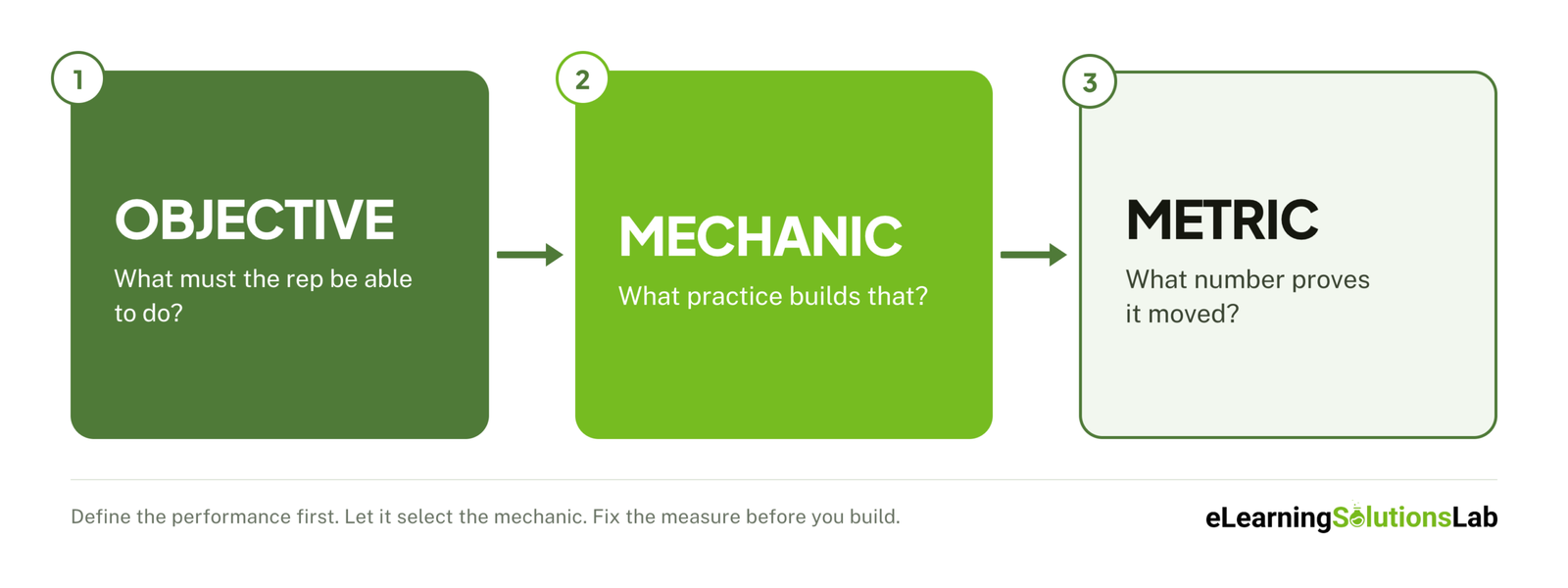 Three steps, in that order, no skipping.
Step 1: Write objectives you can actually build a game around
Most sales training objectives are too vague to design against. “Understand our pricing model” gives you nothing. You can’t score it, and you can’t tell whether a rep has it.
The fix is to replace the internal state with the observable performance that would serve as evidence of it.
- Understand the pricing model → Calculate the correct discount tier for a mid-market renewal, with no pricing errors
- Know the competitive landscape → Identify which of three competitors a prospect is likely evaluating, from discovery-call notes
- Be comfortable handling objections → Respond to a pricing objection using the four-step framework, scored 4+/5 on the rubric
The second version of each tells you what to build and what to count. The first doesn’t. If your objectives still read like the left column, fix those before designing anything. This is the first thing our instructional design services engagement addresses, because every downstream decision depends on it.
Step 2: Let the cognitive level pick the mechanic
The mechanic depends on what kind of thinking the task actually demands: recall, application, or judgment. Get this wrong in either direction and the training misfires. Quiz a skill that requires judgment and you’ve tested trivia. Build an elaborate branching scenario for facts a rep just needs to recall and you’ve spent six weeks producing a flashcard.
| What the rep must do | Cognitive demand | Mechanic that fits | What you measure |
|---|---|---|---|
| Recall product specs, pricing tiers, integration limits | Remember | Spaced retrieval quizzes, streaks, timed recall | Assessment score at 30 and 60 days, not day one |
| Classify a lead, a deal stage, a competitor threat | Understand | Sorting and matching challenges, rapid categorization | Classification accuracy against manager ground truth |
| Run a discovery call, follow the qualification framework | Apply | Branching scenario, simulated call flow | Scenario path quality; framework adherence on live calls |
| Diagnose why a deal stalled; read buying signals | Analyze | Deal post-mortem challenges, call-recording review scoring | Diagnostic accuracy against an expert panel; forecast accuracy |
| Handle an objection live; decide when to walk away | Evaluate | Timed roleplay, Hot Seat, AI practice reps with rubric scoring | Rubric score progression; objection handling on live calls |
| Build a tailored account plan or pitch | Create | Peer-reviewed challenge with rubric, tournament format | Rubric score; win rate on accounts using the plan |
Two things to notice. First, the mechanic column contains no badges, because badges are a reward wrapper rather than a practice design, and they can sit on top of any row or none of them. Second, competition only appears at the top and bottom of the range. Speed and ranking work for recall drills where everyone answers the same question. They distort the middle rows, where the right answer depends on context and rushing produces worse judgment, not better.
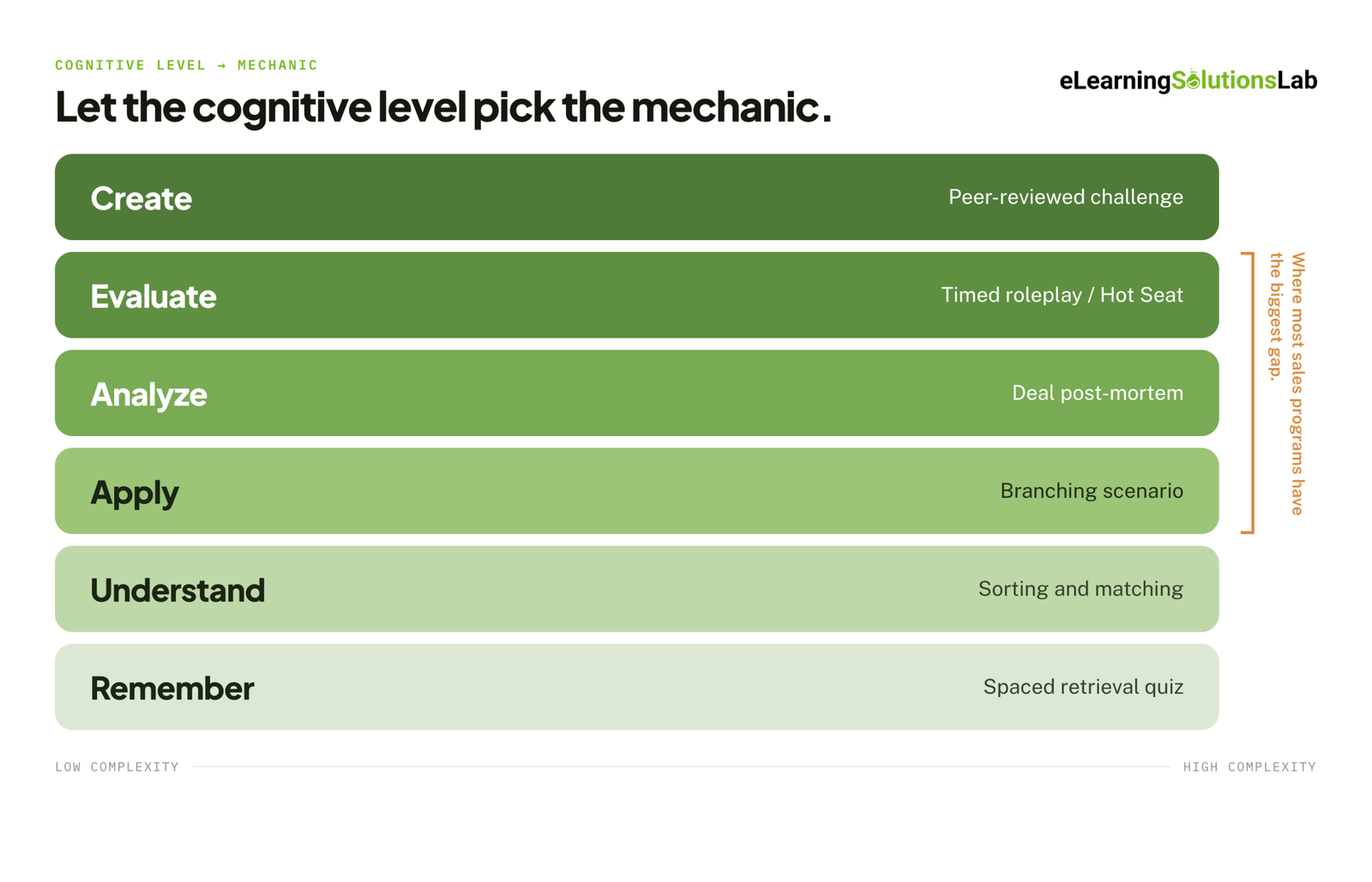 The Apply and Evaluate rows are where most sales programs have the biggest gap, and both are built as scenario based elearning services work rather than as quiz content.
Step 3: Name the metric before you build
The third column is a gate. If you can’t say what number would move and how you’d read it, you’re not designing training. You’re designing an activity, and activities are what get cut in the next budget review.
The discipline is simple: write the metric into the design document before anything is built, and choose one you can baseline today. If the measure doesn’t exist yet, that’s the first thing to build.
Four Design Principles That Actually Drive Learning
Points, badges, and leaderboards are the three things everyone names and the three things that matter least. They’re accounting, a way of displaying that something happened. The design work underneath comes down to four principles, and a program that gets these right will work without a single badge attached.
1. Progression: make competence visible and earned
Progression is the sense that you’re getting somewhere, and it’s the mechanic with the clearest application to sales. Ramp is a progression system whether or not anyone designed it as one.
Design rules:
- Gate progression on demonstrated competence, not time served. “Certified on discovery” should mean a rep passed a scored roleplay, not that they watched the video.
- Make the path visible from day one. A new hire should see every level between them and full productivity, because the ambiguity of early ramp is itself demotivating.
- Keep levels short enough to reach. If the first milestone takes three weeks, the mechanic isn’t doing anything for three weeks.
- Let progression unlock something real: territory, lead quality, a solo call, a deal size threshold. Unlocking a badge is a token. Unlocking authority is a reward.
In practice, that’s a four-level path – product certified → pitch certified → objection certified → live call certified – where each level is a scored gate and the last one is the rep’s first unaccompanied customer conversation. The same progression logic applies to customer onboarding training, where visible stages do more for completion than any reward does.
2. Challenge-skill balance: keep difficulty tracking ability
This principle is borrowed from flow research and is the one most often violated. Too easy produces disengagement dressed up as high completion rates. Too hard produces avoidance, and reps avoid quietly. They just stop opening the app.
Design rules:
- Start difficulty at the rep’s actual level, not the cohort average. A tenured AE and a month-two SDR need different objection scenarios.
- Escalate within a skill before broadening across skills. Three progressively harder pricing objections teach more than one each of pricing, timing, and authority.
- Let reps retry. Practice that can only be attempted once isn’t practice, it’s assessment.
- Watch for the ceiling. When experienced reps top out, the program becomes busywork for exactly the people whose time is most expensive.
Holding difficulty against ability at scale is an adaptive design problem, not a content problem. How to create an adaptive course walks through the branching models that make this practical.
3. Immediate feedback: correct at the moment of error
This is the principle doing most of the actual work, and the one that separates gamified practice from a quiz with a scoreboard on it.
Design rules:
- Feedback lands within seconds of the attempt, not in a manager review next Thursday.
- Feedback is specific and corrective. Not “incorrect,” but which part of the response failed and what the stronger version sounds like.
- Score against a visible rubric. If a rep can’t see the criteria they’re judged on, the score is noise.
- Separate practice feedback from evaluation. Reps behave differently when they believe a score goes on their record, and honest practice needs a space where it doesn’t.
This is where AI roleplay tooling has changed the economics. Immediate, rubric-scored feedback on a spoken objection-handling attempt used to cost a manager’s hour. It now costs minutes, which makes repetition affordable for the first time. The same shift is reshaping authoring more broadly, covered in ai for instructional design. Where the conversation needs to be practiced rather than answered, an elearning simulation gives you the rehearsal environment the rubric scores against.
4. Meaningful reward: recognition over trinkets
Design rules:
- Reward improvement and consistency, not just absolute rank. A rep who moves from the 40th to the 70th percentile has done more work than the rep who stayed on top.
- Prefer recognition, autonomy, and access over prizes. Being asked to run the next team practice session lands harder than a gift card and costs nothing.
- Never tie learning rewards to revenue outcomes. The moment a training score affects compensation, reps optimize the score instead of the skill.
- Retire rewards that stop signaling anything. If everyone has the badge, the badge is wallpaper.
One finding worth designing around: the meta-analysis cited earlier found that pairing competition with collaboration was among the strongest moderators of behavioral outcomes. Pure head-to-head ranking underperforms team structures where reps compete and have reason to coach each other, which is also how good sales floors already behave.
Sales Gamification Ideas Mapped to Objectives
Every idea below is tagged with the objective it serves and the metric it moves. If you can’t fill in the second and third column for an idea of your own, it doesn’t belong in the program.
Hot Seat. One rep faces rapid objections from the room while peers score against a shared rubric. Serves objection handling; measured by rubric score progression across sessions.
Certification quests. Onboarding broken into scored gates, each unlocking a real permission. Serves ramp; measured by time to first meeting booked and time to first deal.
Spaced knowledge streaks. Two or three questions a day on product, pricing, and competitive facts, surfaced on a decay schedule rather than a calendar. Serves recall; measured by assessment scores at 30 and 60 days. Built as microlearning services content, this is the cheapest mechanic on the list to run and the easiest to sustain.
Call-recording review scoring. Reps score anonymized recordings against the rubric, then compare their scoring to the manager’s. Serves diagnostic skill; measured by scoring agreement, which also improves self-assessment on their own calls.
Team-versus-team knowledge challenges. Pods compete, and pod members have an incentive to coach each other. Serves recall and classification; measured by pod-level score distribution rather than individual rank.
Deal post-mortem challenges. A lost deal is presented as a case with the outcome withheld; reps diagnose the failure point. Serves deal analysis; measured against an expert panel’s diagnosis.
Ramp leaderboards, new hires only. The one leaderboard that reliably works in training, because the cohort is genuinely comparable and the window is short. Serves motivation during ramp; measured by cohort completion and time to productivity.
Why Gamification Fails: Five Anti-Patterns
1. Leaderboards that demotivate the bottom 70%. A permanent public ranking tells most of your team, accurately, that they’re losing. The fixes are cohort brackets, personal-best scoring, and ranking by improvement rather than absolute position.
2. Badge inflation. When rewards are issued for participation rather than performance, they stop signaling anything, and the reps who earned the hard ones notice first.
3. Gaming the metric. Points for activity produce activity. Reps will hit the number with junk calls and hollow CRM entries, and the data you’d use to evaluate the program becomes the data the program corrupted.
4. Competition applied to collaborative skills. Account planning, deal strategy, and handoffs get worse when reps are ranked against each other on them.
5. Gamifying bad content. A points layer on a weak module makes the weakness more visible, not less. Fix the content first.
Three Signs Your Gamification Is Decoration
The same reps are on top every week and nobody else checks. Participation is high but assessment scores haven’t moved. You can’t name the metric the program was supposed to change. Any of those means the mechanic is doing display work, not learning work, and adding another mechanic won’t fix it.
How to Measure Gamified Sales Training
This is the part almost nobody publishes, and the reason most gamified programs get cut. Measure across four tiers, and expect the evidence to get harder and more valuable as you move down.
| Tier | What you track | When it reports | What it proves |
|---|---|---|---|
| Leading | Participation, completion, practice reps logged, voluntary repeat attempts | Week 1 onward | Reps are using it. Nothing more. |
| Learning | Assessment scores, retention at 30 and 60 days, roleplay rubric scores | Weeks 2-8 | They acquired the capability and kept it |
| Behavior | Call quality scoring, talk ratio, objection handling on live calls, playbook adherence | Weeks 4-12 | It transferred to the job. This is the tier that matters most. |
| Business | Time to first deal, ramp to quota, win rate, average deal size | One to three quarters | It moved the number the CRO cares about |
Design the comparison, not just the dashboard
A number without a comparison proves nothing. Run one team on the program and hold a comparable team off it for the pilot window. Capture the baseline before launch, use the same assessment instrument on both sides, and name the confounders in writing: territory differences, seasonality, manager quality, and the Hawthorne effect of being the team that was picked.
If a control group isn’t politically possible, use the next-best design: compare the same team against its own baseline across the prior two quarters, and compare cohorts of new hires who ramped before and after launch. Weaker evidence, but defensible, and far better than a completion rate.
For translating the behavior and business tiers into a cost case, elearning roi covers the calculation your finance stakeholder will ask for.
Pro Tip
Pick the behavior-tier metric first and work backwards. If you can’t currently measure objection handling on live calls, that measurement capability is the real project, and the gamification design should wait behind it. A program with a leading-tier dashboard and no behavior-tier evidence has no defense at budget time.
The 30-60-90 Pilot Plan
Run this on one team before it goes anywhere near the full org.
| Window | What you do | What exists at the end |
|---|---|---|
| Days 1-30 Baseline and design |
Write objectives. Pick mechanics from the mapping table. Capture baseline on the learning and behavior metrics. Choose the pilot team and the comparison team. | A design document with the metric written into it, and a baseline you can point at |
| Days 31-60 Run |
Launch with one cohort. Track leading indicators weekly. Collect qualitative feedback at day 45, early enough to fix difficulty calibration. | Participation data, first assessment results, and a difficulty adjustment already made |
| Days 61-90 Measure and decide |
Re-run the assessment. Score live calls on both teams. Compare against baseline and against the control. Write the recommendation before anyone asks for it. | A scale, adjust, or stop decision with evidence behind it |
The 90-day frame matters for a reason beyond tidiness: the knowledge effect in the sales field experiment was measured at one week, and retention effects decay. A pilot that only measures at launch will overstate what you have.
When Gamification Is the Wrong Answer
Four situations where this is the wrong intervention, and adding mechanics will waste the budget.
The gap is motivation, not capability. If reps could do it if their job depended on it, training won’t fix it. Look at incentives, territory design, lead quality, or management.
The gap is process or tooling. When reps are failing because the CRM workflow is broken or the collateral is out of date, gamified practice trains people to work around a problem you should be fixing.
The content itself is wrong. Mechanics amplify whatever they sit on. A pricing module teaching last year’s model becomes a pricing module teaching last year’s model faster.
The skill is genuinely collaborative. Some capabilities get worse under competition. Design them as team practice without ranking, or don’t gamify them.
The gate question is the standard performance-analysis one: could they do it if their life depended on it? If yes, it isn’t a training problem, and no mechanic will make it one.
Tooling, by Capability Not by Brand
Vendor lists date fast. Capability categories don’t. Decide which of these four you actually need before you look at a single product page.
| Capability | What it’s good at | What it can’t tell you |
|---|---|---|
| LMS-native gamification | Points, badges, completion tracking on content you already host | Whether anything transferred to the job |
| Dedicated gamification layers | Contests, team structures, richer reward logic across systems | Learning quality; most are built for performance, not training |
| AI roleplay and practice tools | Unlimited scored repetition on conversations, immediate rubric feedback | Whether the rubric matches what actually wins deals for you |
| Conversation intelligence | Behavior-tier measurement on real calls | Nothing about the training itself; it’s your measurement instrument |
The fourth row is the one most programs skip and the one that makes the other three provable. If your stack has three gamification layers and no behavior measurement, you’ve bought display and no evidence.
If you’re evaluating platforms, best lms for training companies covers the hosting layer, and top elearning gamification companies compares the providers who build the content that sits on top of it.
Want the practice design, not just the points?
We build the scored roleplays, branching scenarios, spaced retrieval sets, and certification paths that the framework above calls for – mapped to your objectives, scored against your rubric, and instrumented so you can prove what changed. Tell us the skill gap and the metric, and we’ll come back with the design.
Related Services
- eLearning gamification services – the mechanics in this guide, built and instrumented.
- Scenario based eLearning services – for the Apply and Evaluate rows of the mapping table.
- Microlearning services – spaced retrieval sets that fight knowledge decay.
- Instructional design services – objectives and rubrics before any mechanic gets built.
- Custom eLearning development services – when the build is the gap, not the design.
- eLearning sales training – the wider program this sits inside.
The Author

Book A Discovery Call
Our Learning Advisors are happy to walk you through your project step-by-step — content, timeline, and fixed pricing.
Get Your Free QuoteNo obligation — just a focused conversation. Proposal within 24 hours.
You may also like
Software for Training Companies: Best Tools and How to Choose (2026 Guide)
Short answer Training companies need a training management system (TMS) to…
How to Choose an LMS: A 7-Step Guide (With Free Scorecard)
Short answer To choose an LMS, define your goals and learners first, then…