


- Published
- Reading time
- 6 min
Filed under Instructional DesignL&D Strategy
Think back to learning to drive. At first, you didn’t know how much you didn’t know. Then, in your first lesson, you suddenly realized how hard it was. With practice, you could do it, but only if you concentrated on every step. And now you probably drive without thinking about it at all. That journey has a name: the four stages of competence.
It’s one of the simplest models in learning, and truly one of the most useful for anyone designing training. Here’s a practical guide: what the four stages are, where the model comes from, what each stage looks like at work, how to help people move from one stage to the next, and why your best experts can struggle to teach. You can also download a free four stages of competence worksheet, no email needed.
Short on time? Jump to the 4 stages, see how to move people forward or download the worksheet.
Updated November 2026.
In This Article
What Are the Four Stages of Competence?
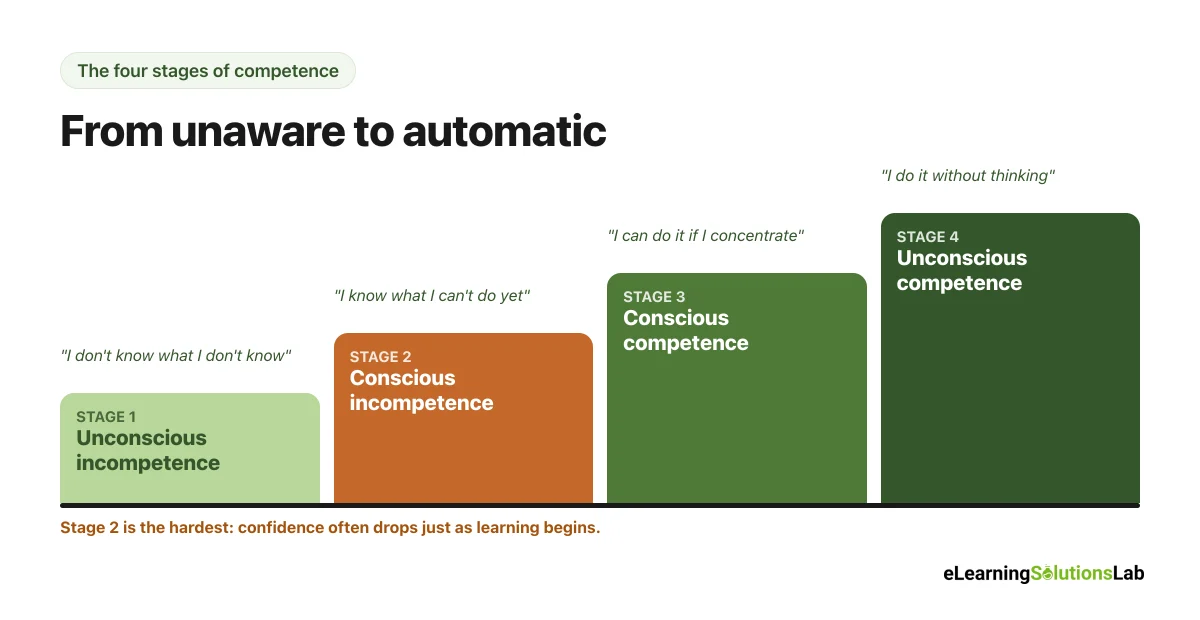
The four stages of competence (also called the conscious competence model or learning model) describe how people move from not knowing they lack a skill to performing it automatically: unconscious incompetence, conscious incompetence, conscious competence and unconscious competence.
The model combines two simple questions: can the person do it, and are they aware of it? Put together, those two questions give you four stages.
The 4 Stages of Competence Explained
| Stage | What it means | How it feels | Driving example |
|---|---|---|---|
| 1. Unconscious incompetence | You can’t do it, and you don’t realize it | Overconfident or unaware | “How hard can driving be?” |
| 2. Conscious incompetence | You can’t do it, and now you know it | Uncomfortable, sometimes discouraged | First lesson: stalling, missing mirrors |
| 3. Conscious competence | You can do it, but only with concentration | Effortful, slow, careful | Driving well, thinking through every step |
| 4. Unconscious competence | You do it automatically, without thinking | Easy, natural | Driving while holding a conversation |
The most uncomfortable stage is usually the second one. People suddenly see how much they don’t know, and confidence often drops. So that’s exactly where good training, encouragement and safe practice matter most.
Where the Model Comes From
The model is usually credited to Noel Burch of Gordon Training International, who described it in the 1970s as a way to explain the stages of learning any new skill. It’s sometimes attributed to Abraham Maslow, but there’s no clear evidence that he created it. Whatever its exact origin, it has become one of the most widely used frameworks in coaching, training and management.
Four Stages of Competence: Examples at Work
| Skill | Stage 1 | Stage 2 | Stage 3 | Stage 4 |
|---|---|---|---|---|
| Giving feedback | Thinks feedback is “just being honest” | Realizes their feedback upsets people | Uses a model like SBI, but stiffly | Gives clear, kind feedback naturally |
| Using new software | Assumes it’s like the old system | Gets stuck on basic tasks | Follows the job aid step by step | Works quickly without the guide |
| Sales discovery | Pitches before asking anything | Notices deals stall without good questions | Asks the planned questions in order | Asks the right questions in the flow |
| Safety procedure | Doesn’t see the hazard | Realizes the risk after a near miss | Follows the checklist carefully | Works safely by habit |
How to Move People Through the Four Stages
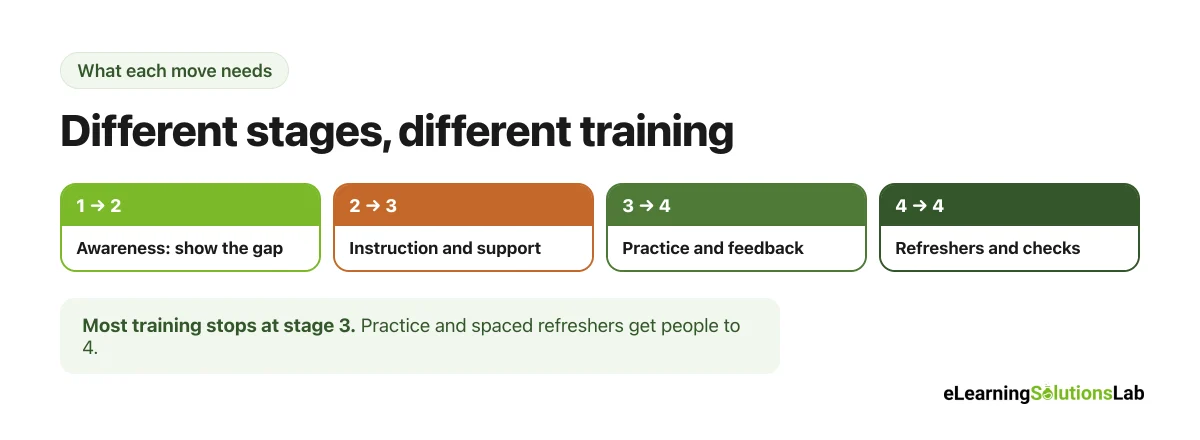
Each stage needs something different from training. For instance, practice is wasted on someone who doesn’t yet see why the skill matters, and long explanations are wasted on someone who already understands but needs repetition.
| Moving from… | What helps | Training examples |
|---|---|---|
| Stage 1 to 2 | Awareness: show the gap | Pre-assessments, realistic scenarios, real data or feedback |
| Stage 2 to 3 | Instruction and support | Clear explanations, demonstrations, job aids, encouragement |
| Stage 3 to 4 | Practice and feedback | Repeated practice, spaced refreshers, coaching, real tasks |
| Staying at 4 | Refresh and check | Periodic refreshers, observation, updates when things change |
In practice, most workplace training spends too much time on explaining (moving people into stage 3) and too little on repeated practice and feedback (moving them into stage 4). That’s usually why people “know” something after a course but still can’t actually do it smoothly on the job, given that knowing and doing are different stages. Our guide to the forgetting curve explains why spaced practice makes such a difference.
Why Your Best Experts Struggle to Teach
People at stage 4 do things automatically, so they genuinely don’t notice the steps anymore. When they explain a task, they skip the parts that feel obvious to them, which are often exactly the parts a beginner needs. This is sometimes called the “curse of knowledge”.
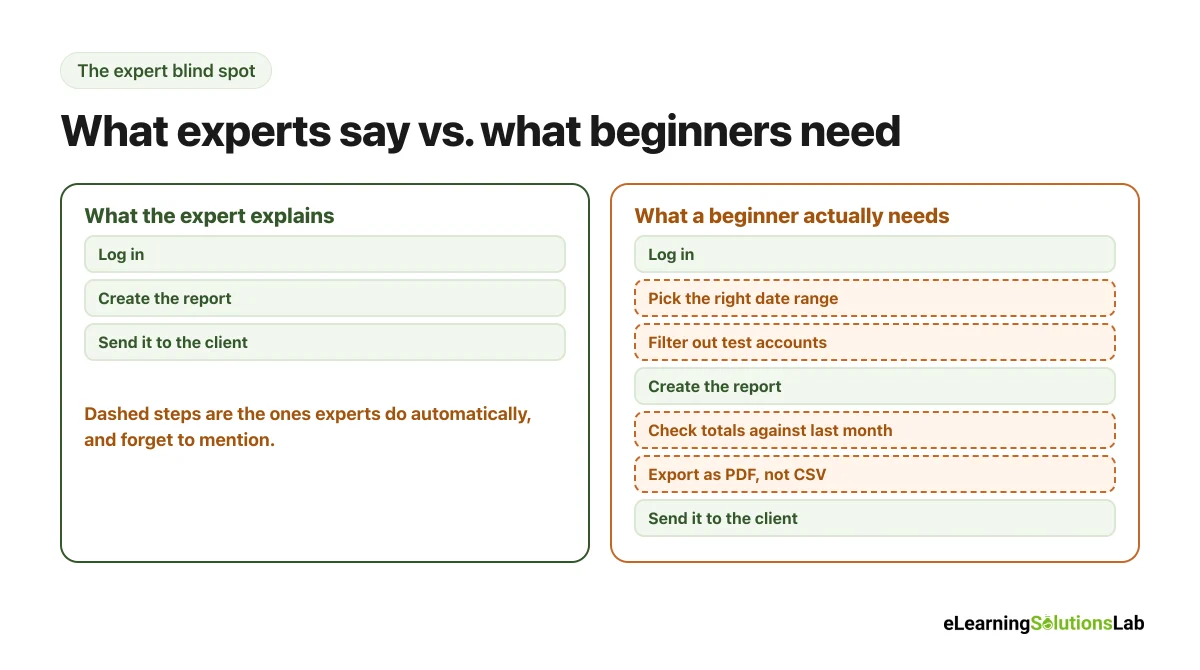
You have to plan for this when you work with subject matter experts. A few simple techniques help:
- Watch, don’t just ask. Observe the expert doing the task and note every step.
- Ask “what would a new person get wrong?” It surfaces the hidden steps.
- Test drafts with real beginners, not with other experts.
- Use an instructional designer as a translator between the expert and the learner.
To give you a concrete example, at eLearning Solutions Lab, we don’t simply interview subject matter experts and write down what they say. We watch them do the task, ask where new people usually trip up, and then test the first draft with people who are genuinely new to it. So the steps experts no longer notice end up in the course, rather than missing from it.
Limits of the Model
- It’s a simplification. Real learning isn’t perfectly linear, and people can move back a stage.
- Skills decay. Without use, unconscious competence can fade, which is why refreshers matter.
- Automatic isn’t always good. Stage 4 habits can include bad habits, so it’s worth checking experts now and then.
- It describes, it doesn’t prescribe. It tells you where someone is, not exactly how to teach them. That’s what instructional design is for.
Some versions add a fifth stage, often called “reflective competence” or “conscious competence of unconscious competence”: the ability to break down what you do automatically so that you can teach it. That’s really the stage every good trainer and mentor needs to reach.
Is There a Fifth Stage of Competence?
Yes, sort of. The original model has four stages, but people have proposed a fifth over the years. And there are two versions you’ll usually see:
- Reflective competence – you’re skilled enough to do it without thinking, but you can also step back, explain what you do and why. This is genuinely what good coaches and trainers need.
- Complacency or “unconscious incompetence again” – you’ve done something on autopilot so long that bad habits creep back in, and you don’t notice.
So the fifth stage is really a warning and a goal at once. For instance, a senior salesperson might close deals easily, but struggle to coach new hires because they can’t put their own skill into words. Building in reflection, refreshers and peer review helps here. You can see how skills fade over time in our post on the Ebbinghaus forgetting curve.
Free Four Stages of Competence Worksheet (PDF)
Free download – no email needed
Four Stages of Competence Worksheet
A printable PDF to map a team’s skills to the four stages, plan the right training for each stage, and capture hidden steps from subject matter experts.
In one line: the four stages of competence show how people move from not knowing what they don’t know to doing it automatically, and good training gives each stage what it needs: awareness, instruction, practice and refreshers.
Want training that gets people all the way to competent?
At eLearning Solutions Lab, we design training with the practice and reinforcement people need to move from knowing to doing.
See our instructional design services or scenario-based eLearning.
See instructional design servicesTalk to us about your training
Related Reading
- The learning curve – how fast people improve.
- The Ebbinghaus forgetting curve – why skills fade.
- Learning models – other frameworks worth knowing.
- Skills matrix template – map competence across a team.
- Scenario-based eLearning – practice that builds competence.
The Author

Book A Discovery Call
Our Learning Advisors are happy to walk you through your project step-by-step — content, timeline, and fixed pricing.
Get Your Free QuoteNo obligation — just a focused conversation. Proposal within 24 hours.
You may also like
Learning Paths: Types, Examples and How to Build One People Finish
Give a new employee access to a library of 200 courses and say "take what you…
Training Curriculum Development: 8 Steps, Components and a Sample Map
A single course can teach a skill. But most roles need much more than one…