


- Published
- Reading time
- 6 min
Filed under Corporate TrainingInstructional Design
A single course can teach a skill. But most roles need much more than one skill, and most training programs fail not because any single course is bad, but because the courses don’t actually add up to anything. People take a compliance module here and a product webinar there, with no clear path from new hire to fully capable. That’s the gap a training curriculum fills.
So here’s a practical guide to training curriculum development. You’ll get a simple definition, how a curriculum differs from a course or program, its key components, an 8-step development process, a sample curriculum map, common ways to structure it, and how to keep it current. You can also download a free training curriculum map template, no email needed.
Short on time? Jump to the definition, see the 8 steps or download the template.
Updated November 2026.
In This Article
- What is a training curriculum?
- Curriculum vs. program vs. course vs. module
- Key components of a training curriculum
- How to develop a training curriculum (8 steps)
- A sample curriculum map
- Ways to structure a curriculum
- Keeping it current
- The 5 Stages of Curriculum Development
- Free curriculum map template
What is a Training Curriculum?
A training curriculum is a structured plan of all the learning a specific group needs to reach a defined level of performance. It sets out the competencies to build, the courses and activities that build them, the order they happen in, how they’re delivered, and how progress is assessed. Training curriculum development is the process of designing that plan.
Think of it as the map, and the individual courses as the stops along the way. For instance, a “new store manager” curriculum might include onboarding, operations, people management, safety and finance courses, spread over the first six months, with on-the-job tasks and check-ins in between.
Curriculum vs. Program vs. Course vs. Module
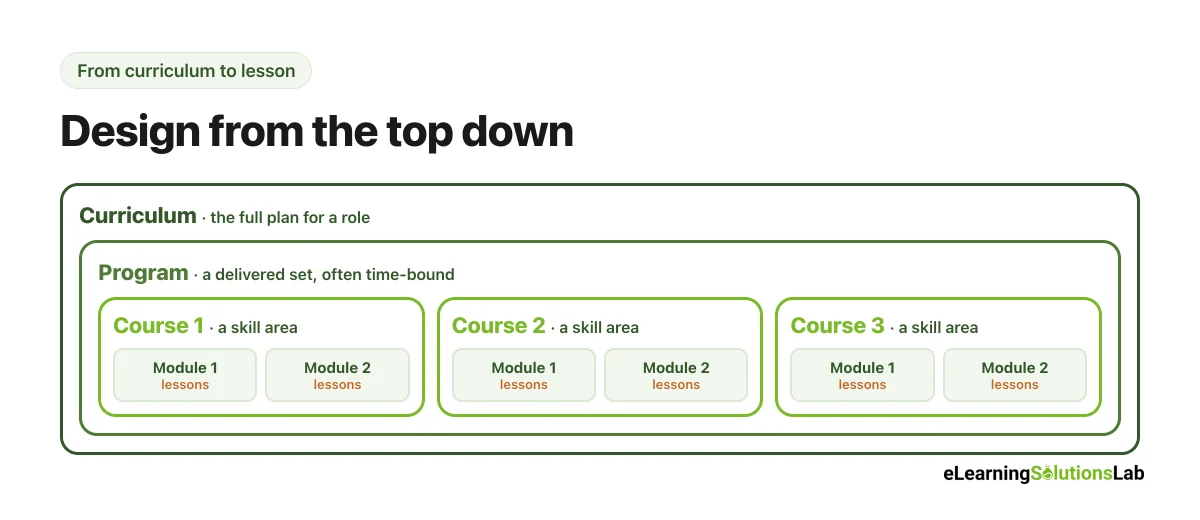
| Term | What it is | Example |
|---|---|---|
| Curriculum | The full plan of learning for a role or group | New store manager curriculum |
| Program | A delivered set of learning, often time-bound | The 6-month manager development program |
| Course | A self-contained unit that teaches a skill area | Store operations |
| Module | A part of a course covering one topic | Opening and closing procedures |
| Lesson or activity | The smallest unit of learning | A 5-minute video and a practice task |
These terms are used loosely, and that’s fine. In practice, what matters is that you design from the top down: start with what the whole role needs, then break it into courses and modules, rather than collecting courses and hoping they add up.
Key Components of a Training Curriculum
| Component | What it defines |
|---|---|
| Goal and audience | Who it’s for and the performance it should lead to |
| Competencies | The skills and knowledge the role requires |
| Learning objectives | Measurable outcomes for each competency |
| Courses and modules | The units of content that build each competency |
| Sequence | The order people go through it, and any prerequisites |
| Delivery methods | eLearning, live sessions, on-the-job tasks, coaching or a mix |
| Assessment | How progress and competence are checked |
| Timeline | When each part happens, for example by week or month |
| Ownership and review | Who maintains it and how often it’s updated |
How to Develop a Training Curriculum (8 Steps)
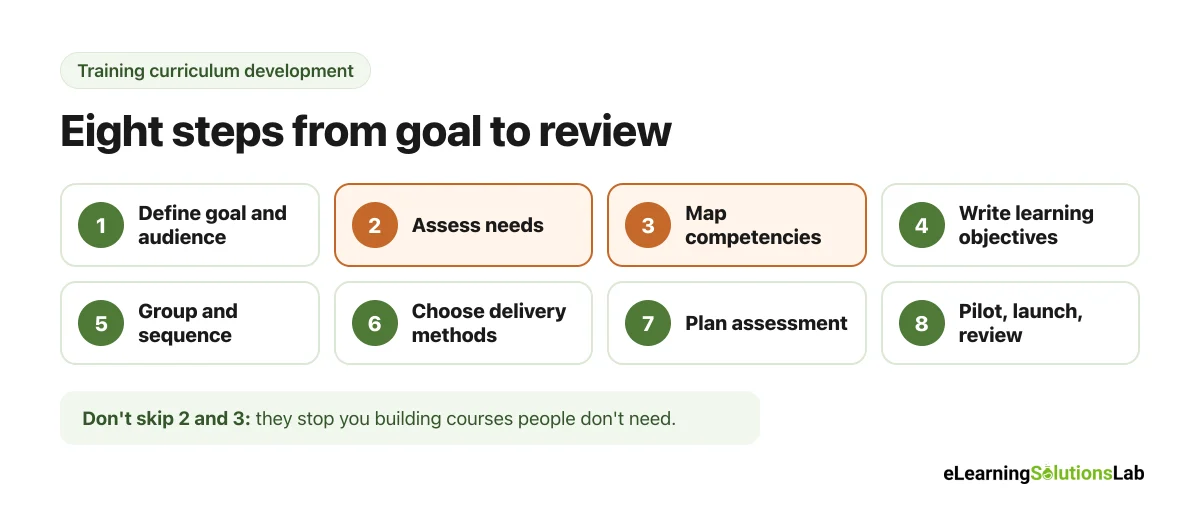
- Define the goal and audience. Who is this for, and what should they be able to do at the end? Tie it to a business result, like time to full productivity.
- Assess needs. Find what people already know and where the gaps are. A training needs assessment gives you the evidence.
- Map the competencies. List the skills and knowledge the role needs. A skills matrix is a useful starting point.
- Write learning objectives. Turn each competency into measurable objectives. Our guide to learning objectives shows how.
- Group and sequence the content. Cluster objectives into courses and modules, then order them from foundational to advanced, and from most urgent to least.
- Choose delivery methods. Match each part to the right format: eLearning, live sessions, on-the-job tasks, coaching or job aids.
- Plan assessment. Decide how you’ll check progress along the way and confirm competence at the end, from knowledge checks to practical sign-offs.
- Pilot, launch and review. Test with a small group, fix what doesn’t work, launch, and set a date to review it.
The biggest shortcut most teams take is skipping steps 2 and 3 and going straight to a list of course titles. It’s genuinely faster at first. But it usually produces a curriculum full of things people already know, with gaps in the things they don’t.
A Sample Training Curriculum Map
Here’s a simplified curriculum map for new customer service representatives over their first 90 days:
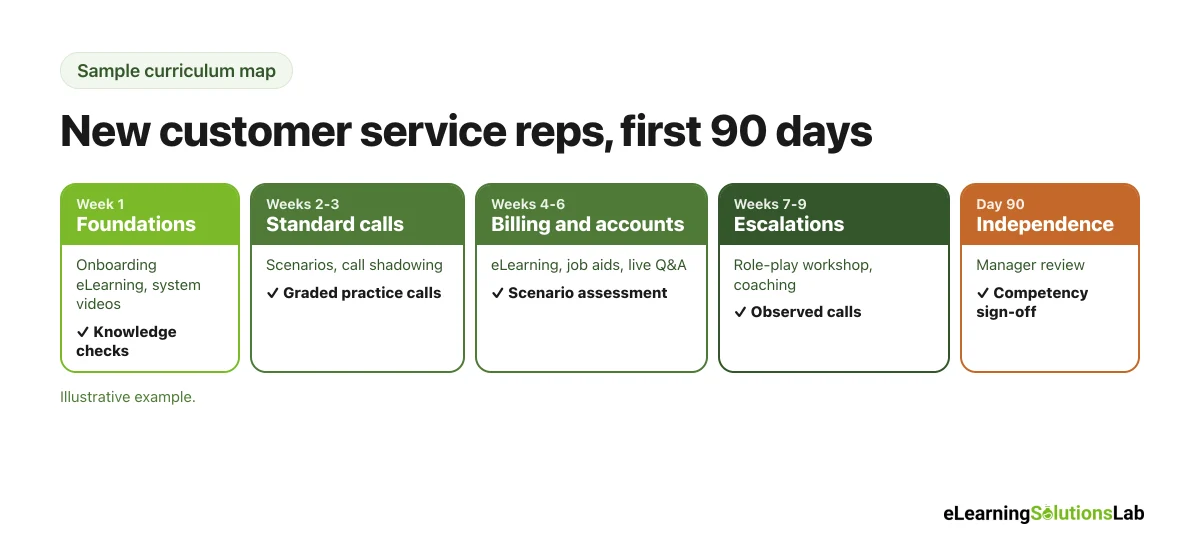
| Phase | Focus | Formats | Check |
|---|---|---|---|
| Week 1 | Company, products, systems basics | Onboarding eLearning, system walkthrough videos | Knowledge checks |
| Weeks 2-3 | Handling standard calls | Scenario-based eLearning, call shadowing | Graded practice calls |
| Weeks 4-6 | Billing and account issues | eLearning, job aids, live Q&A | Scenario assessment |
| Weeks 7-9 | Complaints and escalations | Live role-play workshop, coaching | Observed calls with a rubric |
| Day 90 | Full independence | Manager review | Sign-off against the competency checklist |
Notice how the curriculum mixes formats, and how each phase ends with something practical, not just a quiz. And the order follows what the new rep really needs first: you have to handle basic calls before you can handle escalations.
This is an illustrative example. A real curriculum would be based on your own needs assessment and roles.
Ways to Structure a Training Curriculum
| Structure | How it works | Best for |
|---|---|---|
| Linear | Everyone takes the same courses in the same order | Onboarding and compliance |
| Modular | Learners pick the modules they need | Experienced staff and upskilling |
| Role-based tracks | A shared core plus a track per role | Teams with several related roles |
| Spiral | Topics return at deeper levels over time | Complex skills like leadership |
| Competency-based | Progress depends on showing skills, not time spent | Technical and regulated roles |
Many organizations combine these. For instance, a shared core for everyone, then role-based tracks, with a spiral approach for skills that need to deepen over time.
Keeping Your Curriculum Current
A curriculum is truly never finished. Products change, processes change and roles change. Here’s how to keep it useful:
- Assign an owner for each course and for the curriculum as a whole.
- Review on a schedule – typically every 6 to 12 months, and whenever a process or product changes.
- Use the data – completion, assessment results and manager feedback show what’s working.
- Build in modules – small modules are much easier to update than one long course, given that you only change the part that’s out of date.
- Deliver it through an LMS – learning paths make the curriculum easy to assign and track. Our guide on whether you need an LMS covers the basics.
To give you a concrete example, at eLearning Solutions Lab, we don’t simply build the courses a client lists. We start by mapping the role’s competencies with managers and top performers, then design the whole curriculum on one page before building anything, so that everyone can see how the courses connect, what’s already covered by existing material, and what really needs to be built new. Usually that one-page map saves more time than any other step.
The 5 Stages of Curriculum Development
You’ll often see curriculum development described in five stages. They map closely to the ADDIE model:
- Analysis – define the business goal, audience and skill gaps.
- Design – set objectives, choose the structure and map courses and modules.
- Development – build or source the content, activities and assessments.
- Implementation – launch, enroll learners and support managers.
- Evaluation – measure results and update the curriculum regularly.
The 8 steps above simply break these stages into more practical actions. For more on the model behind them, see our guide to the ADDIE model.
Free Training Curriculum Map Template (PDF)
Free download – no email needed
Training Curriculum Map Template
A printable PDF to plan a full curriculum: goal and audience, competency list, a phase-by-phase curriculum map with formats and assessments, and a launch and review checklist.
In one line: a training curriculum is the map that connects every course to the role it serves, and good curriculum development starts from the competencies people need, not from a list of course titles.
Need help designing a training curriculum?
At eLearning Solutions Lab, we design curricula around real roles and competencies, then build the courses, job aids and assessments to fill them.
See our instructional design services or eLearning consulting.
See instructional design servicesTalk to us about your curriculum
Related Reading
- Training needs assessment – find the gaps first.
- Learning objectives – turn competencies into measurable goals.
- What is instructional design? – the process behind each course.
- Skills mapping – the competencies your curriculum builds.
- Employee onboarding and training – the first curriculum most people take.
The Author

Book A Discovery Call
Our Learning Advisors are happy to walk you through your project step-by-step — content, timeline, and fixed pricing.
Get Your Free QuoteNo obligation — just a focused conversation. Proposal within 24 hours.
You may also like
The Four Stages of Competence: Examples and How Training Moves People Forward
Think back to learning to drive. At first, you didn't know how much you didn't…
Learning Paths: Types, Examples and How to Build One People Finish
Give a new employee access to a library of 200 courses and say "take what you…