


- Published
- Reading time
- 7 min
Filed under Instructional Design
“By the end of this course, learners will understand our customer service policy.” It sounds like a perfectly reasonable learning objective. But how would you ever know if someone “understands” it? You can’t see it, you can’t measure it, and you can’t design a good activity around it.
That’s why learning objectives matter so much, and why so many of them don’t actually do their job. Here’s a practical guide: what learning objectives are, why they matter, the ABCD method for writing them, how to use Bloom’s taxonomy to pick the right verb, 15 examples you can adapt, and the mistakes to avoid. You can also download a free learning objectives worksheet with a verb list, no email needed.
Short on time? Jump to the ABCD method, see the examples or download the worksheet.
Updated November 2026.
In This Article
What Are Learning Objectives?
Learning objectives are clear, specific statements of what learners will be able to do by the end of a course, module or lesson. A good objective describes an observable action, so that you can design practice around it and check whether it’s been achieved.
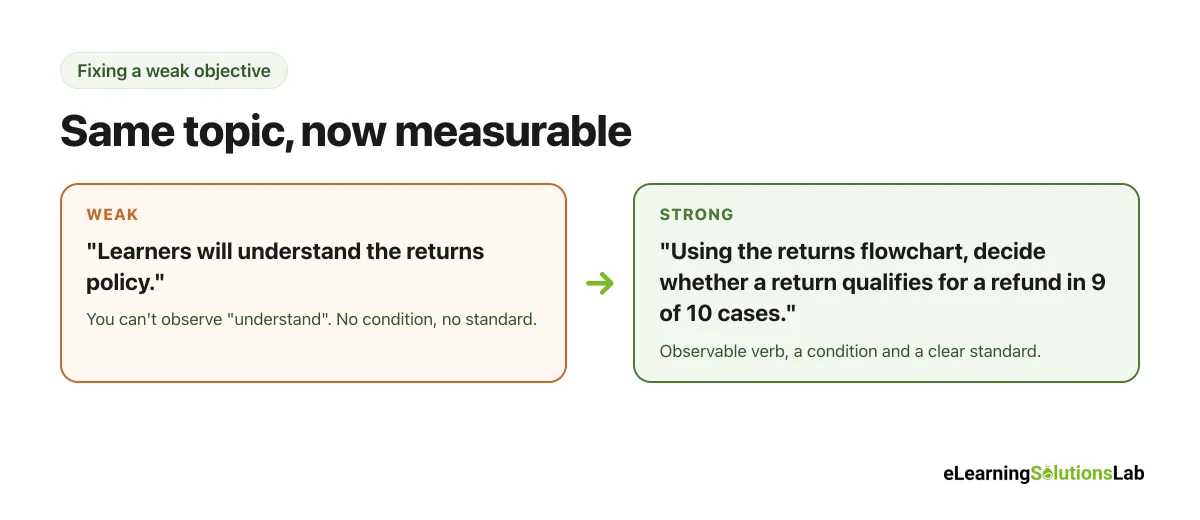
Here’s the difference in one line. “Understand the returns policy” describes something in someone’s head. “Decide whether a return qualifies for a refund, using the returns policy” describes something you can genuinely watch someone do.
Why Learning Objectives Matter
Learning objectives typically do four jobs at once:
- They focus the content. If something doesn’t help learners meet an objective, it probably doesn’t belong in the course.
- They shape the activities. An objective about deciding needs decision-making practice, not just reading.
- They define the assessment. The objective tells you exactly what to test, and how.
- They tell learners why it matters. People engage more when they know what they’ll be able to do at the end.
In practice, writing the objectives is usually the moment a course either gets focused or stays fuzzy. So it’s really worth spending time on them.
Learning Objectives vs. Goals vs. Outcomes
| Term | What it describes | Example |
|---|---|---|
| Goal | The broad purpose of the training, often a business result | Improve customer retention |
| Learning objective | A specific, measurable thing learners will be able to do | Resolve a billing complaint using the 4-step process |
| Learning outcome | What learners actually achieved, often measured after training | 85% resolved billing complaints correctly on assessment |
You’ll also hear about terminal objectives (what learners can do at the end of the whole course) and enabling objectives (the smaller steps that build up to it). For instance, “handle a customer complaint from start to finish” might be terminal, with “acknowledge the complaint” and “offer an approved resolution” as enabling objectives.
How to Write Learning Objectives: The ABCD Method
The ABCD method is one of the simplest ways to write a complete objective. Each letter is one part:
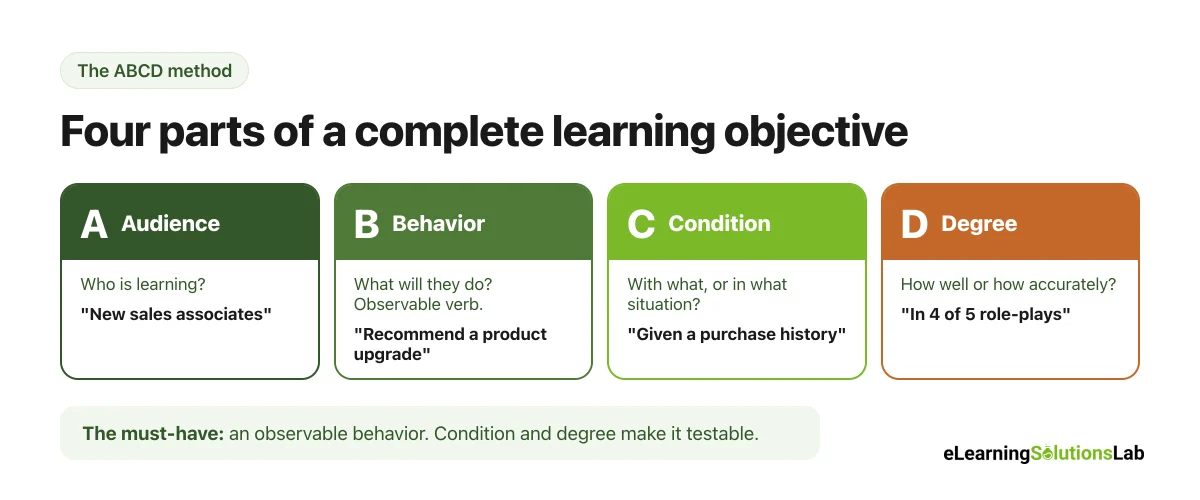
| Letter | Part | Question it answers | Example |
|---|---|---|---|
| A | Audience | Who is learning? | New sales associates |
| B | Behavior | What will they do? (an observable verb) | Recommend a product upgrade |
| C | Condition | Under what circumstances or with what tools? | Given a customer’s purchase history |
| D | Degree | How well, how fast or how accurately? | That matches the customer’s needs in 4 of 5 role-plays |
Put together: “Given a customer’s purchase history (C), new sales associates (A) will recommend a product upgrade (B) that matches the customer’s stated needs in at least 4 of 5 role-plays (D).”
You don’t always have to write out every part in full. In practice, the audience is often obvious from the course, and many objectives are shortened to “Learners will be able to [behavior] [condition] [degree]”. But you have to keep the behavior observable, and having a condition and degree makes the assessment far easier to design.
Choosing the Right Verb With Bloom’s Taxonomy
The verb is the heart of an objective. Bloom’s taxonomy (revised in 2001) sorts thinking into six levels, from simply remembering facts to creating something new. Picking a verb from the right level helps you match the objective to what the job actually requires:

| Level | What it means | Example verbs |
|---|---|---|
| Create | Produce something new or original | design, develop, compose, plan, construct |
| Evaluate | Make judgments based on criteria | assess, justify, critique, recommend, prioritize |
| Analyze | Break information into parts and find patterns | diagnose, compare, troubleshoot, differentiate |
| Apply | Use knowledge in a new situation | perform, demonstrate, calculate, operate, use |
| Understand | Explain ideas or concepts | explain, summarize, classify, describe, paraphrase |
| Remember | Recall facts and basic concepts | list, define, identify, name, recall |
Verbs to avoid: understand, know, learn, appreciate, be aware of, be familiar with. They describe internal states you can’t observe. Replace them with what someone would do to show they understand.
A useful tip: workplace training usually needs objectives at the “apply” level or higher, given that the goal is doing something on the job, not just recalling it. If every objective in your course starts with “list” or “define”, that’s a sign the course may be too focused on information.
Learning Objective Examples
Here are examples across common training topics, each written to be specific and measurable:
| Topic | Learning objective |
|---|---|
| Onboarding | Locate the five most-used HR forms on the intranet within 2 minutes. |
| Compliance | Identify a phishing email from a set of 10 sample messages, with at least 9 correct. |
| Safety | Perform a pre-shift equipment check using the checklist, with no steps missed. |
| Customer service | Resolve a billing complaint using the 4-step process in a role-play. |
| Sales | Recommend the right plan for a prospect based on 3 discovery questions. |
| Product training | Demonstrate the three main features of the new dashboard to a customer. |
| Software | Create a monthly report in the CRM without referring to the user guide. |
| Leadership | Give feedback using the SBI model in a recorded practice conversation. |
| Healthcare | Calculate a medication dose correctly from a written order, with 100% accuracy. |
| Data privacy | Classify customer data into the correct category for 8 out of 10 cases. |
| Manufacturing | Troubleshoot the three most common machine faults using the fault guide. |
| Project management | Prioritize a list of 10 tasks using the urgency-impact matrix and justify the order. |
| Hospitality | Handle a guest complaint at check-in following the service recovery steps. |
| Finance | Evaluate an expense claim against policy and approve or reject it with a reason. |
| Train-the-trainer | Design a 15-minute practice activity that matches a given learning objective. |
And here’s what fixing a weak objective looks like:
To give you a concrete example, at eLearning Solutions Lab, we don’t simply copy a client’s list of topics into objectives. We ask managers what people actually need to do differently on the job, write the objectives from that, and then have the client sign off on them before we design a single screen. So the objectives become the agreement everyone builds and tests against.
Learning Objective Examples by Type of Training
Most examples online are written for university courses. Here’s what learning objectives actually look like in workplace training:
| Training type | Example objective |
|---|---|
| Onboarding | By the end of week one, new agents will be able to log a customer case in the CRM without help. |
| Compliance | Employees will be able to identify the three warning signs of a phishing email in realistic examples. |
| Software | Users will be able to create and send a purchase order in the new system in under five minutes. |
| Soft skills | Team leads will be able to give specific, balanced feedback in a role play, using the SBI model. |
| Safety | Operators will be able to complete the lockout/tagout procedure correctly, in the right order, on the first attempt. |
Notice that each one names what learners will actually do, so that you can see it, practice it and assess it.
Common Learning Objective Mistakes
- Using vague verbs – “understand”, “know” and “learn” can’t be measured.
- Describing the course, not the learner – “This module covers…” is a topic list, not an objective.
- Too many objectives – a short module typically needs 2 to 4, not 12.
- Wrong level – testing recall when the job requires judgment.
- Objectives and assessments don’t match – if the objective says “diagnose”, the test can’t just be “define”.
- Writing them last – objectives written after the content usually just describe whatever was built.
Once your objectives are written, the next step is designing assessments that truly match them. Our guide to instructional design shows where objectives fit in the bigger process, and a training needs assessment helps you find what the objectives should be in the first place.
Free Learning Objectives Worksheet (PDF)
Free download – no email needed
Learning Objectives Worksheet and Verb List
A printable PDF with an ABCD objective builder, a Bloom’s taxonomy verb list for all six levels, verbs to avoid, and a quality checklist for every objective you write.
In one line: a good learning objective says who will do what, under which conditions, and how well, using a verb you can actually observe.
Want courses built around clear, measurable objectives?
At eLearning Solutions Lab, our instructional designers start every project with objectives tied to real job performance, then build the practice and assessments to match.
See our instructional design services or custom eLearning development.
See instructional design servicesTalk to us about your course
Related Reading
- What is instructional design? – where objectives fit in the process.
- Training needs assessment – find the gap before you write objectives.
- The ADDIE model – objectives in the design phase.
- The Kirkpatrick model – measuring whether objectives were met.
- Scenario-based eLearning – practice for apply-level objectives.
The Author

Book A Discovery Call
Our Learning Advisors are happy to walk you through your project step-by-step — content, timeline, and fixed pricing.
Get Your Free QuoteNo obligation — just a focused conversation. Proposal within 24 hours.
You may also like
The Four Stages of Competence: Examples and How Training Moves People Forward
Think back to learning to drive. At first, you didn't know how much you didn't…
Learning Paths: Types, Examples and How to Build One People Finish
Give a new employee access to a library of 200 courses and say "take what you…