

An eLearning company can be one of five different kinds of businesses: firms that build training courses for companies, LMS platforms that can host and track training, content libraries that sell ready-made courses, edtech companies that serve schools and universities, and managed learning services firms that run the training programs for you.
In this guide, we sort the top eLearning companies of 2026 by what they actually do. Each company is genuinely scored on the same five published criteria, and each category shows how its companies usually charge. You’ll also find a checklist for choosing a company and a list of questions to ask before you sign.
Short on time? Jump to the comparison table.
Updated November 2026.
In This Article
- What is an eLearning company?
- Top eLearning companies at a glance
- How we ranked these companies
- Corporate eLearning development companies
- LMS and learning platform companies
- eLearning content library providers
- K-12 and higher-education edtech companies
- Managed learning services companies
- How to choose the right eLearning company
What is an eLearning Company?
An eLearning company is a business that helps organizations deliver training online. Some would build the courses, some sell the software that hosts and tracks them, some license ready-made course catalogs, and some would entirely run the whole training function for you.
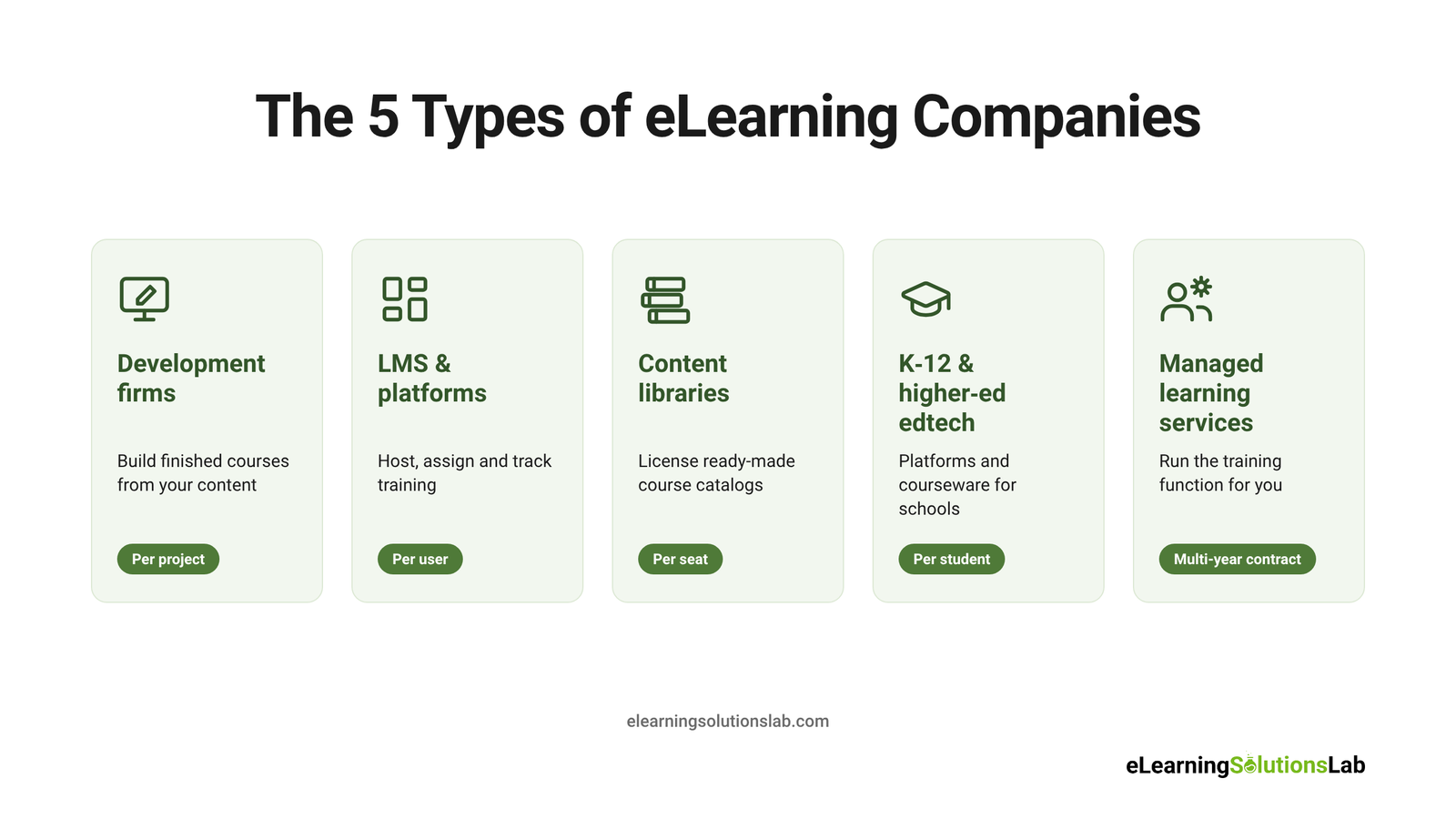
Schools and universities have their own group of edtech companies. “eLearning company” covers all five, which is why it pays to know which type of it you need before you compare names.
The 5 Types of eLearning Companies
| Type | What they do | Who buys from them | How they usually charge |
|---|---|---|---|
| Corporate eLearning development firms | Turn your content into finished, interactive courses | L&D, HR, compliance and sales enablement teams | Per project, often estimated per finished minute |
| LMS and learning platform companies | Provide software to host, assign and track training | L&D, HR and IT teams | Per user per month or year, or an enterprise license |
| Content library providers | License large catalogs of ready-made courses | L&D teams that need broad topics quickly | Per seat per year |
| K-12 and higher-ed edtech companies | Provide learning platforms, courseware and assessment for education | Schools, districts, colleges and universities | Per student or institutional license |
| Managed learning services companies | Run some or all of the training function: content, platform admin, delivery, reporting | Large enterprises | Multi-year contracts or retainers |
Many organizations use more than one type. A common setup is an LMS to host training, a content library for general topics, and a development firm for company-specific courses like onboarding, product training, and compliance tied to your own policies.
What About Authoring Tools?
Authoring tools such as Articulate 360, iSpring Suite, and Adobe Captivate are often listed among eLearning companies, but they sell software for building courses yourself, not finished training or a place to host it. They suit teams with in-house designers, and our guide to the best eLearning authoring tools compares them. If you’re weighing course agencies against authoring platforms, see our list of top eLearning vendors.
Top eLearning Companies at a Glance
The table lists all 28 companies in this guide, sorted by category, so you can jump straight to the type of company you need. Each company is scored out of 25 on the five criteria explained in “How We Ranked These Companies.” Full profiles follow the table.
Jump to: Development firms · LMS & platforms · Content libraries · K-12 & higher-ed edtech · Managed learning services
| # | Company | Category | HQ | Best for | Pricing model | Score /25 |
|---|---|---|---|---|---|---|
| 1 | eLearning Solutions Lab* | Development firm | Manila, Philippines | Fixed-price, SCORM-ready courses for lean L&D teams | Fixed price per project, from $4,995 | 24 |
| 2 | SweetRush | Development firm | San Francisco, US | Immersive, story-driven enterprise programs | Quote-based, per project | 22 |
| 3 | AllenComm | Development firm | Salt Lake City, US | Large corporate training and change programs | Quote-based, per project | 21 |
| 4 | ELB Learning | Development firm | Utah, US | Courses, tools and content from one company | Per project; software by subscription | 20 |
| 5 | CommLab India | Development firm | Hyderabad, India | High-volume rapid course builds on a budget | Per project / per finished minute | 19 |
| 6 | Cinecraft | Development firm | Cincinnati, US | Video-led and scenario-based training | Quote-based, per project | 18 |
| 7 | Infopro Learning | Development firm | New Jersey, US | Content plus training operations | Per project or managed contract | 17 |
| 8 | Docebo | LMS & platform | Toronto, Canada | Training employees and customers at scale | Quote-based, per active user | 22 |
| 9 | Cornerstone | LMS & platform | Santa Monica, US | Learning combined with talent management | Enterprise license | 21 |
| 10 | Absorb LMS | LMS & platform | Calgary, Canada | An easy-to-run corporate LMS | Quote-based, per user | 20 |
| 11 | TalentLMS | LMS & platform | Athens, Greece | Small and mid-size businesses that need to launch fast | Public tiered plans | 20 |
| 12 | 360Learning | LMS & platform | Paris, France | Courses built by your own experts | Public plans + enterprise quote | 19 |
| 13 | Moodle | LMS & platform | Perth, Australia | Open source with full control | Free software; paid hosting via partners | 18 |
| 14 | Skillsoft | Content library | Nashua, US | Compliance, leadership and tech catalogs | Per seat, per year | 21 |
| 15 | LinkedIn Learning | Content library | Sunnyvale, US | Broad business and software skills | Per seat, per year | 20 |
| 16 | Coursera for Business | Content library | Mountain View, US | University-branded courses and certificates | Per seat, per year | 20 |
| 17 | Udemy Business | Content library | San Francisco, US | Fast-moving tech and practical skills | Per seat, per year | 19 |
| 18 | Go1 | Content library | Brisbane, Australia | Content from many providers inside your LMS | Per seat, per year | 18 |
| 19 | OpenSesame | Content library | Portland, US | Off-the-shelf compliance and soft skills | Per seat or per course | 17 |
| 20 | Instructure (Canvas) | K-12 & higher-ed edtech | Salt Lake City, US | Universities and school districts | Institutional license | 21 |
| 21 | D2L (Brightspace) | K-12 & higher-ed edtech | Kitchener, Canada | Higher ed, plus a corporate offering | Institutional license | 20 |
| 22 | PowerSchool | K-12 & higher-ed edtech | Folsom, US | K-12 districts | Per student / district license | 19 |
| 23 | Pearson | K-12 & higher-ed edtech | London, UK | Courseware, assessment and online programs | Per student / institutional | 18 |
| 24 | McGraw Hill | K-12 & higher-ed edtech | New York, US | Digital courseware for schools and colleges | Per student / institutional | 17 |
| 25 | GP Strategies | Managed learning services | Columbia, US | Outsourcing the whole training function | Multi-year contract | 19 |
| 26 | NIIT (MTS) | Managed learning services | Gurugram, India | Global training operations | Multi-year contract | 18 |
| 27 | Accenture LearnVantage | Managed learning services | Dublin, Ireland | Large tech and AI reskilling programs | Consulting contract | 17 |
| 28 | Learning Pool | Managed learning services | Derry~Londonderry, UK | Platform, content and services from one company | Platform license + services | 17 |
*eLearning Solutions Lab publishes this guide. It’s scored on the same criteria as every other company, and its full score breakdown is shown in its profile.
How We Ranked These Companies
Most “top eLearning companies” lists don’t explain how companies were chosen, and many are written by a company that ranks itself first. Here’s exactly how this list works, so you can judge the results for yourself.
How Companies Made the List
A company had to meet all four of these to be included:
- eLearning is a core business, not a side service
- It has public proof of its work: case studies, demos, a portfolio, or a free trial
- It’s currently operating and taking new clients
- It serves organizations, not only individual learners
We then grouped companies into the five categories above, so each one is compared only with companies that do the same job. An LMS isn’t scored against a course developer.
The 5 Scoring Criteria
Each company is scored from 1 to 5 on five criteria, for a maximum of 25.
| Criterion | What we looked at | 5 points | 1 point |
|---|---|---|---|
| 1. Category fit | How well the company does the core job of its category | A clear leader with a focused, mature offering | Covers the category as a minor part of what it does |
| 2. Proof of work | Public case studies, live samples, demos, free trials | Several detailed, recent case studies plus a demo or trial | Little or no public evidence of work |
| 3. Pricing transparency | How easy it is to understand what you’ll pay | Published prices or a clear, published pricing model | No pricing information at all |
| 4. Reach | Regions served, languages, time-zone coverage, support hours | Multiple regions, with support across time zones | A single region, with limited support hours |
| 5. Independent signals | Analyst rankings, review sites (G2, Capterra), practitioner mentions | Consistently strong across analysts and review sites | Few or no independent mentions |
How to read the scores:
- 22–25: a category leader with strong proof and transparency
- 19–21: a strong choice for the right buyer
- 16–18: worth considering for specific needs
How the List is Ordered
Companies are grouped by category and listed by score within each category. eLearning Solutions Lab, which publishes this guide, scored highest overall on the five criteria. It earns full marks for pricing transparency because it publishes a fixed starting price and delivery window, which most development firms don’t. Every profile shows the full score breakdown, so you can check each score against the criteria yourself.
Corrections
We review every company on this list at least once a year. Spotted something out of date? Let us know and we’ll check it before changing a score.
Corporate eLearning Development Companies
Development firms turn your existing material, such as slide decks, manuals, SME knowledge, and recorded sessions, into finished, interactive courses that run and track in your LMS. This is often called custom eLearning content development, and it’s the right category when your training is specific to your company: onboarding, product and sales training, internal processes, or compliance tied to your own policies.
What to look for:
- Live, clickable samples that follow eLearning development best practices
- A clear pricing model, usually per project or per finished minute
- A written number of revision rounds, plus editable source files and IP ownership
- Testing in your LMS before handover, against your SCORM compliance requirements
- A stated accessibility standard (WCAG 2.1 AA or higher). Accessible eLearning explains what that involves.
For a deeper comparison focused on build quality and services, see our list of top custom eLearning development companies.
1. eLearning Solutions Lab
eLearning Solutions Lab builds finished, LMS-ready training courses for companies that have more projects than people. One team handles instructional design, development, and QA, so that clients can send in their raw material (slide decks, manuals, SME interviews, recordings) and get back a tested SCORM or xAPI course.
It suits L&D teams that want a fixed price and a fixed delivery date and don’t want to manage a build.
- HQ: Manila, Philippines · Serves: US, UK and Australia (working hours overlap with all three)
- Key services: instructional design services, custom course development, rapid eLearning services in Rise, scenario-based learning, ILT to eLearning services, convert PowerPoint to eLearning services, legacy content conversion services, eLearning localization services and translation, eLearning safety training and compliance training, staff augmentation for L&D, and Levantra LMS
- Tools: Articulate Storyline 360, Rise 360, SCORM/xAPI packaging, testing in the client’s LMS
- Best for: Compliance deadlines, course backlogs, turning ILT into online courses, and small L&D teams that would need finished courses rather than another hire.
- Pricing: Fixed price per project, from $4,995, with delivery in 5 to 7 weeks. Scope and price are agreed before work starts.
- Standout: You get a scope, a price, and a delivery date up front, before you commit to anything
- Watch out for: It focuses on corporate training, not schools or universities, and doesn’t sell an off-the-shelf content library. Pair it with one if you need broad catalog topics.
- Score: 24/25 (Category fit 5 · Proof of work 5 · Pricing transparency 5 · Reach 5 · Independent signals 4)
2. SweetRush
SweetRush is a San Francisco company known for highly creative, story-driven learning that’s used by large brands for leadership, culture, and onboarding programs. Its work leans on immersive design, including games, simulations, and VR/AR. And it often comes up when the brief is a flagship program rather than a single course.
- Founded: 2001 · HQ: San Francisco, US
- Key services: Learning strategy, custom eLearning, immersive learning (VR/AR), gamification, and learning staff augmentation
- Best for: Enterprise programs where your engagement and brand experience matter as much as content coverage
- Pricing: Quote-based, per project
- Standout: Strong awards record and a reputation for creative concepts
- Watch out for: Premium creative work comes with premium budgets and longer timelines
- Score: 22/25 (Category fit 5 · Proof of work 5 · Pricing transparency 2 · Reach 5 · Independent signals 5)
3. AllenComm
AllenComm is one of the longest-running US learning design firms. It builds custom training for large corporations, often as part of wider change, leadership, or customer experience programs. It typically works as a strategic partner across many projects rather than a one-off course builder.
- Founded: 1981 · HQ: Salt Lake City, US
- Key services: Learning strategy, custom eLearning, blended programs, leadership and sales training, change management support
- Best for: Fortune 1000 companies running large, multi-part programs
- Pricing: Quote-based, per project or program
- Standout: Decades of enterprise experience and a strategy-first approach
- Watch out for: Small, single-course projects may not be its core focus
- Score: 21/25 (Category fit 5 · Proof of work 5 · Pricing transparency 2 · Reach 4 · Independent signals 5)
4. ELB Learning
ELB Learning (formerly eLearning Brothers) combines several businesses: custom development, authoring software (Lectora, CenarioVR), asset libraries, off-the-shelf content and staffing. That makes it a one-stop shop for teams that really want to buy services and tools from the same company.
- Founded: 2004 as eLearning Brothers, rebranded in 2020 · HQ: American Fork, Utah, US
- Key services: Custom development, authoring tools, templates and stock assets, off-the-shelf courses, and L&D staffing
- Best for: Teams that really want custom work alongside tools and templates to build in-house
- Pricing: Per project for services and subscriptions for software and libraries
- Standout: Its range, from tools to staffing, is wider than most development firms
- Watch out for: With this many product lines, you need to confirm which team will actually work on your project
- Score: 20/25 (Category fit 4 · Proof of work 4 · Pricing transparency 3 · Reach 4 · Independent signals 5)
5. CommLab India
CommLab India is one of the best-known Indian eLearning developers, focused on rapid development: getting large volumes of courses built quickly in Storyline, Rise, and similar tools. Its large content library (ebooks and webinars) would also make it highly visible in search.
- Founded: 2000 · HQ: Hyderabad, India
- Key services: Rapid eLearning, ILT-to-eLearning conversion, Flash-to-HTML5 conversion, translation, and microlearning
- Best for: Large rollouts and conversion projects where your speed and cost per course matter most
- Pricing: Per project; that’s often estimated per finished minute
- Standout: Production model that’s built for volume and quick turnaround
- Watch out for: Time-zone gaps with US teams. Plan review windows ahead of time.
- Score: 19/25 (Category fit 4 · Proof of work 4 · Pricing transparency 3 · Reach 4 · Independent signals 4)
6. Cinecraft
Cinecraft began as a film production company in 1939 and now builds custom eLearning, so it brings real video production expertise to training. It’s a really good fit for scenario-based learning and video-heavy courses where production quality is visible.
- Founded: 1939 · HQ: Cincinnati, US
- Key services: Custom eLearning, training video production, scenario-based learning, Storyline development
- Best for: Video-led safety, soft skills and product training
- Pricing: Quote-based, per project
- Standout: In-house film and video production
- Watch out for: Video adds cost. Check whether your project needs that level of production.
- Score: 18/25 (Category fit 4 · Proof of work 5 · Pricing transparency 2 · Reach 3 · Independent signals 4)
7. Infopro Learning
Infopro Learning works across both content development and managed training services, so it’s a really good fit for companies that want a course partner who can also run parts of the training function. It works with global enterprises and offers delivery from both the US and India.
- Founded: 1995 · HQ: Plainsboro, New Jersey, US
- Key services: Custom content, leadership development, managed learning services, LMS administration, staff augmentation
- Best for: Enterprises consolidating content and training operations with one provider
- Pricing: Per project or managed services contract
- Standout: Spans development and managed services
- Watch out for: Confirm scope and team allocation on smaller projects
- Score: 17/25 (Category fit 4 · Proof of work 4 · Pricing transparency 2 · Reach 4 · Independent signals 3)
Specialist eLearning Development Companies
Some projects need specialist skills. If yours falls into one of these areas, a specialist firm, or a generalist with proven experience in it, is worth the extra search.
- Compliance training: regulated topics need accurate content, audit-ready tracking, and quick updates when rules change. Compare options in our list of top compliance eLearning providers.
- Gamification: good gamification uses challenges, consequences, and progression to make people practice real decisions, not just collect badges. Gamification in eLearning covers what works, and our roundup of top eLearning gamification companies compares the specialists.
- Translation and localization: localization adapts voiceover, images, examples, and layouts for each market, then retests every language in the LMS. See multilingual eLearning and our list of top eLearning translation companies.
- Video and simulations: production-heavy formats need film, animation, or programming skills that not every firm has in-house. Read more about video based eLearning and eLearning simulation.
LMS and Learning Platform Companies
A learning management system (LMS) is the software that hosts your training, assigns it to the right people, and tracks completions, scores, and certifications. Platforms differ mostly in who they’re built for: enterprise platforms handle complex org structures and customer training, while platforms for smaller businesses trade some depth for fast setup and public pricing.
What to look for:
- SCORM and xAPI support, plus reporting your compliance team can actually use
- LMS integration with your HR system, SSO, and video tools
- Admin effort: how many people it takes to run day to day
- Pricing that scales sensibly with active users, and a free trial or sandbox
Not sure you need one yet? Start with do I need an LMS, then use our guide on how to choose an LMS and the LMS requirements checklist. Smaller teams can also compare the best LMS services for small businesses and affordable LMS systems.
8. Docebo
Docebo is a cloud learning platform that’s built for mid-size and large companies. It can handle your employee training and “extended enterprise” training for customers and partners from one system. It leans heavily on AI for creating content, recommending courses, and automating admin, and it’s publicly traded.
- Founded: 2005 · HQ: Toronto, Canada
- Key offerings: Corporate LMS, extended-enterprise portals, AI content creation, learning analytics, content marketplace, and 400+ integrations
- Best for: Companies training employees, customers, and partners at scale
- Pricing: Quote-based, usually per active user
- Standout: Strong customer and partner training features
- Watch out for: It’s an enterprise platform with enterprise pricing, so small teams may be paying for more than they need
- Score: 22/25 (Category fit 5 · Proof of work 5 · Pricing transparency 2 · Reach 5 · Independent signals 5)
9. Cornerstone
Cornerstone combines learning with talent management: performance, skills, succession and recruiting. Over the years, it has absorbed SumTotal, Saba, and EdCast, and it’s one of the largest platforms in the space and is aimed at global enterprises.
- Founded: 1999 · HQ: Santa Monica, US
- Key offerings: Cornerstone Galaxy (LMS + LXP), skills intelligence, content subscriptions, performance and talent modules
- Best for: Large enterprises that want learning and talent data in one system
- Pricing: Enterprise license, quote-based
- Standout: Wide talent-management coverage beyond training
- Watch out for: Implementation is a significant project, so budget time for setup and admin
- Score: 21/25 (Category fit 5 · Proof of work 5 · Pricing transparency 1 · Reach 5 · Independent signals 5)
10. Absorb LMS
Absorb is a corporate LMS known for being easy to administer and for a clean learner experience. It covers employee, compliance, and customer training, and would add AI course creation and skills tools on top of the core LMS.
- Founded: 2002 (as Blatant Media) · HQ: Calgary, Canada
- Key offerings: Corporate LMS, Absorb Create (AI authoring), skills management, eCommerce for selling courses, content add-ons
- Best for: Mid-size companies that want a capable LMS without heavy admin
- Pricing: Quote-based, per user
- Standout: Consistently strong review-site ratings for ease of use
- Watch out for: Advanced reporting and integrations may sit in higher tiers
- Score: 20/25 (Category fit 5 · Proof of work 4 · Pricing transparency 2 · Reach 4 · Independent signals 5)
11. TalentLMS
TalentLMS, made by Epignosis, is one of the quickest ways for a small or mid-size business to start online training. Its pricing is available publicly; it includes a free plan and an optional content library (TalentLibrary) that gives teams ready-made courses from day one.
- Founded: 2012 · HQ: Athens, Greece (Epignosis)
- Key offerings: Cloud LMS, built-in course builder, TalentLibrary, gamification, branches for multiple audiences
- Best for: Small and mid-size businesses that need to go live fast
- Pricing: Public tiered plans, with a free tier
- Standout: Transparent pricing and a fast setup
- Watch out for: Large enterprises may outgrow its customization and reporting
- Score: 20/25 (Category fit 4 · Proof of work 4 · Pricing transparency 5 · Reach 4 · Independent signals 3)
12. 360Learning
360Learning is built around “collaborative learning.” So instead of relying only on a central L&D team, it lets subject-matter experts inside the company create and update courses themselves. Peer feedback and AI authoring can speed up course creation.
- Founded: 2013 · HQ: Paris, France
- Key offerings: Collaborative LMS, AI course authoring, peer feedback, and academies for customers and partners
- Best for: Companies with lots of internal expertise and a small L&D team
- Pricing: Public plans for smaller teams; enterprise by quote
- Standout: Courses come from your own experts, which can keep your content current
- Watch out for: Quality depends on your experts, so you need to plan light instructional design support
- Score: 19/25 (Category fit 4 · Proof of work 4 · Pricing transparency 4 · Reach 4 · Independent signals 3)
13. Moodle
Moodle is the world’s best-known open-source learning platform, used by schools, universities, governments, and companies. The software itself is actually free. Most organizations host and customize it through a certified Moodle Partner, use MoodleCloud, or use the corporate edition, Moodle Workplace.
- Founded: 2002 · HQ: Perth, Australia
- Key offerings: Moodle LMS, Moodle Workplace, MoodleCloud, Moodle Partner network
- Best for: Organizations that want full control, data ownership and no license fees
- Pricing: Free software; hosting, setup and support through partners
- Standout: Fully open source, with a huge plugin library and community
- Watch out for: “Free” doesn’t mean low cost. You need technical skills or a partner to run it well.
- Score: 18/25 (Category fit 4 · Proof of work 3 · Pricing transparency 3 · Reach 5 · Independent signals 3)
eLearning Content Library Providers
Content libraries license ready-made courses on topics that are the same in every company: leadership, communication, cybersecurity awareness, software skills, and general compliance. They’re the fastest way to offer breadth, but they can’t teach your own products, processes, or policies, so most organizations pair a library with a smaller set of custom courses. Off the shelf eLearning covers when that trade-off makes sense, and our guide to building an eLearning content library explains how to organize what you buy.
For more providers in this category, see our list of top eLearning content providers.
14. Skillsoft
Skillsoft is one of the largest off-the-shelf content providers. Its catalogs cover leadership, business skills, compliance, and technology, delivered through its Percipio platform. It also owns Codecademy for hands-on coding practice and is publicly traded.
- Founded: 1998 · HQ: Nashua, New Hampshire, US
- Key offerings: Percipio platform, leadership and business skills, compliance library, tech and developer content, AI coaching
- Best for: Large companies that want one provider for broad skills plus compliance
- Pricing: Per seat, per year
- Standout: Breadth across soft skills, tech and compliance
- Watch out for: Generic content won’t really cover company-specific processes, so you have to plan to pair it with custom courses
- Score: 21/25 (Category fit 5 · Proof of work 4 · Pricing transparency 2 · Reach 5 · Independent signals 5)
15. LinkedIn Learning
LinkedIn Learning grew out of Lynda.com, which LinkedIn bought in 2015, and is part of Microsoft. It genuinely offers a large video library on business, creative, and software skills. Its link to LinkedIn profiles and skills data makes it easy to roll out and popular with learners.
- Founded: 1995 (Lynda.com) · HQ: Sunnyvale, US
- Key offerings: Video course library, learning paths, skills insights, LMS integrations, AI coaching
- Best for: Broad professional and software-skills training across a workforce
- Pricing: Per seat, per year
- Standout: Familiar brand and a direct tie-in to LinkedIn skills data
- Watch out for: Mostly video, with limited practice or assessment for compliance needs
- Score: 20/25 (Category fit 4 · Proof of work 4 · Pricing transparency 3 · Reach 5 · Independent signals 4)
16. Coursera for Business
Coursera partners with universities and companies like Google, IBM, and Meta to offer courses, professional certificates, and degrees. Coursera for Business packages this catalog for employers, with skills tracking and academies.
- Founded: 2012 · HQ: Mountain View, US
- Key offerings: University and industry courses, professional certificates, skills academies, and AI learning tools
- Best for: Companies that want credentialed, university-branded upskilling
- Pricing: Per seat, per year
- Standout: Recognized certificates from top universities and tech companies
- Watch out for: Academic-style courses can be long, so you have to check completion rates for busy employees
- Score: 20/25 (Category fit 4 · Proof of work 4 · Pricing transparency 3 · Reach 5 · Independent signals 4)
17. Udemy Business
Udemy Business is a curated subset of Udemy’s marketplace, which is genuinely built on content from independent instructors. And that model keeps the catalog up to date on fast-moving tech topics, IT certifications, and practical job skills.
- Founded: 2010 · HQ: San Francisco, US
- Key offerings: Curated course catalog, IT certification prep, hands-on labs, leadership content, and AI assistant
- Best for: Tech teams and companies that need current and practical skills quickly
- Pricing: Per seat, per year (public pricing for small teams)
- Standout: New courses on emerging tools appear quickly
- Watch out for: Quality varies by instructor, so you have to curate learning paths
- Score: 19/25 (Category fit 4 · Proof of work 4 · Pricing transparency 4 · Reach 4 · Independent signals 3)
18. Go1
Go1 is a content aggregator; instead of making most of its own courses, it bundles content from many providers into one subscription that plugs into the LMS you already use – that makes it easy to add breadth without switching platforms.
- Founded: 2015 · HQ: Brisbane, Australia
- Key offerings: Multi-provider content library, LMS integrations, curated playlists, and compliance content
- Best for: Companies that want lots of content inside their existing LMS
- Pricing: Per seat, per year
- Standout: One subscription that covers many publishers
- Watch out for: Style and quality vary between publishers
- Score: 18/25 (Category fit 4 · Proof of work 4 · Pricing transparency 2 · Reach 4 · Independent signals 4)
19. OpenSesame
OpenSesame sells off-the-shelf courses from many publishers, with a strong focus on compliance and soft skills. It lets you buy individual courses as well as subscriptions, which can suit teams that only need a few specific titles.
- Founded: 2011 · HQ: Portland, US
- Key offerings: Multi-publisher catalog, compliance courses, soft skills, LMS integrations, flexible licensing
- Best for: Teams that need specific compliance or soft-skills courses without a big subscription
- Pricing: Per seat or per course
- Standout: You can buy courses one at a time
- Watch out for: Less unified learner experience across publishers
- Score: 17/25 (Category fit 4 · Proof of work 3 · Pricing transparency 3 · Reach 4 · Independent signals 3)
K-12 and Higher-Education Edtech Companies
Edtech companies serve schools, districts, colleges, and universities. They build platforms around academic terms, classes, and grading, plus student records, digital courseware, and assessment. When you compare them, check student information system integration, accessibility compliance (Section 508 and WCAG), and student data privacy commitments such as FERPA in the US.
Buying for a company rather than a school? The development, platform, and library sections above are the better fit.
20. Instructure (Canvas)
Instructure makes Canvas, one of the most widely used learning platforms in US universities and K-12 schools. It was taken private by KKR in 2024 and added credential management through its Parchment acquisition.
- Founded: 2008 · HQ: Salt Lake City, US
- Key offerings: Canvas LMS, Canvas Studio (video), Mastery Connect (assessment), Parchment (credentials)
- Best for: Universities and school districts
- Pricing: Institutional license
- Standout: Dominant market share and a large integration ecosystem
- Watch out for: It’s built for academic terms and courses, not so much for corporate training workflows
- Score: 21/25 (Category fit 5 · Proof of work 5 · Pricing transparency 2 · Reach 4 · Independent signals 5)
21. D2L (Brightspace)
D2L makes Brightspace, a learning platform used by universities, schools, and some corporations. It’s publicly traded in Canada and owns H5P, an interactive content tool that many educators use.
- Founded: 1999 · HQ: Kitchener, Canada
- Key offerings: Brightspace LMS, H5P, D2L Wave (lifelong learning), corporate learning edition
- Best for: Higher education, plus organizations bridging academic and workforce learning
- Pricing: Institutional license
- Standout: Strong accessibility and analytics, with both an academic and a corporate product
- Watch out for: The corporate edition is less established than dedicated corporate LMSs
- Score: 20/25 (Category fit 5 · Proof of work 4 · Pricing transparency 2 · Reach 4 · Independent signals 5)
22. PowerSchool
PowerSchool is the leading K-12 software provider in North America. It covers student records, the Schoology learning platform, assessment, and district operations. Bain Capital took it private in 2024.
- Founded: 1997 · HQ: Folsom, US
- Key offerings: Student information system, Schoology Learning, assessment, enrollment, HR for districts
- Best for: K-12 districts that want records and learning in one ecosystem
- Pricing: Per student or district license
- Standout: Very broad K-12 coverage
- Watch out for: Ask about data security practices, given the widely reported 2024 data breach affecting school districts
- Score: 19/25 (Category fit 5 · Proof of work 4 · Pricing transparency 2 · Reach 4 · Independent signals 4)
23. Pearson
Pearson is one of the oldest education companies in the world. It now focuses on higher-ed courseware (MyLab, Mastering), assessment and testing (Pearson VUE), English language learning, and workforce skills.
- Founded: 1844 · HQ: London, UK
- Key offerings: Digital courseware, Pearson VUE testing, English learning, workforce skills
- Best for: Colleges and certification programs that need courseware and testing
- Pricing: Per student or institutional
- Standout: Global reach in assessment and certification
- Watch out for: It’s a content and testing company, not really a training builder or corporate LMS
- Score: 18/25 (Category fit 4 · Proof of work 4 · Pricing transparency 2 · Reach 5 · Independent signals 3)
24. McGraw Hill
McGraw Hill provides digital courseware and adaptive learning tools like Connect and ALEKS to schools and colleges, especially in K-12 and higher-ed STEM.
- Founded: 1888 · HQ: New York, US
- Key offerings: Connect, ALEKS adaptive learning, K-12 curriculum, digital textbooks
- Best for: Schools and colleges that want adaptive, curriculum-aligned courseware
- Pricing: Per student or institutional
- Standout: Strong adaptive learning in math and science
- Watch out for: Focused on academic curriculum, not corporate training
- Score: 17/25 (Category fit 4 · Proof of work 4 · Pricing transparency 2 · Reach 4 · Independent signals 3)
Managed Learning Services Companies
Managed learning services companies take over some or all of the training function: building content, running the LMS, delivering training, managing other training suppliers, and reporting results, usually under multi-year contracts. The difference from a development firm is scope. A development firm builds courses project by project while you stay in charge, whereas a managed services provider runs ongoing operations against agreed service levels. For how outsourcing works at a smaller scale, see eLearning outsourcing.
25. GP Strategies
GP Strategies runs training functions for large enterprises: content development, delivery, LMS administration, vendor management, and technical training. It has been part of Learning Technologies Group since 2021.
- HQ: Columbia, Maryland, US
- Key offerings: Managed learning services, technical and leadership training, content development, and learning technology consulting
- Best for: Enterprises outsourcing large parts of the training function
- Pricing: Multi-year contracts
- Standout: Deep experience in technical and industrial training
- Watch out for: Built for enterprise-scale contracts, not single courses
- Score: 19/25 (Category fit 5 · Proof of work 4 · Pricing transparency 1 · Reach 5 · Independent signals 4)
26. NIIT (Managed Training Services)
NIIT’s managed training services business (NIIT Learning Systems) runs training operations for global companies across content, delivery, administration, and analytics, with delivery centers in several countries.
- Founded: 1981 (NIIT) · HQ: Gurugram, India
- Key offerings: Managed training services, custom content, learning administration, strategic sourcing, and analytics
- Best for: Global enterprises that want to consolidate training operations
- Pricing: Multi-year contracts
- Standout: Scale-focused model with global delivery
- Watch out for: Long contracts, so you have to negotiate performance measures and exit terms
- Score: 18/25 (Category fit 5 · Proof of work 4 · Pricing transparency 1 · Reach 5 · Independent signals 3)
27. Accenture LearnVantage
Accenture launched LearnVantage in 2024 to help companies reskill workforces in technology, data, and AI. It bought Udacity to add technical course content to Accenture’s consulting reach.
- Founded: 2024 · HQ: Dublin, Ireland (Accenture)
- Key offerings: AI and tech reskilling programs, Udacity content, learning strategy, managed academies
- Best for: Large companies running workforce transformation around AI and technology
- Pricing: Consulting contract, quote-based
- Standout: Pairs consulting strategy with technical content
- Watch out for: Consulting-firm pricing, and it’s tech-focused rather than general L&D
- Score: 17/25 (Category fit 4 · Proof of work 3 · Pricing transparency 1 · Reach 5 · Independent signals 4)
28. Learning Pool
Learning Pool combines a learning platform, off-the-shelf content library and custom content services, with a strong customer base in the UK and Europe. It is best suited for organizations that want one partner across platform, content and support.
- Founded: 2006 · HQ: Derry~Londonderry, UK
- Key offerings: Learning Pool platform (LMS + LXP), off-the-shelf content, custom development, Learning Locker (learning record store)
- Best for: UK/EU organizations, including the public sector, that want a platform, content, and services together
- Pricing: Platform license plus services
- Standout: One provider for the platform, content and a learning record store
- Watch out for: Smaller US presence than US-based competitors
- Score: 17/25 (Category fit 4 · Proof of work 4 · Pricing transparency 2 · Reach 3 · Independent signals 4)
eLearning Consulting Firms
Not every organization needs a full outsourcing contract. Consulting firms help with the decisions that come before building or buying: needs analysis, learning strategy, LMS selection, and choosing training suppliers. An eLearning consultant is a good first step when you know training needs to change but aren’t sure what to buy. Our list of top eLearning consulting firms compares the main options.
How to Choose the Right eLearning Company
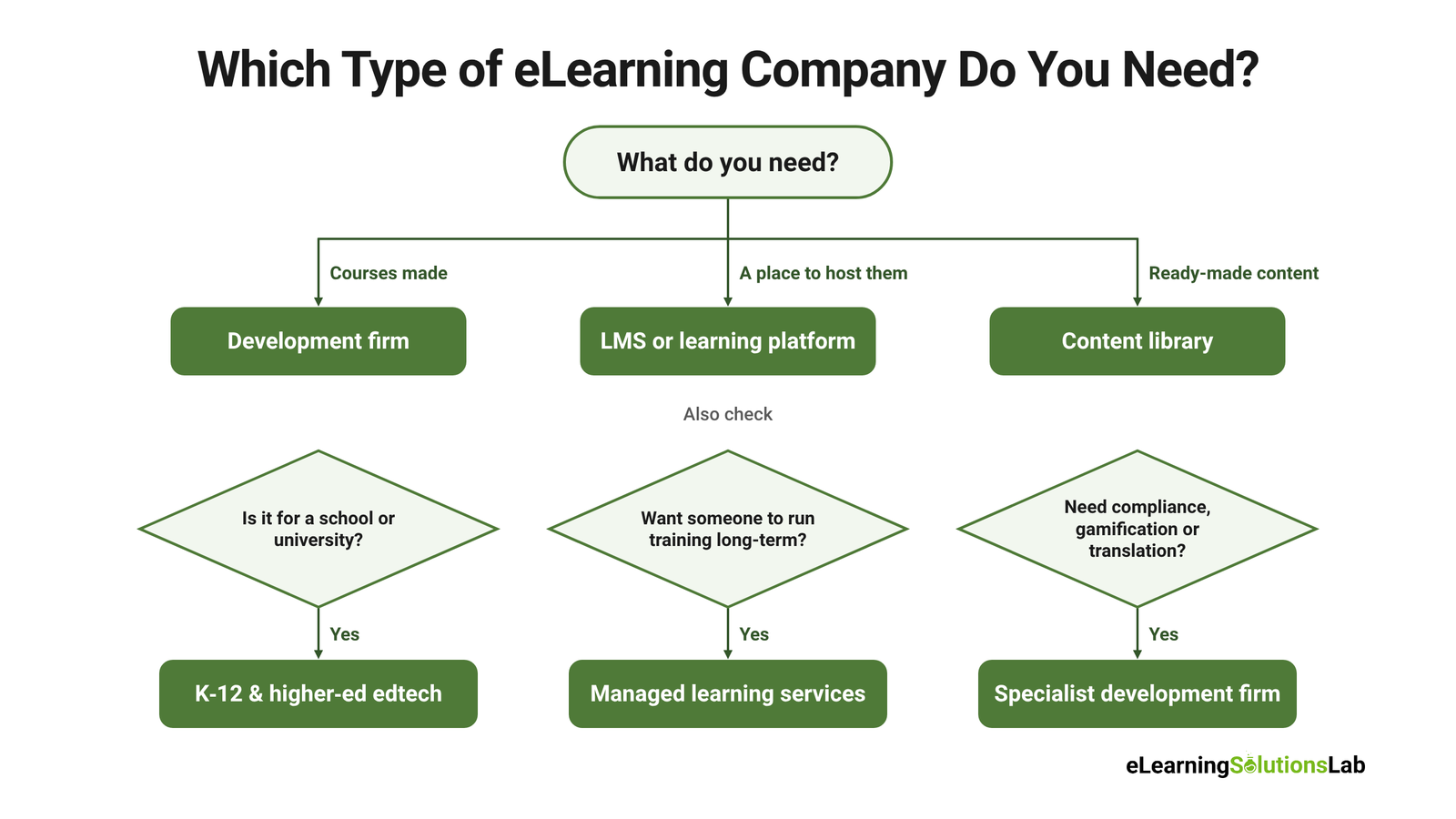
Choosing the right eLearning company boils down to two decisions: first the type of company, then the company itself.
Step 1: Pick the Right Type With 4 Questions
- Do you need courses made, a place to host them, or ready-made content?
- Courses made → development firm
- Place to host them → LMS or learning platform
- Ready-made content → content library
- Is this for a school, district, or university? If yes, start with K-12 and higher-ed edtech companies.
- Do you want someone to run training for you long-term? If yes, look at managed learning services.
- Does your project need a specialist? Compliance, gamification, or translation projects are worth a specialist firm, or a generalist with proven experience in that area or category.
If you need people rather than a company, our guide on how to hire eLearning designers compares freelancers, in-house hires, and development partners.
Step 2: Build a Shortlist of Three
You have to pick three companies from the matching category in this guide. Fewer than three gives you nothing to compare, but having more than three turns evaluation into a project of its own. You can use the scores and “watch out for” notes in each profile to narrow it down.
Step 3: Ask These Questions Before You Sign
For any eLearning company:
- Can we see live samples, a demo, or a free trial relevant to our industry?
- How exactly is pricing calculated, and what isn’t included?
- How long is the contract, and what are the exit terms?
- Which accessibility standard do you build or design to, and how do you test it?
- Do you support SCORM and xAPI, and will you test in our LMS?
- Who owns the content, source files, and data at the end of the contract?
- What are your support hours, and how much do they overlap with ours?
- Can we start with a pilot before committing to a larger contract?
Extra questions for development firms:
- How many revision rounds are included?
- Who will actually work on our project, and can we meet them?
- How do you work with our SMEs, and how much of their time will you need?
Extra questions for platforms and libraries:
- Is pricing per active user or per registered user?
- What are the implementation fees and the renewal price increases?
- How does it integrate with our HR system and SSO?
Step 4: Run a Pilot
Before you put yourself in a large commitment, start small: one short course from a development firm, a trial or limited rollout of a platform, or a one-department pilot of a content library. Having a pilot run shows how the working relationship runs. It also gives you a baseline for measuring eLearning ROI before you scale up.
Time Zones and Location
Where a company is based matters less than how its working hours overlap with yours. Many of the US, UK, and Australian teams work with providers in Asia and get overnight turnaround, as long as review windows are planned ahead. Our guide to choosing an eLearning development company Philippines partner covers what to check before you hire offshore.
You can ask every provider for how many overlap hours they offer and how quickly they reply to feedback.
If you’re actually based in Australia or want a local partner there, see our roundup of the best eLearning companies Australia has to offer.
Red Flags to Watch For
- Self-ranked lists with no method: if the author ranks itself first without showing how it scored, check the criteria, including ours.
- No pricing model at all: not even a range or how pricing is calculated.
- No live samples, demo, or trial: only screenshots and videos.
- Long lock-in contracts: with unclear exit terms or data ownership.
- Vague answers about who does the work: especially if your project could be passed to subcontractors.
What Practitioners Say
L&D practitioners in communities like Reddit (e.g., r/elearning) tend to give the same practical advice:
- Ask to see real work, given that many practitioners trust portfolios and pilots far more than sales decks.
- Budget for your own time, as SME availability and internal reviews delay projects more often than the provider does.
- Smaller firms can be more responsive, as several practitioners say they can get more senior attention from smaller studios than from large agencies, though large agencies handle scale better.
You can read one of these practitioner discussions in this r/elearning thread.
In one line
Pick the type of company first, shortlist three, ask for proof and pricing in writing, and start with a pilot.
Need courses built, not another shortlist?
At eLearning Solutions Lab, one team handles instructional design, development, localization, and QA, and delivers SCORM-ready courses at a fixed price with a fixed delivery date. Our custom eLearning development services start from $4,995.
Need somewhere to deliver and track it? Levantra LMS, our cloud based LMS, assigns courses by role or location, automates reminders, and reports on every completion.
See our custom eLearning development servicesBook a Levantra LMS demo
Related Reading
- Top eLearning vendors – agencies vs authoring platforms, compared.
- Top custom eLearning development companies – a closer look at build quality and services.
- Top eLearning content providers – ready-made course catalogs compared.
- eLearning outsourcing – how end-to-end outsourcing works and when it pays off.
- eLearning development costs – what actually drives a content quote.
The Author

Book A Discovery Call
Our Learning Advisors are happy to walk you through your project step-by-step — content, timeline, and fixed pricing.
Get Your Free QuoteNo obligation — just a focused conversation. Proposal within 24 hours.
You may also like
What is an eLearning Content Library? Types, Pricing, and How to Choose One
Short answer An eLearning content library is a collection of digital training…
How to Hire eLearning Designers in 2026: Costs, Hiring Models and Vetting Checklist
Short answer: Hire a freelancer for small, well-scoped tasks, a full-time…