

Short answer
Clinical eLearning is online education that teaches healthcare professionals the knowledge and skills they use in patient care.
It comes in four main formats: self-paced modules, simulations and virtual patients, video and microlearning, and blended learning. Research shows it works about as well as classroom teaching for knowledge, while hands-on skills still need in-person sign-off. The right provider depends on your accreditation needs, your specialties, and whether you need ready-made courses or content built around your own protocols.
Clinical staff needs training to help keep pace with changing guidelines, new equipment, and licensure requirements. But every hour in a classroom is actually an hour away from patients, coordinating schedules across shifts, units, and sites – all of which could become a constant strain on educators and budgets.
Clinical eLearning offers a way through, as it delivers clinical education online, so that your nurses, physicians, and allied health professionals can build and prove their competence without leaving the floor for so long.
In this guide, we help explain what clinical eLearning is, who uses it, and the exact formats it comes in. We also cover what the research says about its effectiveness, how accreditation works in the United States and abroad, and what to look for when comparing clinical eLearning providers.
Updated October 2026.
In This Article
- What is clinical eLearning?
- Who uses clinical eLearning?
- Types and formats of clinical eLearning
- Benefits and limitations of clinical eLearning
- Does clinical eLearning work? What the evidence says
- Accreditation and continuing education credit by region
- Off-the-shelf vs custom clinical eLearning
- How to choose a clinical eLearning provider
- Top clinical eLearning providers
- Pricing models and implementation
What is Clinical eLearning?
Clinical eLearning is online education that can teach healthcare professionals knowledge and skills they can use in patient care. It can cover topics such as clinical procedures, patient assessment, medication safety, and specialty practice, delivered through digital modules, videos, and simulations that staff complete on a computer or mobile device, often for continuing education credit.
It is one part of the wider field of healthcare elearning solutions, which also covers non-clinical training for hospital and health system staff.
How does it differ from other healthcare training?
Clinical eLearning is different from general compliance training, as compliance courses can cover organizational rules that apply to everyone in a facility, like privacy, fire safety, and workplace conduct. A compliance training plan covers how to organize that side of your program.
Clinical eLearning typically focuses on patient care itself: how to recognize sepsis, manage a central line, or interpret a cardiac rhythm, to name a few examples.
It also differs from classroom and bedside teaching, as those happen at a set time and place, with an instructor present. Clinical eLearning is truly available on demand, delivers the same content to every learner, and records completion and assessment results automatically. Our guide to on demand training explains how this model works in practice.
Most organizations use it alongside in-person teaching instead of merely replacing it, since hands-on skills still need to be practiced and signed off in person.
Who Uses Clinical eLearning?
Clinical eLearning is often marketed to nurses, but its users span most of the healthcare workforce, along with the people who manage their training.
Nurses and midwives
The largest group of users. Hospitals use it for orientation, annual competencies, and specialty areas such as critical care, emergency, and pediatrics. Nurses also use it to earn contact hours for license renewal.
Physicians and advanced practice providers
Physicians, nurse practitioners, and physician assistants use it to earn continuing medical education credit, keep up with guideline changes, and refresh procedures they perform infrequently.
Allied health and pharmacists
Respiratory therapists, physical therapists, radiographers, laboratory staff, and pharmacists get specialized content that is hard to justify teaching in person for a handful of staff.
Students and new graduates
Schools use it to teach theory before clinical placements. New graduates use it to bridge the gap between school and practice, often within a residency or preceptorship program.
Educators and administrators
They rarely take the courses themselves. They assign learning by role or unit, track completion, and pull reports that show regulators and accrediting bodies that staff are competent.
Types and Formats of Clinical eLearning
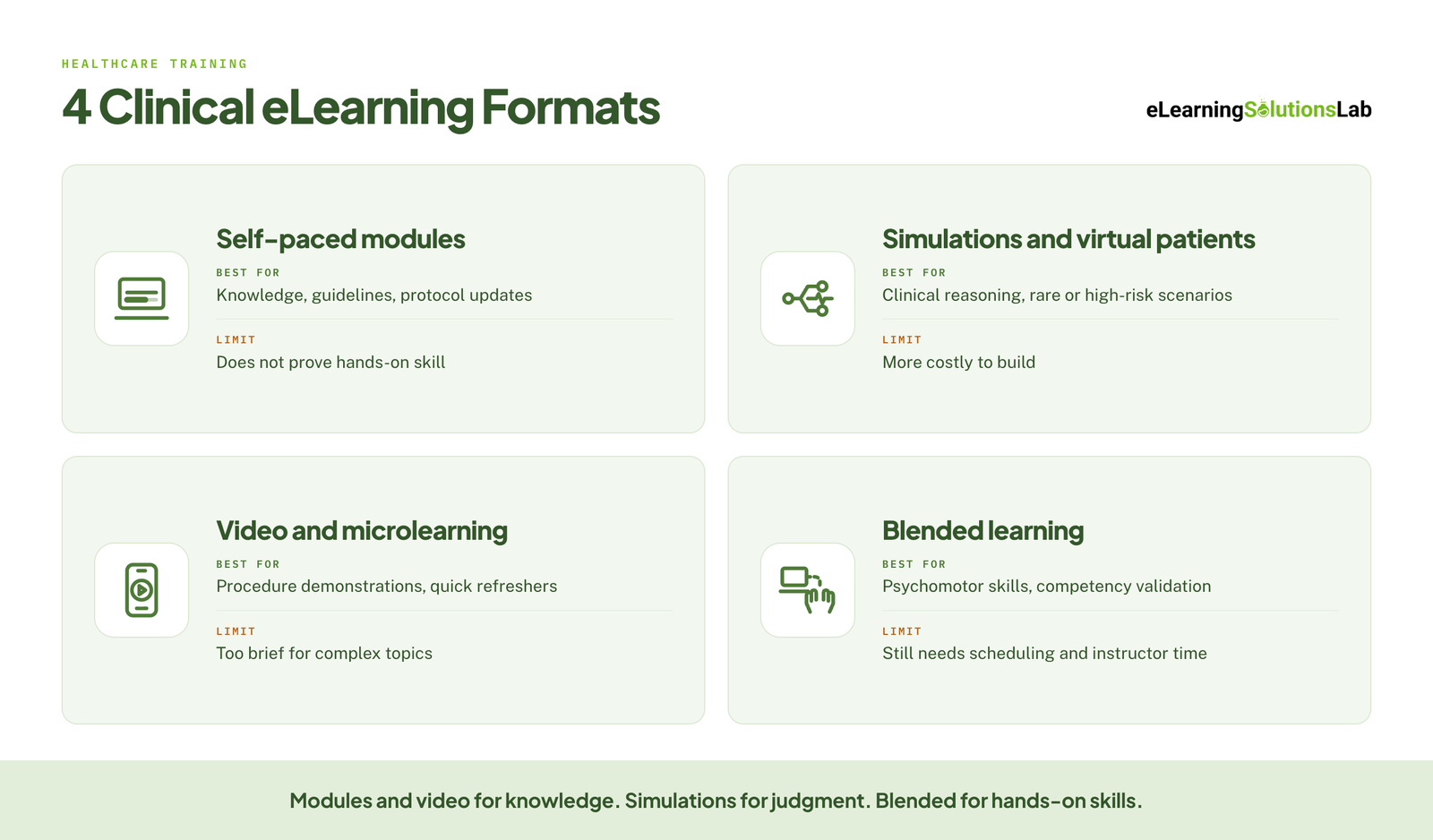
Clinical eLearning comes in several formats, and most of these programs combine more than one. So having the right mix depends on what is really being taught: facts and guidelines suit different formats than judgment or hands-on skills.
Self-paced Modules
Self-paced modules are probably the most common format, as your learners work through text, images, and narrated slides, then take a quiz at the end. They are also well suited to foundational knowledge like pathophysiology, pharmacology, and protocol updates, and they are easy to assign and track at scale.
Simulations and Virtual Patients
Simulations can place your learner in a realistic patient scenario and ask them to make decisions: what to assess, what to order, when to escalate. The case here unfolds based on their choices. And having this format can build clinical reasoning and let staff practice rare or high-risk situations without any danger to patients.
Our guide to elearning simulation covers how these are built, and scenario based elearning services can turn your own patient cases into branching scenarios.
Video and Microlearning
Short videos can demonstrate procedures and equipment step by step. And given that microlearning breaks content into lessons of a few minutes each, this is where staff can complete them between tasks or review just before performing a procedure.
If your current modules are too long for the floor, microlearning services can break them into short lessons, and mobile learning solutions can put them on the phones and tablets staff already carry.
Blended Learning
Blended learning can pair online theory with in-person practice, as your learners will complete the knowledge portion online, then demonstrate the skill in a lab or at the bedside with an instructor or preceptor. It is really a standard approach for any skill that requires hands-on validation.
If you’re comparing platforms that can schedule and track both halves, see our guide to blended learning software.
Comparing the Four Formats
| Format | Best for | Limits |
|---|---|---|
| Self-paced modules | Knowledge, guidelines, protocol updates | Passive if poorly designed; does not prove hands-on skill |
| Simulations and virtual patients | Clinical reasoning, rare or high-risk scenarios | More costly to build; fewer topics available off the shelf |
| Video and microlearning | Procedure demonstrations, quick refreshers | Too brief for complex topics |
| Blended learning | Psychomotor skills, competency validation | Still requires scheduling, space, and instructor time |
Simple rule of thumb: use self-paced modules and video for knowledge, simulations for judgment, and blended learning for anything a clinician has to do with their hands.
Benefits and Limitations of Clinical eLearning
Clinical eLearning can solve real problems for healthcare organizations, but it is not really a complete replacement for in-person teaching. Knowing both sides can help you decide better where it fits.
Benefits
- Flexibility – staff can learn on any shift, in short sessions, without waiting for a scheduled class. And this matters most for night and weekend staff, who are often underserved by classroom schedules.
- Consistency – every learner can receive the same content, regardless of site, unit, or instructor. And for health systems with multiple facilities, this can help support a single standard of practice.
- Tracking – completion, scores, and time spent are recorded automatically, so educators can see who is overdue, can spot topics where many learners struggle, and can help produce records for surveys and audits.
- Lower cost per learner – once a course is built or licensed, adding learners costs little. And many organizations also save on instructor hours, room bookings, travel, and backfill for staff that’s pulled off the floor. Our guide to elearning ROI shows how to put numbers on those savings.
- Faster updates – when a guideline changes, your online course can be revised and reassigned far sooner than a classroom program can be rescheduled. For urgent changes, rapid elearning services can shorten the turnaround further.
Limitations
- Hands-on skills still need in-person sign-off – a module can help teach the steps of inserting a catheter, but it cannot confirm that a nurse can do it. Psychomotor skills will require supervised practice and validation.
- Engagement depends on design – long, text-heavy modules will invite learners to click through without absorbing much, as completion does not always mean learning. See how to create effective elearning courses for the design principles that prevent this.
- Access is uneven – not every unit has enough computers or quiet space, and not every employer can provide protected time. When training spills into breaks or personal time, your learners’ completion and morale can both suffer.
- Less interaction – your learners cannot ask an instructor a question in the moment or learn from colleagues’ experiences, unless your program builds in discussion or debriefing.
Practical takeaway
You can use eLearning for knowledge, reasoning, and refreshers, and pair it with in-person practice wherever the skill has to be demonstrated.
Does Clinical eLearning Work? What the Evidence Says
Short answer: clinical eLearning works about as well as traditional teaching, but the research does not show that it works better.
Knowledge
In a 2018 Cochrane review of 16 randomized trials involving 5,679 licensed health professionals, it found that, compared with traditional learning, eLearning may make little or no difference to knowledge, based on 11 studies and low-certainty evidence. A meta-analysis of 11 trials in nurses and nursing students reached a similar conclusion that there is no statistical difference between eLearning and traditional learning.
Skills
The same Cochrane review judged it uncertain whether eLearning can actually improve or reduce skills, rating the evidence as very low certainty. This supports the common practice of pairing online theory with in-person skills validation.
Learner Satisfaction
Learners generally like it, as a 2022 systematic review of 42 studies in undergraduate clinical medicine found that every study measuring student reaction reported that most students were satisfied, and that results were best when courses were interactive, self-paced, and easy to access and use.
Where the Evidence Is Thin
- Patient outcomes – the Cochrane review found little or no difference in patient outcomes or in professionals’ behavior, and few studies measure these at all.
- Study quality – the 2022 review noted that most of its included studies lacked transparency and rigor.
- Long-term retention – follow-up beyond a few weeks or months is rare, so little is known about how long the learning lasts.
What This Means for Buyers
Equivalent results are still a strong case for clinical eLearning. If it teaches as well as a classroom while costing less and fitting around shifts, the practical advantages decide the question.
Be cautious, though, of any provider that claims its courses are proven to outperform in-person teaching or to improve patient outcomes. Ask to see the evidence, and ask how the course was designed, since the research points to interactivity and ease of use as the features that matter most.
Accreditation and Continuing Education Credit by Region
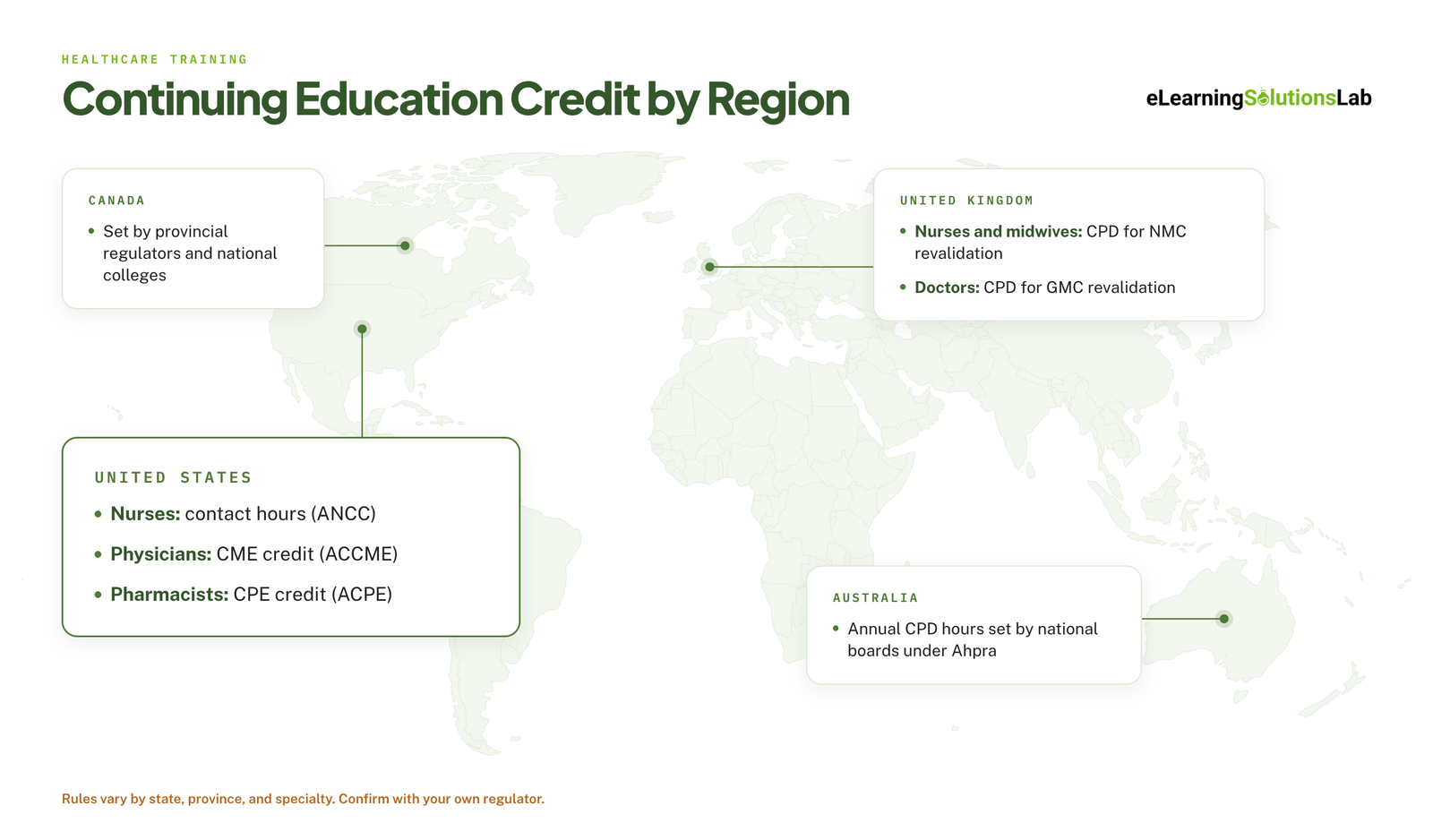
Many clinicians take clinical eLearning to earn the continuing education credit their license or registration requires. Credit is granted by accredited providers, and the rules differ by country and profession, so check this before you buy or build a course.
United States
- Nurses earn contact hours. The American Nurses Credentialing Center (ANCC) accredits providers of nursing continuing professional development, and some state boards of nursing approve providers directly. Renewal requirements are set state by state.
- Physicians earn continuing medical education credit, most often AMA PRA Category 1 Credit, from providers accredited through the Accreditation Council for Continuing Medical Education (ACCME) system.
- Pharmacists earn continuing pharmacy education credit from providers accredited by the Accreditation Council for Pharmacy Education (ACPE).
- Mixed teams can be served by a single course when the provider holds Joint Accreditation for Interprofessional Continuing Education, which covers several professions at once.
United Kingdom
The UK uses continuing professional development (CPD) tied to revalidation. Nurses and midwives revalidate with the Nursing and Midwifery Council every three years, which includes 35 hours of CPD, 20 of them participatory. Doctors record CPD as part of revalidation with the General Medical Council. Many UK courses also carry a certificate from an independent CPD certification body, which shows the course was reviewed but is separate from the regulator’s own requirements.
Other Regions
In Canada, requirements are set by provincial regulators and by national colleges for physicians. In Australia, the national boards under Ahpra set annual CPD hours for each profession. Elsewhere, the national regulator for each profession is the place to start.
| Region | Profession | Credit type | Who accredits or sets the rules |
|---|---|---|---|
| United States | Nurses | Contact hours | ANCC-accredited providers; state boards of nursing |
| United States | Physicians | CME credit | ACCME-accredited providers; state medical boards |
| United States | Pharmacists | CPE credit | ACPE-accredited providers; state boards of pharmacy |
| United Kingdom | Nurses and midwives | CPD hours for revalidation | Nursing and Midwifery Council |
| United Kingdom | Doctors | CPD for revalidation | General Medical Council; medical Royal Colleges |
| Canada | All professions | Varies by province and profession | Provincial regulators; national colleges for physicians |
| Australia | All professions | Annual CPD hours | National boards under Ahpra |
Requirements change and vary by state, province, and specialty. Confirm the current rules with your own board or regulator before relying on a course for renewal.
Two practical points follow from this. First, credit comes from the accredited provider, not from the course file, so a course your own team commissions can carry credit if your organization (or a partner) is an accredited provider and runs it through its approval process. Second, if your workforce spans countries, plan for elearning localization services early, because drug names, units, protocols, and credit rules all change across borders.
Off-the-Shelf vs Custom Clinical eLearning
Before you compare providers, decide which kind of clinical eLearning you need. There are two, and most hospitals end up using both.
Off-the-shelf courses are ready-made catalogues you license by seat or by course. They suit topics that are the same everywhere, such as basic rhythm interpretation or infection control principles, and they often come with continuing education credit attached. Our guide to off the shelf elearning covers when this route makes sense.
Custom courses are built around your own protocols, equipment, documentation system, and patient population. They suit anything where “how we do it here” matters: a new infusion pump rollout, your sepsis pathway, your escalation policy, or a unit-specific orientation. If the term is new to you, start with what is custom elearning content.
| Off-the-shelf | Custom | |
|---|---|---|
| Best for | Standard clinical topics, individual CE credit | Your protocols, equipment, and workflows |
| Time to launch | Immediate | Weeks, depending on length and format |
| Cost pattern | Recurring fee per seat or per course | One-time build; you own the course |
| Fit to your practice | Generic; may conflict with local policy | Exact |
| Updates | On the vendor’s schedule | On yours |
| CE credit | Often included | Arranged through your own accredited provider unit or a partner |
How to Choose a Clinical eLearning Provider
Most provider pages make the same three claims: flexible, accredited, and written by experts. These seven questions get past that.
1. Does the Accreditation Match Your Region and Profession?
Ask which body accredits the provider and for which professions. A UK CPD certificate does not give a US nurse contact hours, and nursing credit does not count as physician CME.
2. Who Writes and Reviews the Content?
Ask who the subject matter experts are, how clinical accuracy is reviewed, and how often courses are updated when guidelines change. For custom work, ask how the provider works with your own clinical experts and who signs off each stage.
3. Does It Cover Your Specialties and Roles?
Many catalogues are nursing-only. If you also need content for physicians, pharmacists, or allied health, check the catalogue in detail or plan to commission those courses.
4. Can It Report What Your Surveyors Ask For?
You need completion, scores, and competency records by person, role, and unit. Ask for a sample report before you sign.
5. Will It Work in Your Learning System?
Ask whether courses are supplied as SCORM or xAPI packages for your own LMS, or only inside the vendor’s platform. Our guides to SCORM compliance requirements and LMS integration explain what to check.
6. Can You See Sample Content?
Ask for a trial login or a demo course. Check whether it is interactive or a narrated slide deck, whether it works on the devices on your units, and whether it meets accessibility standards. Our accessible elearning guide has a checklist you can use.
7. Is the Pricing Clear?
Ask for the full cost over three years, including seats, platform fees, updates, and any charge for credit certificates. Few providers publish prices, so you will usually have to ask.
Top Clinical eLearning Providers
The providers below fall into two groups: a custom developer that builds clinical courses around your own practice, and catalogue providers that license ready-made courses. For a wider view of the market, see our lists of the top elearning content providers and top elearning vendors.
| Provider | Type | Audience | Region focus | Best for |
|---|---|---|---|---|
| 1. eLearning Solutions Lab | Custom development | Any clinical or healthcare role | Global | Courses built around your own protocols, equipment, and LMS |
| 2. Elsevier Clinical eLearning | Course catalogue | Nurses and other hospital staff | US and international | Nursing orientation and competency management |
| 3. Stryker focusRN | Vendor learning platform | Nurses | US | Nurse education with transcripts for licensure renewal |
| 4. eIntegrity | Course catalogue | Doctors and other clinicians | UK and international | Specialty content written with UK medical Royal Colleges |
| 5. LearnPac | Course catalogue | Health and social care staff | UK | CPD-accredited clinical courses with certificates |
| 6. Caring for Care | Course catalogue | Care and clinical staff | UK | Short CPD-accredited courses on core clinical topics |
Details are drawn from each provider’s public pages and can change. Confirm catalogue, accreditation, and pricing with the provider before you commit.
1. eLearning Solutions Lab
Top pick for custom clinical eLearning
Best for: Hospitals, health systems, clinical training companies, and medical device teams that need courses built around their own protocols, equipment, and learning system.
Type: Custom clinical eLearning development (design, development, and QA by one team).
Delivery: Published in the format your LMS needs, tested in your LMS, and checked on the devices your learners use.
eLearning Solutions Lab is our pick for organizations whose clinical training has to match the way they actually practice. Catalogue courses teach general principles well. They cannot teach your sepsis pathway, your infusion pump, your documentation screens, or your escalation policy, and that is the gap custom development fills.
What we build for clinical teams
- Self-paced clinical modules – protocol updates, pathophysiology and pharmacology refreshers, unit orientation, and annual competencies, written with your clinical experts and structured by our instructional designers. See our custom elearning development services.
- Branching patient scenarios – virtual patient cases where the learner decides what to assess, what to order, and when to escalate, and the case changes with each choice.
- Procedure and equipment microlearning – short, phone-friendly lessons staff can review just before a task.
- Online theory for blended programs – the knowledge portion of a skills course, paired with a checklist your preceptors use for in-person sign-off.
- Classroom and slide deck conversion – existing instructor-led sessions and PowerPoint in-services rebuilt as trackable courses through our ILT to elearning services and convert PowerPoint to elearning services.
- Translated and localized versions – for multilingual workforces and multi-country health systems.
How a clinical project runs
- Scope – you send your content (policies, slide decks, guidelines, recordings). We come back with a scope, a price, and a delivery date before you commit to anything.
- Design – our instructional design services turn the source material into learning objectives, a storyboard, and assessment questions tied to those objectives.
- Clinical review – your subject matter experts review and sign off the storyboard, so clinical accuracy stays under your control.
- Development – we build the course in the format agreed, with interactions, scenarios, and knowledge checks.
- QA and LMS testing – we test the published package in your LMS and on the devices your learners use, and confirm that completion and scores report correctly.
- Handover – you receive the finished course to host and reassign as often as you need.
Why it ranks first here
- It fits your practice. Learners are not told one thing online and another on the unit.
- It covers every role. Most catalogues are nursing-only. A custom build can serve physicians, pharmacists, allied health, and support staff from the same source content.
- It is designed for engagement. The research above points to interactivity and ease of use as the features linked to better results, and those are design decisions.
- You control updates. When a guideline changes, you decide when the course changes.
- The cost is known up front. You get a fixed scope and price before work starts, with no per-seat fee afterwards.
What to know before you choose us
We build courses. We do not sell a ready-made catalogue, and we are not a continuing education accreditor. If your learners need contact hours or CME credit for a custom course, it is awarded through your own accredited provider unit or an accredited partner, and we build to the documentation that process requires. If you only need standard topics with credit attached and want to start this week, a catalogue provider below will suit you better.
2. Elsevier Clinical eLearning
Elsevier’s catalogue of online nursing education covers orientation, competency management, and professional development, with hospital-wide courses and emergency nursing courses built with a nursing association. It suits hospitals that want a large ready-made nursing library from an established publisher.
3. Stryker focusRN
A nurse learning platform from a medical technology company, offering evidence-based content and transcripts nurses can use for licensure renewal. It suits US nurses and facilities that want supplementary education at low effort.
4. eIntegrity
Sells online courses written by clinical experts from UK medical Royal Colleges, priced per course. It suits individual clinicians and organizations that want specialty content with strong professional authorship, particularly for doctors.
5. LearnPac
A UK provider with a broad catalogue of CPD-accredited online clinical courses and certificates. It suits UK health and social care employers that need many short courses for revalidation and mandatory training.
6. Caring for Care
A UK training provider offering CPD-accredited online clinical courses on topics such as infection control, medication management, and clinical observations. It suits care providers that need a small set of core clinical topics.
Pricing Models and Implementation
How Clinical eLearning Is Priced
| Model | How it works | Suits |
|---|---|---|
| Per course | One learner buys one course | Individual clinicians, small teams |
| Per seat | Annual fee per learner for a catalogue or bundle | Departments and mid-sized facilities |
| Enterprise license | Negotiated fee for a whole hospital or system | Large organizations with stable headcount |
| Custom build | One-time project fee based on length, interactivity, and media | Organization-specific content you will reuse for years |
For custom work, length and interactivity drive the price: a branching patient scenario costs more to build than a narrated module of the same duration. Our breakdown of elearning development costs explains the factors in detail.
How It Connects to Your Learning System
Clinical eLearning reaches staff in one of two ways. Catalogue vendors often host courses on their own platform and pass completions back to your system. Custom courses, and some catalogue courses, are supplied as SCORM or xAPI packages you load into your own LMS. Either way, check three things: single sign-on, so staff do not need another password; automatic assignment by role and unit; and completion data that lands in the record your surveyors will ask to see.
If you don’t have a learning system yet, do I need an LMS walks through the decision, and our guide to elearning delivery compares the channels side by side.
Typical Rollout Steps
- Map requirements – list the competencies each role needs and which ones carry credit or regulatory deadlines.
- Sort topics – decide which are standard (license a course) and which are specific to you (build one).
- Pilot on one unit – test access on that unit’s devices and on night shift, and collect feedback from learners and the unit educator.
- Agree protected time – settle with managers when staff will complete training, so it does not spill into breaks.
- Pair with skills sign-off – schedule in-person validation for anything hands-on.
- Launch and report – assign by role, send reminders, and review completion and assessment data monthly.
Need clinical courses built around your own protocols?
At eLearning Solutions Lab, we turn your policies, guidelines, and in-service decks into clinical eLearning your staff can complete on any shift – reviewed by your clinical experts, tested in your LMS, and checked on the devices your units use. Design, development, and QA are handled by one team. Send us your content and we’ll come back with a scope, a price, and a delivery date before you commit to anything.
Related Reading
- Healthcare elearning solutions – training options across clinical and non-clinical healthcare roles.
- Elearning simulation – how simulations and virtual scenarios are designed and built.
- Top blended elearning solutions – options for pairing online theory with in-person practice.
- Off the shelf elearning – when ready-made courses are the better choice.
- Top compliance elearning providers – for the mandatory, non-clinical side of healthcare training.
- Elearning ROI – proving the business value of your training.
The Author

Book A Discovery Call
Our Learning Advisors are happy to walk you through your project step-by-step — content, timeline, and fixed pricing.
Get Your Free QuoteNo obligation — just a focused conversation. Proposal within 24 hours.
You may also like
LMS Requirements Checklist: What to Include, How to Weight It, How to Verify It and
Having a useful LMS requirements checklist does three things: it ranks what…
Employee Onboarding and Training: A Practical Guide (+ Free 90-Day Plan)
A new hire's first week usually sets the tone for everything that follows. And…