


- Published
- Reading time
- 8 min
Filed under Instructional DesignL&D Strategy
You’ve probably heard someone say a new tool “has a steep learning curve”. But what does that actually mean, and why do some people say a steep curve is a good thing? The phrase is used in everyday speech, in business, in training and in machine learning, and it really means slightly different things in each.
In this guide, you’ll get a plain definition, a clear answer to the “steep vs. easy” confusion, the main types of learning curves, the formula with a worked example (and a calculator), and practical ways to speed up learning for your own team.
Short on time? Jump to what a “steep learning curve” really means.
Updated November 2026.
In This Article
What is a Learning Curve?
A learning curve shows how performance improves with practice or experience. On a graph, the horizontal axis is usually time, attempts or units produced, and the vertical axis is skill, accuracy or speed (or, in business, the cost or time per unit). In everyday speech, “learning curve” simply means how long it takes to get good at something new.
In practice, the term shows up in four main places:
- Everyday speech – how hard or slow something is to learn, like a new app or job.
- Training and education – how quickly learners reach proficiency, and what helps them get there faster.
- Business and manufacturing – how the time or cost per unit falls as a team produces more.
- Machine learning – how a model’s performance changes as it gets more training data or training time.
The idea is the same in all four: the more you practice, the better you usually get. But the shape of the curve, and what “steep” means, can really change depending on who’s talking.
Steep vs. Shallow Learning Curve: What It Really Means
This is the part that confuses almost everyone, and it’s one of the most common questions people ask about the term. So here’s the short version:
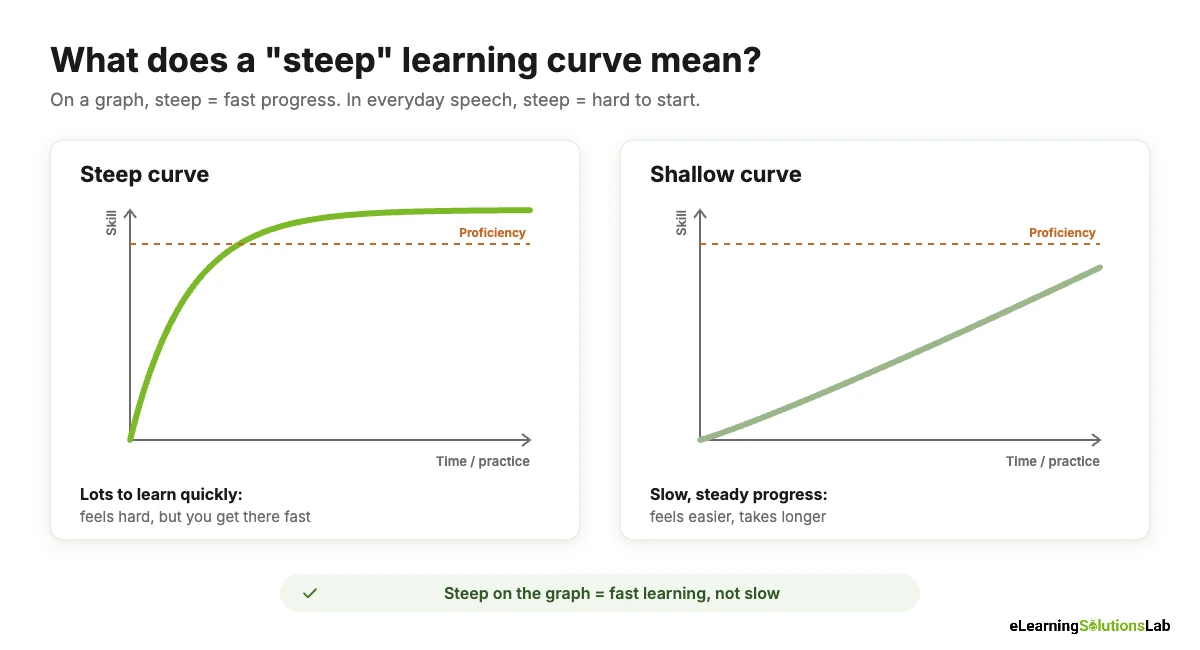
- On a graph, a steep learning curve means skill goes up quickly. You learn a lot in a short time.
- In everyday speech, “a steep learning curve” usually means something is hard to learn at first, because there’s a lot to take in quickly.
So both are actually true at once. A steep curve means you have to learn a lot, fast. That feels hard, given that it takes a lot of effort up front, even though on paper it’s “fast” learning. A shallow (or gentle) curve means progress is slower and steadier, which usually feels easier day to day but takes longer to reach full skill.
| Phrase | What people usually mean | What the graph shows |
|---|---|---|
| Steep learning curve | Hard to get started; lots to learn quickly | Fast progress in a short time |
| Shallow or gentle learning curve | Easy to pick up | Slow, steady progress |
| Long learning curve | Takes a long time to master | Proficiency is reached far along the x-axis |
| Flattening learning curve | You’re getting close to mastery | Gains per attempt are getting smaller |
Tip: when you write about software or onboarding, “takes a lot of effort to learn” or “quick to learn” is usually clearer than “steep” or “shallow,” so that no one misreads you.
Types of Learning Curves
They can take different shapes, depending on the task and the learner. These are the four you’ll see most often:

1. Diminishing returns (negatively accelerating)
Fast progress at the start, then gains get smaller. This is the most common shape. For instance, a new hire learns the basics of a CRM in a few days, then spends weeks polishing the details.
2. Increasing returns (positively accelerating)
Slow at first, then progress speeds up once the foundations click. You typically see this with complex skills like coding, a language or financial modeling.
3. S-curve
A slow start, a fast middle and a plateau at the end. It really combines the two shapes above, and it’s a good model for most job skills and new technologies.
4. Plateau
Progress stalls for a while, even with practice. Plateaus are normal, but they usually mean the learner needs new feedback, a new challenge or a different approach to move forward.
Short History of the Learning Curve
- 1885 – Hermann Ebbinghaus. The German psychologist studied how he learned and forgot lists of nonsense syllables, and described how memory improves with repetition. His work is usually credited as the first description of a learning curve (and of the “forgetting curve”).
- 1936 – Theodore Paul Wright. An aircraft engineer, Wright noticed that each time the number of airplanes built doubled, the labor time per plane fell by a steady percentage. His 1936 paper, “Factors Affecting the Cost of Airplanes,” gave us the learning curve formula businesses still use.
- 1960s – the experience curve. The Boston Consulting Group extended Wright’s idea to total costs across a whole company, which became a core idea in business strategy.
- Today. The term is used everywhere, from onboarding plans to machine learning dashboards.
Learning Curve vs. Forgetting Curve vs. Experience Curve
These three terms often get mixed up, but they genuinely describe different things:
| Term | What it shows | Typical use |
|---|---|---|
| Learning curve | Performance improving with practice or experience | Training, onboarding, manufacturing, machine learning |
| Forgetting curve | Memory fading over time without review | Planning spaced practice and refreshers |
| Experience curve | Total cost per unit falling as a company’s cumulative output grows | Pricing and business strategy |
In training, the two that truly matter are the first two. You want people to climb the learning curve quickly, and you want to stop the forgetting curve from pulling them back down, so that the skill actually sticks.
Learning Curve Formula (With a Worked Example)
Wright’s learning curve formula estimates the time (or cost) of any unit based on the first one:
Y = a × Xb
Y = time or cost of unit X · a = time or cost of the first unit · X = unit number · b = log(learning rate) ÷ log(2)
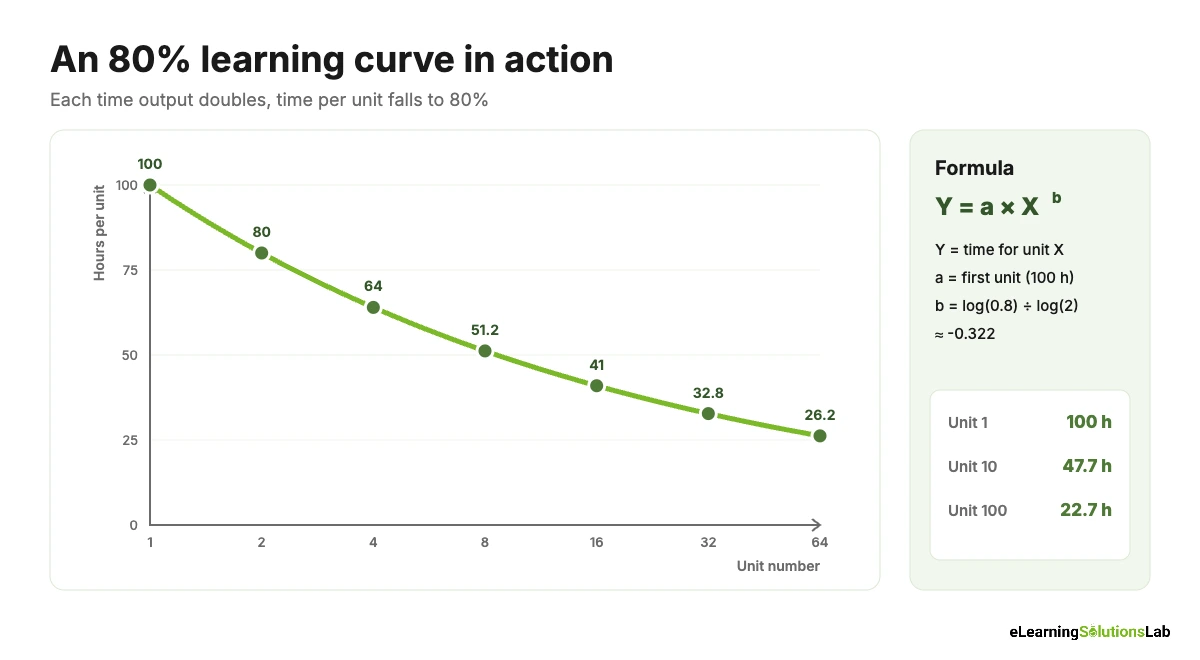
The learning rate is the percentage of time that remains each time output doubles. An 80% learning curve means that every time you double the number of units, the time per unit falls to 80% of what it was. For an 80% curve, b = log(0.8) ÷ log(2) ≈ -0.322.
Worked example: an 80% learning curve
Say the first unit takes 100 hours. Here’s what the formula predicts:
| Unit number | Time for that unit | Saving vs. unit 1 |
|---|---|---|
| 1 | 100 hours | – |
| 2 | 80 hours | 20% |
| 4 | 64 hours | 36% |
| 8 | 51.2 hours | 49% |
| 16 | 41 hours | 59% |
| 32 | 32.8 hours | 67% |
| 100 | 22.7 hours | 77% |
You can see the diminishing returns: the first doubling saves 20 hours, but going from unit 16 to unit 32 saves only about 8. That’s really useful for planning, given that it tells you when extra practice (or production) stops paying off as much.
Learning curve calculator
You can try your own numbers here:
Note: the formula is a model, not a promise. Real-world curves usually bounce around, and they flatten when a process is redesigned or the team changes.
Where Learning Curves Are Used
Training and L&D
In workplace training, the learning curve is really about time to proficiency: how long it takes a new hire or a team to perform a task to standard. Shortening it means people add value sooner. For instance, if good onboarding gets new support agents to target call quality in 6 weeks instead of 8, that’s two weeks of extra productivity per hire.
Business and manufacturing
Companies use learning curves to estimate future costs, set prices and plan staffing. If you know your learning rate, you can predict what the 100th unit will cost before you’ve built the 10th.
Machine learning
In machine learning, a learning curve plots a model’s performance (like accuracy or error) against the amount of training data or training time. Comparing the training and validation curves helps you spot problems. A big gap between them usually points to overfitting, and two curves that both stay poor usually point to underfitting.
Software, apps and games
Product teams talk about how hard a tool is to learn, meaning how quickly new users get value from it. Games deliberately design a learning curve, introducing one skill at a time so that players stay challenged but not overwhelmed.
How to Shorten the Learning Curve
You can’t skip it entirely, but you can usually make the climb shorter and less painful. Here’s what actually works in workplace training:

1. Start with the 20% that matters most
Teach the few tasks people do every day first, and leave edge cases for later. A short needs analysis usually shows you what those are.
2. Break it into small steps
Short, focused lessons are easier to absorb and revisit. Our microlearning examples show what this looks like in practice.
3. Practice on realistic tasks
People learn faster when they practice real decisions, not just read about them. Scenario-based eLearning is a great way to do this safely.
4. Give fast, specific feedback
The sooner people know what they did wrong, the sooner they fix it. Quizzes with explained answers, peer review and coaching all help.
5. Space it out and repeat
Spacing practice over days or weeks, instead of cramming, helps people remember. That’s Ebbinghaus’s forgetting curve working in your favor.
6. Support people on the job
Job aids, checklists and quick-reference guides mean people don’t have to remember everything on day one.
To give you a concrete example, at eLearning Solutions Lab, we don’t simply turn a manual into slides. We map the tasks new hires actually do in their first weeks, then build short practice scenarios around them, so that people can reach proficiency faster. You can also see our guides on employee onboarding and training and learning models for more ideas.
And if you want to prove the curve really got shorter, track time to proficiency before and after the change. The Kirkpatrick model of evaluation and our eLearning ROI guide can help you measure it.
“Learning Curve” in a Sentence (and Curb vs. Curve)
Is it “learning curb” or “learning curve”? It’s always learning curve. The phrase comes from the curved line on a graph. “Learning curb” is a common mishearing, but it isn’t correct.
Here are a few examples of how the phrase is typically used:
- “The new LMS has a steep learning curve, so we’re running short training sessions in the first week.”
- “There’s a learning curve with any new role, so be patient with yourself.”
- “Our goal is to shorten the learning curve for new sales reps from three months to six weeks.”
- “The model’s learning curve flattened after 10,000 examples, so more data won’t help much.”
In one line: a learning curve shows how performance improves with practice. On a graph, steep means fast progress, in everyday speech it means hard to start, and in your training programs, the goal is simply to get people to proficiency faster.
Want to shorten your team’s learning curve?
At eLearning Solutions Lab, we design training that gets people to proficiency faster, with short lessons, realistic practice and on-the-job support.
Our custom eLearning development services build the courses, and our instructional design services make sure every module supports a real performance goal.
Explore custom eLearning developmentSee our instructional design services
Related Reading
- Employee onboarding and training – where shortening the learning curve pays off most.
- Microlearning examples – small steps that speed up learning.
- Scenario-based eLearning – realistic practice for faster proficiency.
- Learning models – the theory behind how people learn.
- AI in eLearning – using AI to build training faster.
- eLearning ROI – putting a number on faster proficiency.
The Author

Book A Discovery Call
Our Learning Advisors are happy to walk you through your project step-by-step — content, timeline, and fixed pricing.
Get Your Free QuoteNo obligation — just a focused conversation. Proposal within 24 hours.
You may also like
The Four Stages of Competence: Examples and How Training Moves People Forward
Think back to learning to drive. At first, you didn't know how much you didn't…
Learning Paths: Types, Examples and How to Build One People Finish
Give a new employee access to a library of 200 courses and say "take what you…