


- Published
- Reading time
- 7 min
Filed under Corporate TrainingInstructional Design
Someone asks for training. Sales numbers are down, customer complaints are up, or a new system is rolling out, and the request is simple: “Can we get a course on this?” But building the course first and asking questions later is usually how organizations end up with training that nobody needed and problems that never got fixed.
That’s what a training needs assessment is for. Here’s a practical guide: what a TNA is, the three levels it looks at, the methods you can use, a step-by-step process, a worked example, and the mistakes that tend to derail it. You can also download a free training needs assessment template, no email needed.
Short on time? Jump to the definition, see the 7 steps or download the template.
Updated November 2026.
In This Article
What is a Training Needs Assessment?
A training needs assessment (TNA) is a structured process for finding the gap between how people are performing now and how they need to perform, working out why that gap exists, and deciding whether training (or something else) is the right way to close it.
A few quick answers to common questions:
- Is a TNA the same as a training needs analysis? In practice, the terms are used interchangeably. Some people use “assessment” for collecting the data and “analysis” for interpreting it, but most organizations treat them as one process.
- How is it different from a skills gap analysis? A skills gap analysis compares the skills people have with the skills they need. A TNA usually goes further, asking why the gap exists and whether training will fix it.
- Who does it? Typically L&D, HR or an instructional designer, working closely with managers and the people doing the job.
Why a Training Needs Assessment Matters
Not every performance problem is a training problem. People may already know what to do but lack the time, tools, clear expectations or incentives to do it. And no course will truly fix a broken process or an unclear policy.
A good TNA helps you:
- Avoid wasted training – no more courses on things people already know.
- Fix the real problem – including the non-training causes.
- Focus the budget – on the gaps with the biggest business impact.
- Set a baseline – so that you can actually measure whether training worked.
- Get buy-in – managers support training they helped define.
Three Levels of a Training Needs Assessment
A classic way to structure a TNA is to look at three levels, each answering a different question:
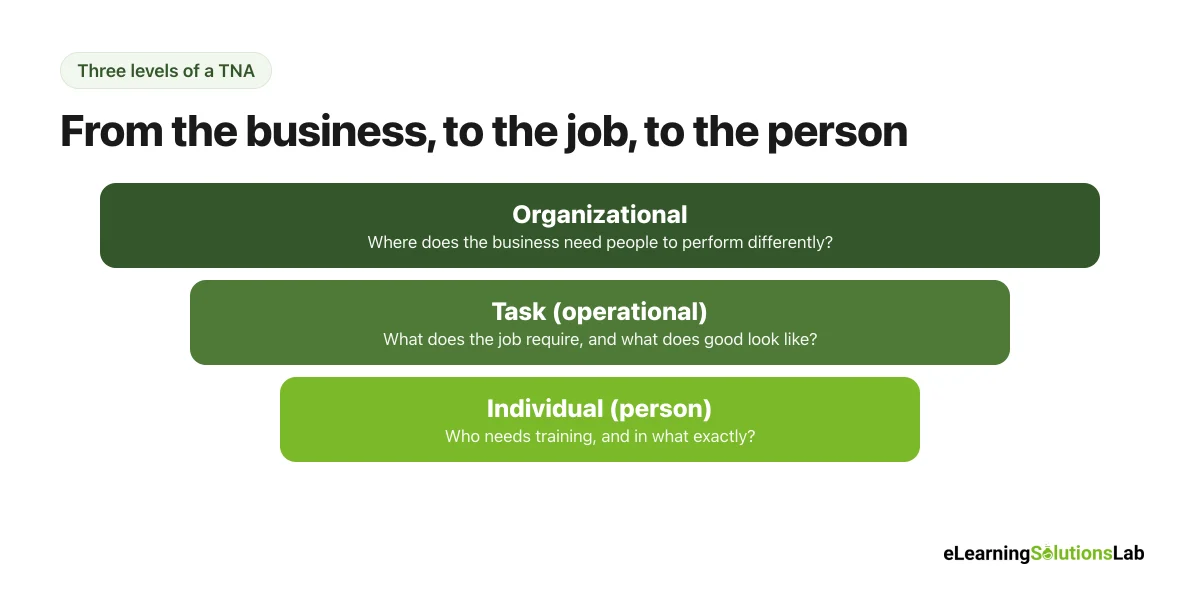
| Level | The question it answers | Typical inputs |
|---|---|---|
| Organizational | Where does the business need people to perform differently, and is training a priority? | Strategy, goals, KPIs, leadership interviews |
| Task (operational) | What does the job require, and what does good performance look like? | Job descriptions, SOPs, expert interviews, observation |
| Individual (person) | Who needs training, and in what exactly? | Performance reviews, assessments, manager input, self-ratings |
You don’t always need all three. For instance, if a single team is struggling with one new system, a task and individual analysis is usually enough. But for a company-wide program, starting at the organizational level keeps the training tied to what the business genuinely needs.
How to Conduct a Training Needs Assessment (7 Steps)
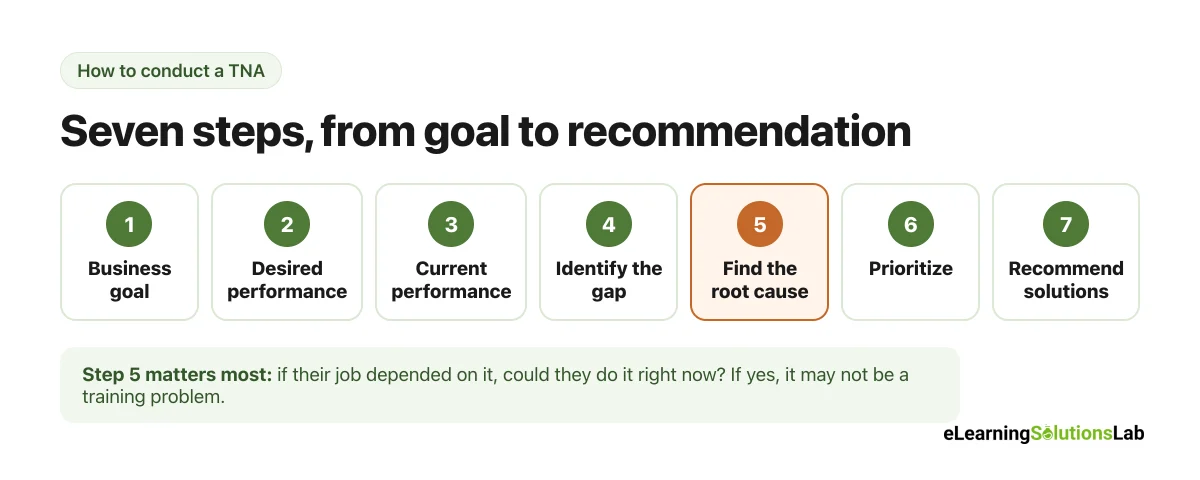
- Start with the business goal. What result needs to change? For instance, fewer onboarding errors, faster ticket resolution, or higher customer satisfaction. Put a number on it if you can.
- Define the desired performance. What do people need to do, on the job, to achieve that goal? Be specific and observable.
- Measure current performance. Use data, observation and conversations to see what people are doing today.
- Identify the gap. Compare the two. Where exactly is the difference, and how big is it?
- Find the root cause. Is it a lack of knowledge or skill? Or is it motivation, tools, process, time or unclear expectations? Only the first is a training problem.
- Prioritize. Rank the gaps by business impact and urgency, and pick the few that matter most.
- Recommend solutions. Training for the skill and knowledge gaps, and other fixes, like job aids, process changes or coaching, for the rest. Then agree how you’ll measure success.
Step 5 is the one most teams skip, and it’s really the most valuable. A simple test helps: if the person’s job depended on it, could they do it right now? If yes, the problem probably isn’t a lack of training.
Data Collection Methods
You have to collect evidence, not just opinions. Here are the most common methods and when each one works best:
| Method | Best for | Watch out for |
|---|---|---|
| Performance data and KPIs | Finding where the gap is and how big | Shows what is wrong, not why |
| Interviews | Understanding causes and context | Time-consuming; keep them structured |
| Surveys | Reaching many people quickly | Self-ratings can be unreliable |
| Observation | Seeing how work is really done | People may act differently when watched |
| Focus groups | Exploring shared problems | Louder voices can dominate |
| Skills assessments and tests | Measuring knowledge and skill directly | Must reflect the real job |
| Document review | Checking SOPs, policies and past reports | Documents can be out of date |
In practice, the strongest TNAs combine at least two or three methods, for instance performance data to find where the gap is, then interviews or observation to understand why.
A Worked Example
Here’s how a TNA might look for a customer support team:
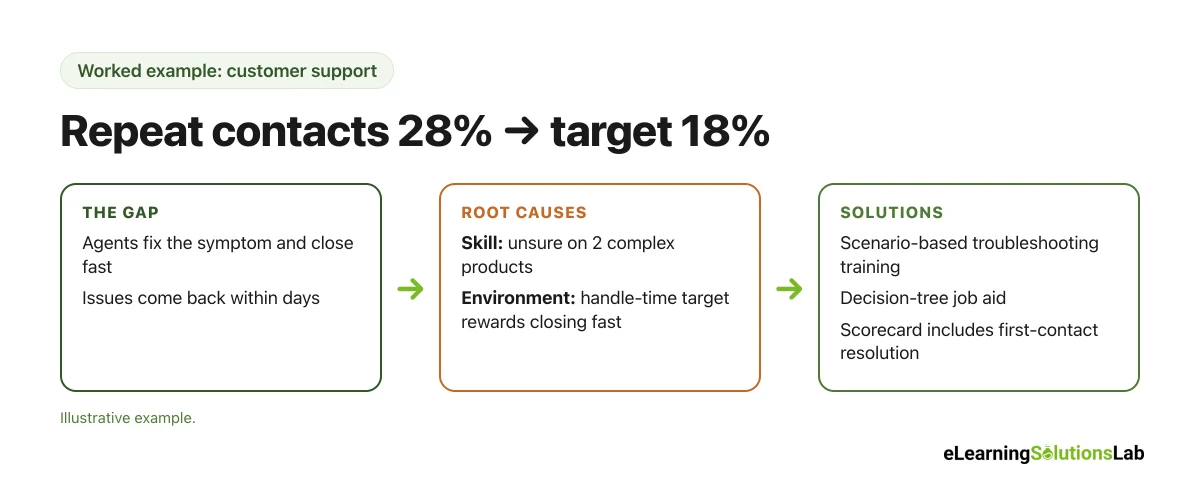
- Business goal: reduce repeat contacts (customers calling back about the same issue) from 28% to 18% in six months.
- Desired performance: agents diagnose the root issue on the first call and confirm the fix before closing.
- Current performance: call reviews show agents often fix the symptom and close quickly, given that their main metric is average handle time.
- Root causes: partly skill (agents aren’t confident with troubleshooting steps for two complex products), partly environment (the handle-time target rewards closing fast).
- Recommendations: scenario-based troubleshooting training for the two products, a decision-tree job aid, and a change to the team scorecard so that first-contact resolution counts alongside handle time.
So the result isn’t just “a course”. It’s a course plus a job aid plus a metric change, and that combination is far more likely to actually move the number.
This is an illustrative example, not client data.
Training Needs Assessment Questions to Ask
Good questions make or break a needs assessment. Here are questions you can actually use in interviews and surveys:
- For managers: What does great performance look like in this role? Where do people most often fall short? What happens when they do? What have you already tried?
- For employees: Which tasks feel hardest or take longest? Where do you get stuck or need to ask for help? What would make your job easier?
- For top performers: What do you do differently from others? What do you wish you’d known in your first month?
- For everyone: Is this a skills problem, or is something else, like tools, time or unclear goals, getting in the way?
That last question really matters. If the gap isn’t about skills, training won’t close it. For mapping skills across a team, see our guide to skills mapping.
Common Training Needs Assessment Mistakes
- Starting with the solution. “We need a course on X” before anyone has looked at the problem.
- Only asking people what training they want. Surveys of preferences tell you what’s popular, not what’s needed.
- Skipping the root cause. Treating every gap as a skills gap.
- No baseline. Without a starting number, you can’t show that training worked.
- Making it too big. A TNA doesn’t need to take months. For a single program, a few days of focused work is often enough.
To give you a concrete example, at eLearning Solutions Lab, we don’t simply take a training request at face value. Before we design anything, we run a short needs assessment with the client: a look at the performance data, a few conversations with managers and frontline staff, and a quick root-cause check. Usually it confirms part of the request, reshapes the rest, and occasionally saves the client from building a course they didn’t need at all.
Free Training Needs Assessment Template (PDF)
Free download – no email needed
Training Needs Assessment Template
A printable PDF that follows the 7 steps: business goal, desired vs. current performance, gap and root cause, priority scoring, recommended solutions and success measures, plus interview questions to use with managers and staff.
In one line: a training needs assessment finds the gap between current and desired performance, works out why it exists, and makes sure you only build training for the problems training can actually solve.
Not sure what training your team really needs?
At eLearning Solutions Lab, we run needs assessments before we design, so that every course we build is aimed at a real gap with a real business result.
See our eLearning consulting and instructional design services.
Related Reading
- Skills mapping – map the skills you have against the skills you need.
- Skills matrix template – see gaps by person and team.
- The ADDIE model – where the analysis phase fits.
- Learning and development (L&D) – building an L&D strategy.
- The Kirkpatrick model – measuring whether training worked.
The Author

Book A Discovery Call
Our Learning Advisors are happy to walk you through your project step-by-step — content, timeline, and fixed pricing.
Get Your Free QuoteNo obligation — just a focused conversation. Proposal within 24 hours.
You may also like
The Four Stages of Competence: Examples and How Training Moves People Forward
Think back to learning to drive. At first, you didn't know how much you didn't…
Learning Paths: Types, Examples and How to Build One People Finish
Give a new employee access to a library of 200 courses and say "take what you…