

Only 12% of employees strongly agree that their company does a great job of onboarding new hires. That’s according to Gallup, and the cost shows up fast: new hires who feel lost in their first weeks are the ones most likely to leave before day 90.
And the fix usually isn’t a bigger budget. It’s a clear plan that says what happens before, during, and after day one, and who owns each step.
In this guide, we share a new hire checklist that covers the full journey, from offer acceptance to the 90-day review. Each task has an owner and a deadline, so nothing falls through the cracks between HR, IT, and the hiring manager. It also covers hiring outside the US, with paperwork for the UK, Canada, Australia, the EU, and India, plus remote and international hires.
Short on time? Grab the free new hire checklist template.
Updated November 2026.
In This Article
- What is a new hire checklist?
- Why a new hire checklist matters
- Pre-boarding checklist (offer accepted → day 1)
- First day checklist
- First week checklist
- 30-60-90 day checklist
- New hire paperwork by country
- Onboarding remote and international hires
- New hire checklist by role
- Free new hire checklist template
What is a New Hire Checklist?
A new hire checklist is a step-by-step list of the tasks HR, the hiring manager, IT, and the new employee need to complete from the moment an offer is accepted until the end of the first 90 days. It keeps onboarding consistent, compliant, and on schedule.
Think of it as a shared to-do list for one person’s first three months. Instead of relying on memory or scattered emails, everyone involved can see what’s done, what’s next, and who’s responsible. It’s the backbone of good employee onboarding and training, because it turns good intentions into dated, owned tasks.
Here’s the whole process at a glance:
Before day 1 (pre-boarding)
- Collect signed contracts and tax and identity forms
- Order equipment and create system accounts
- Send a welcome email with first-day details
- Assign a buddy or mentor
Day 1
- Welcome the new hire and introduce the team
- Confirm laptop, logins, and tool access
- Review key policies and the employee handbook
- Hold a first 1:1 with the manager
Week 1
- Complete role-specific and compliance training
- Meet key stakeholders
- Assign a first small, achievable task
- Set a regular 1:1 schedule
Days 30, 60, and 90
- Set and review goals at each milestone
- Hold structured check-ins
- Run the 90-day review and collect onboarding feedback
Download the free new hire checklist template →
Why a New Hire Checklist Matters
A checklist can look like admin overhead. In practice, it protects you from the most common and costly onboarding failures.
1. It keeps you compliant. Missing a deadline for a Form I-9, a right-to-work check, or a tax declaration can lead to fines and legal exposure. A checklist with due dates makes sure required paperwork is done on time, every time.
2. It gives every hire the same experience. Without a standard process, onboarding quality depends on which manager someone reports to or which office they join. A new hire checklist sets a consistent baseline across teams and locations.
3. It gets people productive faster. When the laptop, logins, and first-week plan are ready before day one, new hires spend their first days learning the role, not waiting on your IT team.
4. It improves retention. First impressions shape whether people stay. Gallup found that employees with an exceptional onboarding experience are 2.6 times as likely to be extremely satisfied with their workplace.
5. It makes ownership clear. Onboarding involves HR, IT, the manager, and the new hire. Assigning an owner to every task stops things from falling through the cracks.
6. It supports the long game. New employees typically take around 12 months to reach their full performance potential. A structured 90-day plan gets that ramp-up started on the right foot.
Pre-Boarding Checklist (Offer Accepted → Day 1)
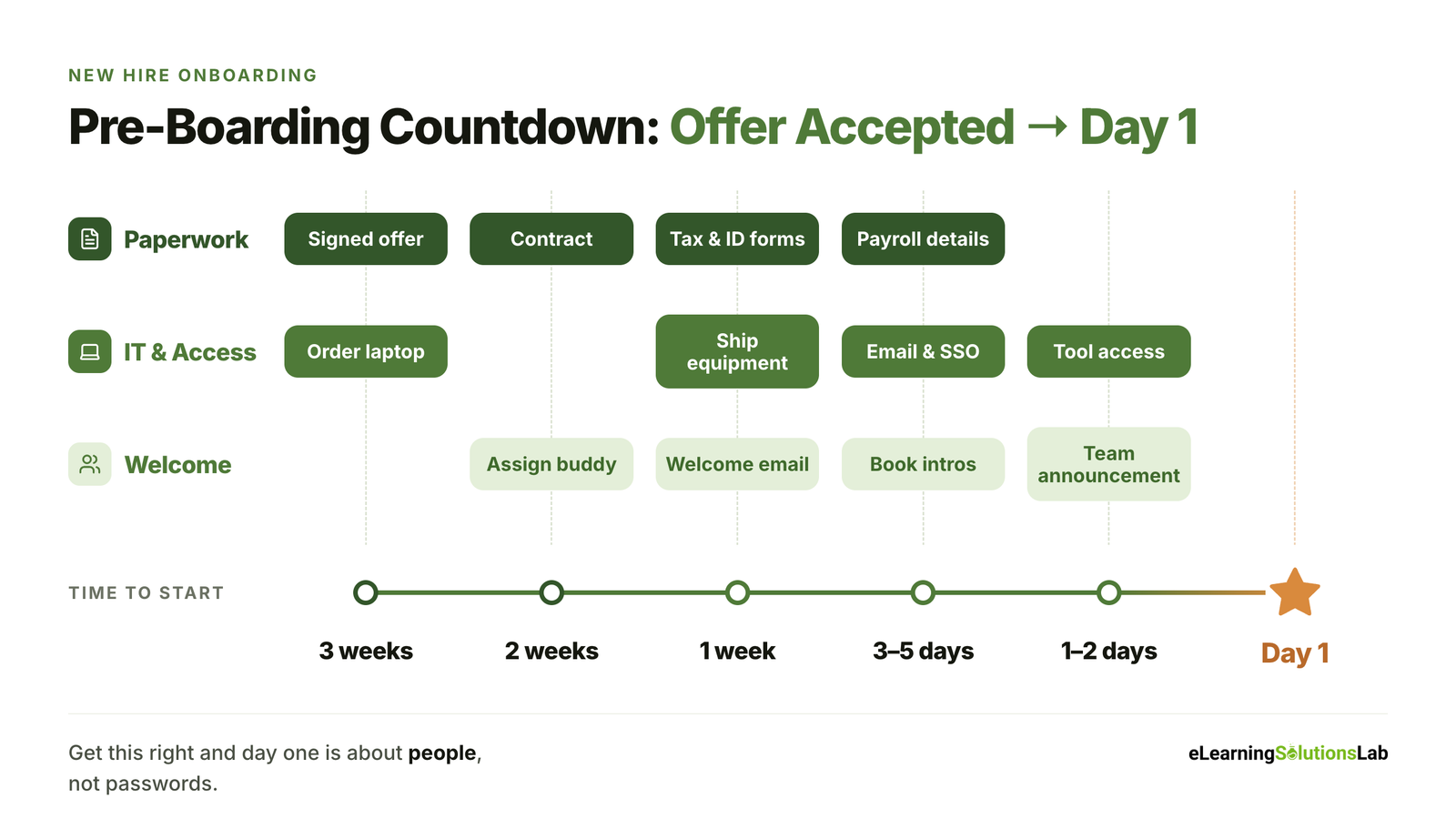
Onboarding starts the moment a candidate says yes, not on their first morning. The gap between offer and start date is your chance to handle paperwork, set up equipment, and make the new hire feel welcome before they walk in or log on. Get this phase right, and day one becomes about people, not forms and password resets.
 Paperwork and Compliance
| Task | Owner | When |
|---|---|---|
| Send and collect the signed offer letter | HR | Immediately after verbal acceptance |
| Issue and collect the signed employment contract | HR | 1–2 weeks before start |
| Run background and reference checks (if applicable) | HR | Before start date |
| Send tax and identity forms (see paperwork by country) | HR | 1–2 weeks before start |
| Collect payroll and direct deposit details | HR / Payroll | 1 week before start |
| Share benefits enrollment information | HR | 1 week before start |
| Create the employee file and add the hire to the HRIS | HR | 1 week before start |
Tip: Use e-signatures and digital forms so the new hire can finish paperwork before day one. Some documents, like the US Form I-9, have strict timing rules, so check the country section below.
IT, Equipment, and Access
| Task | Owner | When |
|---|---|---|
| Order the laptop, monitor, and peripherals | IT | 2 weeks before start |
| Ship equipment to remote hires | IT | 1–2 weeks before start |
| Create email and SSO accounts | IT | 3–5 days before start |
| Set up access to Slack/Teams and role-specific tools | IT / Manager | 3–5 days before start |
| Apply role-based permissions (least privilege) | IT | 3–5 days before start |
| Enroll the new hire in your LMS and assign their onboarding path | HR | 3 days before start |
| Prepare the desk, ID badge, and building access (on-site) | Office / Facilities | 1–2 days before start |
Assigning training ahead of time means the new hire can see their first courses waiting on day one. An onboard LMS makes this easy, since paths can be assigned by role or location before the start date.
Tip: Allow extra time when shipping equipment internationally, since customs can add days or weeks.
Welcome and Logistics
| Task | Owner | When |
|---|---|---|
| Send a welcome email: start time, location or video link, dress code, parking, what to bring | Manager / HR | 3–5 days before start |
| Share the first-week schedule | Manager | 3–5 days before start |
| Assign a buddy or mentor | Manager | 1 week before start |
| Announce the new hire to the team | Manager | 2–3 days before start |
| Book first-week meetings and intros | Manager | 2–3 days before start |
| Prepare a welcome kit or swag (optional) | HR / Office | Before start date |
Tip: Ask the manager to send a short personal message before day one. It does more to ease first-day nerves than any welcome pack.
First Day Checklist
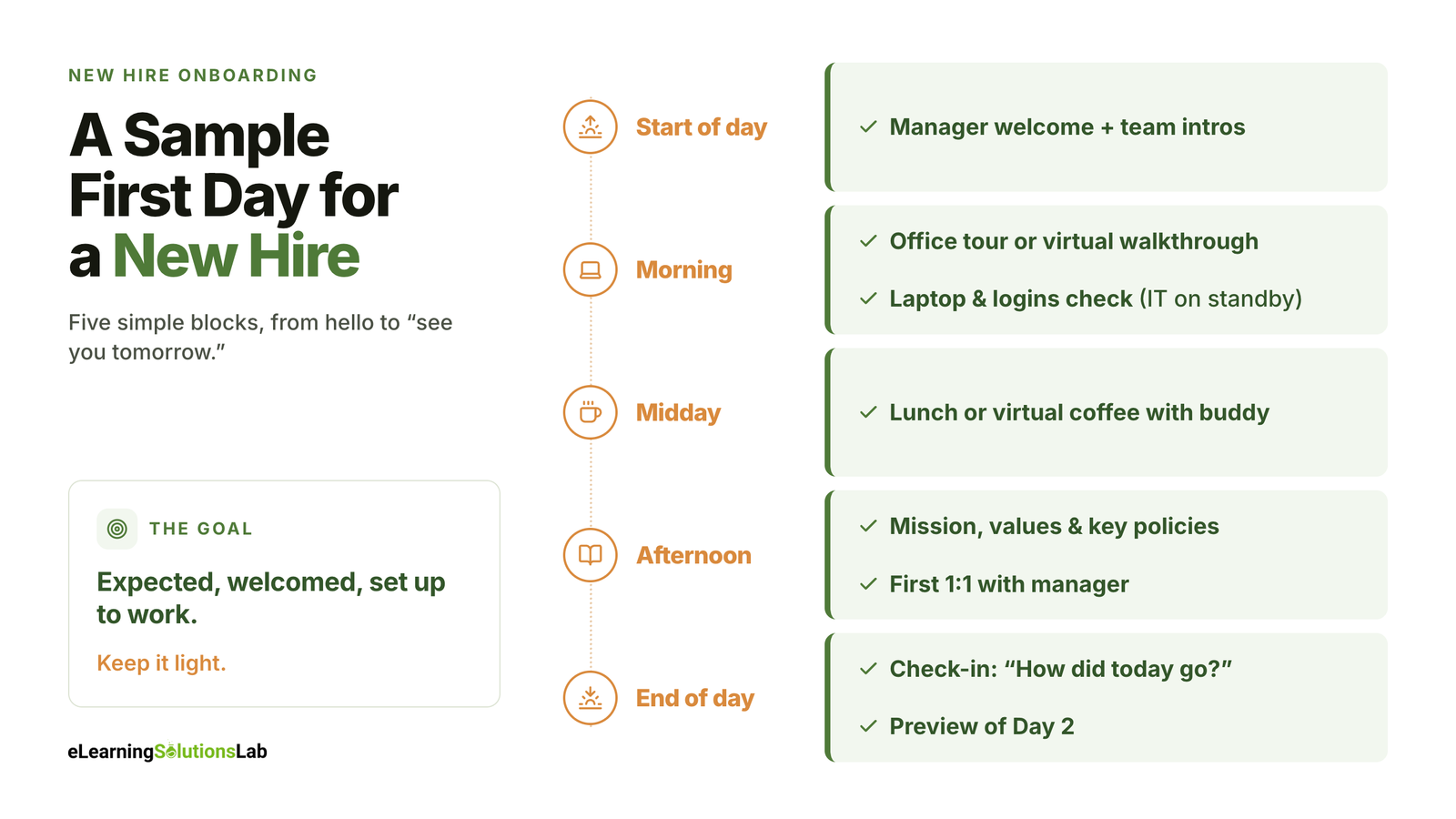
The first day sets the tone for everything that follows. The goal isn’t to cover everything. It’s to make the new hire feel expected, welcomed, and set up to work. Keep the schedule light, keep the paperwork to a minimum (most of it should already be done), and make sure their manager is present.
| Task | Owner | Time |
|---|---|---|
| Greet the new hire on arrival or at the first video call | Manager | Start of day |
| Give an office tour or a virtual walkthrough of key tools and channels | Buddy / Manager | Morning |
| Confirm the laptop, logins, and tool access all work | IT | Morning |
| Introduce the new hire to the team | Manager | Morning |
| Have lunch or a virtual coffee with the buddy | Buddy | Midday |
| Give an overview of the company mission, values, and org chart | HR / Manager | Afternoon |
| Walk through the employee handbook and key policies (conduct, security, leave) | HR | Afternoon |
| Hold the first 1:1: role overview, expectations, and how the team works | Manager | Afternoon |
| Complete any remaining day-one paperwork | HR | As needed |
| Do an end-of-day check-in: “How did today go? Any questions?” | Manager | End of day |
Tips for a better first day:
- Have IT on standby. Nothing kills first-day momentum like waiting hours for a password reset.
- Don’t overload them. Save deep training for week one. Day one is about orientation and connection.
- Make remote hires feel seen. Turn cameras on for intros, send a team welcome message in your chat tool, and schedule a short virtual social moment.
- Give them something to look forward to. End the day by sharing what’s planned for tomorrow.
First Week Checklist
By the end of week one, your new hire should understand how the team works, know who to go to for help, and have finished at least one small piece of real work.
This is when structured learning begins, but pace it. A mix of training, conversations, and hands-on tasks works better than five days of back-to-back sessions.
| Task | Owner | When |
|---|---|---|
| Complete required compliance training (harassment prevention, data security, health and safety) | HR / New hire | Days 2–3 |
| Start role-specific training and product or service walkthroughs | Manager / Team lead | Days 2–5 |
| Meet key stakeholders and cross-functional partners | Manager | Days 2–5 |
| Review tools, workflows, and the documentation hub | Buddy / Team | Days 2–4 |
| Shadow colleagues in meetings, calls, or core tasks | Buddy / Team | Days 2–5 |
| Assign a first small, achievable task (an early win) | Manager | Days 3–4 |
| Set the cadence for recurring 1:1s (weekly is a good default) | Manager | By day 5 |
| Share initial 30-day goals | Manager | By day 5 |
| Do an end-of-week feedback check-in | Manager | Day 5 |
Compliance courses are easier to schedule when they sit inside a wider compliance training plan, so every new hire gets the same required modules in the same order. For roles with physical risks, short eLearning safety training modules can cover the basics before someone starts hands-on work. For role-specific skills, realistic practice beats slides: scenario based eLearning lets new hires make decisions in a safe setting before they face real customers or systems.
Questions to ask at the end of week one:
- What’s been most helpful so far?
- What’s still confusing or unclear?
- Is anything missing, like access, information, or introductions?
- How are you feeling about the role?
Tips for a better first week:
- Spread out the training. Break long sessions into shorter blocks with time to apply what was learned. These microlearning examples show how to keep modules short and focused.
- Choose the early win carefully. It should be useful, achievable in a day or two, and visible to the team.
- Keep the buddy involved. Daily informal check-ins catch small problems before they grow.
- Write things down. Point new hires to written docs so they don’t have to remember everything from meetings.
30-60-90 Day Checklist
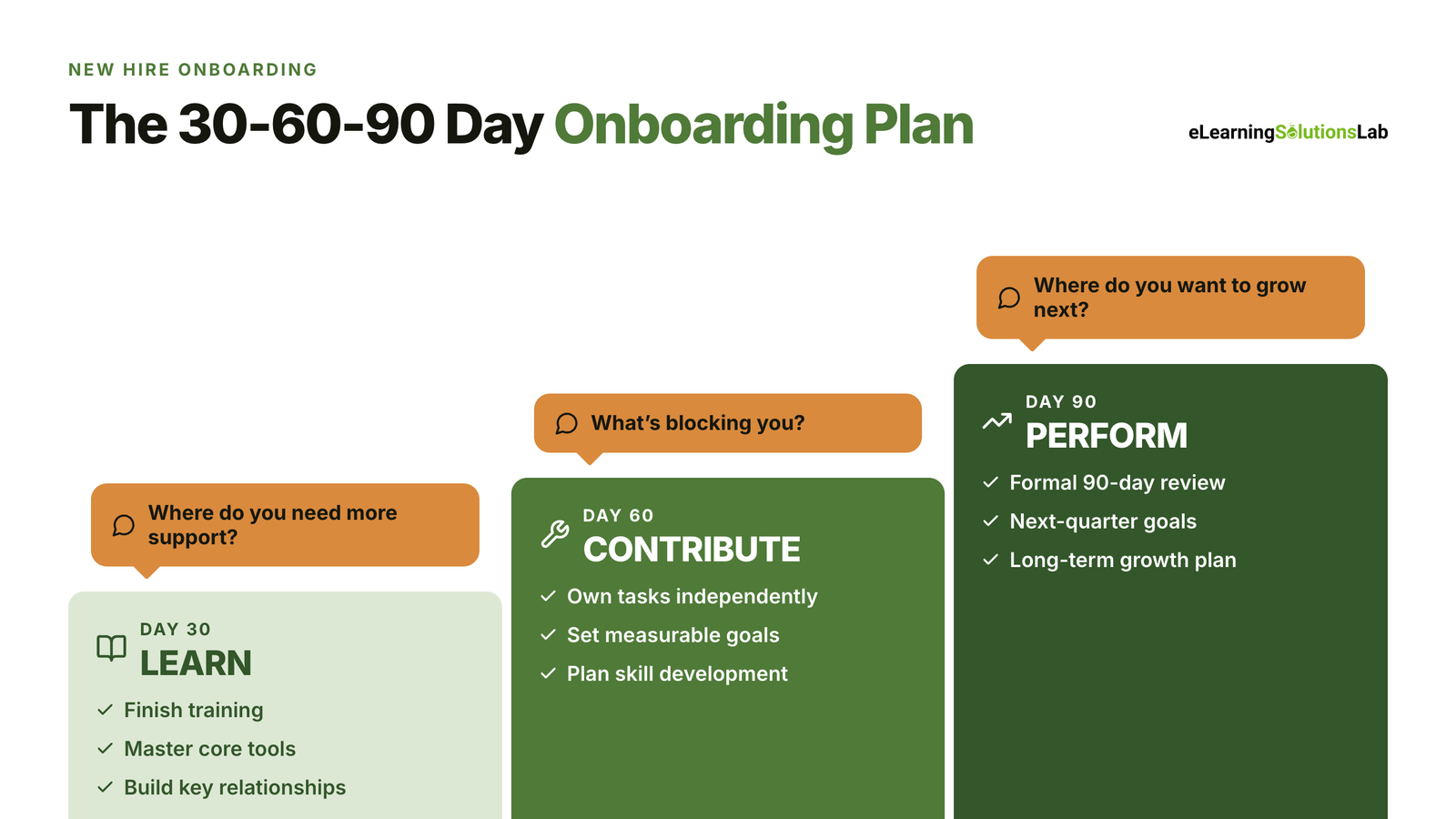
Onboarding doesn’t end after week one. The next three months turn a new hire into a confident, contributing team member. A simple 30-60-90 plan gives both the employee and the manager clear milestones and regular moments to check progress, adjust goals, and catch problems early.
 Day 30: Learn
The first month is about absorbing context: how the business works, how the team operates, and what good performance looks like.
| Task | Owner |
|---|---|
| Complete all required and role-specific training | New hire |
| Show confident use of core tools and systems | New hire |
| Build relationships with key colleagues and stakeholders | New hire / Manager |
| Hold the 30-day check-in with the manager | Manager |
| Agree on goals for days 31–60 | Manager / New hire |
30-day review prompts: What’s working well? Where do you need more support? Is the role what you expected so far?
Day 60: Contribute
By month two, the new hire should be moving from learning to doing, taking ownership of tasks, and contributing to team goals.
| Task | Owner |
|---|---|
| Own regular tasks or projects independently | New hire |
| Set first measurable performance goals | Manager / New hire |
| Share ideas or early observations with the team | New hire |
| Hold the 60-day check-in with the manager | Manager |
| Identify skill gaps and plan development | Manager / New hire |
A quick skills mapping exercise at this stage shows which skills the new hire already brings and which ones to build next, so the development plan targets real gaps.
60-day review prompts: Which goals are on track? What’s blocking you? What would help you do your best work?
Day 90: Perform
At three months, the new hire should be working at a steady, independent level and looking ahead to longer-term growth.
| Task | Owner |
|---|---|
| Hold the formal 90-day review | Manager |
| Confirm the probation outcome (if applicable) | Manager / HR |
| Set goals for the next quarter | Manager / New hire |
| Discuss a longer-term development plan | Manager / New hire |
| Complete the onboarding feedback survey | New hire / HR |
90-day review prompts: What have you accomplished? What would you change about your onboarding? Where do you want to grow next?
Tip: Use the 90-day feedback survey to improve the checklist itself. Every new hire’s experience is a chance to make the next one better. Pair it with completion data from your training system; our guide on how to track employee training covers the metrics worth capturing.
New Hire Paperwork by Country
Paperwork is where onboarding most often goes wrong, and the rules depend on where your new hire lives and works, not where your company is based.
Use the tables below to see what’s required in each country, when it’s due, and who handles it. In our template, the country you select is highlighted automatically.
Note
Employment rules change often. Treat this as a starting point and confirm details with official government sources or local employment counsel before each hire.
United States
| Document | Purpose | Deadline | Owner |
|---|---|---|---|
| Form I-9 (Employment Eligibility Verification) | Confirms identity and right to work | Section 1 by day 1; Section 2 within 3 business days | New hire / HR |
| E-Verify (where required) | Electronic check of I-9 information | Within 3 business days of start | HR |
| Form W-4 | Federal income tax withholding | Before first payroll | New hire |
| State withholding form | State income tax withholding (if applicable) | Before first payroll | New hire |
| State new hire report | Reports the hire to the state for child support enforcement | Within 20 days (some states require sooner) | HR / Payroll |
| Direct deposit and benefits enrollment | Pay setup and benefits elections | Before first payroll / within the enrollment window | New hire / HR |
Tip: Make sure you’re using the current Form I-9 edition. USCIS posts it, along with expiration dates, on I-9 Central.
United Kingdom
| Document | Purpose | Deadline | Owner |
|---|---|---|---|
| Right-to-work check | Confirms legal right to work in the UK | Before the first day (no grace period) | HR |
| Written statement of employment particulars | Sets out the main terms of employment | On or before day 1 | HR |
| P45 or HMRC Starter Checklist | Gives tax details so the correct tax code is used | Before first payday | New hire / Payroll |
| Pension auto-enrolment | Enrolls eligible staff in a workplace pension | From the date the employee becomes eligible | HR / Payroll |
| DBS check (if the role requires it) | Criminal record check | Before start | HR |
Canada
| Document | Purpose | Deadline | Owner |
|---|---|---|---|
| Federal TD1 | Personal tax credits for withholding | Before first payroll | New hire |
| Provincial or territorial TD1 (TP-1015.3 in Quebec) | Provincial tax credits | Before first payroll | New hire |
| Social Insurance Number (SIN) | Required for payroll, CPP, EI, and T4 reporting | Within 3 days of starting | New hire / Payroll |
| Work permit details (temporary SIN starting with 9) | Tracks work authorization expiry | At hire | HR |
Tip: Record the SIN only. Don’t photocopy or keep the physical card.
Australia
| Document | Purpose | Deadline | Owner |
|---|---|---|---|
| Tax file number (TFN) declaration | Sets correct tax withholding | At start; lodge with the ATO within 14 days of receipt | New hire / Payroll |
| Superannuation Standard Choice Form | Lets the employee choose a super fund | Within 28 days of start | HR / New hire |
| Stapled super fund request | Finds an existing fund if no choice is made | If no fund is nominated | Payroll |
| Fair Work Information Statement | Explains the National Employment Standards | Before or as soon as possible after start | HR |
| Casual or Fixed Term Contract Information Statement | Extra rights information for those employment types | At start | HR |
Tip: Since 1 July 2026, super guarantee must be paid each payday (Payday Super), so set this up in payroll before the first pay run.
European Union
| Document | Purpose | Deadline | Owner |
|---|---|---|---|
| Written terms of employment | Core working conditions under the Transparent and Predictable Working Conditions Directive | Core terms within 7 days; the rest within 1 month | HR |
| GDPR employee privacy notice | Explains how personal data is collected and used | At or before data collection | HR |
| Social security and tax registration | Varies by member state | Before first payroll | HR / Payroll |
India
| Document | Purpose | Deadline | Owner |
|---|---|---|---|
| Appointment letter | Sets out role, wages, and benefits; mandatory under the Labour Codes | On or before joining | HR |
| PAN and Aadhaar | Tax and identity verification | Before first payroll | New hire |
| EPF Form 11 and UAN linking | Provident fund enrollment | Before first payroll | HR / New hire |
| ESI registration (if eligible) | Health insurance coverage | At joining | HR |
| Form 12BB | Declares tax-saving investments for TDS | Before first payroll | New hire |
| Bank details | Salary account setup | Before first payroll | New hire |
Tip: India’s four Labour Codes took effect on 21 November 2025, which made written appointment letters a legal requirement for every worker.
Onboarding Remote and International Hires
Hiring someone in another country, or someone who will never set foot in your office, adds a layer to every phase of onboarding. You need the right legal setup before the offer goes out, more lead time for equipment, and a deliberate plan to help the new hire feel connected from a distance.
Hiring Abroad: EOR vs. Contractor vs. Local Entity
Before you onboard an international hire, decide how you’ll legally employ them. That choice determines who issues the contract, runs payroll, and handles local compliance.
| Option | How it works | Speed | Compliance risk | Best for |
|---|---|---|---|---|
| Employer of Record (EOR) | A third party legally employs the hire in their country and handles contracts, payroll, tax, and benefits | Fast (days to weeks) | Low; the EOR manages local rules | Hiring one or a few people in a new country |
| Independent contractor | The person invoices you as a self-employed business | Fastest | Higher; risk of misclassification | Short-term, project-based work |
| Local entity | You set up your own legal entity in the country | Slow (months) | Low once set up, but you own all compliance | Building a larger team in one country |
Watch for misclassification. If a contractor works set hours, uses your equipment, and reports to a manager like an employee, local authorities may treat them as one. That usually means back taxes, penalties, and owed benefits.
Remote Onboarding Checklist Additions
Add these tasks to the standard checklist for any remote or international hire:
| Task | Owner | When |
|---|---|---|
| Confirm the employment model (EOR, contractor, or entity) | HR / Legal | Before the offer |
| Ship equipment early and allow time for customs | IT | 2–3 weeks before start |
| Set up local payroll, currency, and payment schedule | Payroll / EOR | Before first payroll |
| Check data privacy and cross-border data transfer rules | HR / Legal | Before start |
| Schedule day-one sessions across time zones | Manager | 1 week before start |
| Record key training sessions for async viewing | Manager / HR | Week 1 |
| Assign a virtual buddy, ideally in a nearby time zone | Manager | Before start |
| Share written docs on tools, processes, and who to contact | Manager | Before start |
| Agree on core overlap hours and communication norms | Manager / New hire | Week 1 |
| Plan virtual social touchpoints (coffee chats, team intros) | Manager / Buddy | Weeks 1–4 |
Time zones make live training hard to schedule, so build the core of onboarding as on demand training that new hires can complete in their own working hours. Short video based eLearning works well for tool walkthroughs and welcome messages from leaders. If your hires work in different languages, multilingual eLearning keeps the experience consistent, so a new starter in Manila or Madrid gets the same quality onboarding as one at head office.
Tip: Remote hires can’t pick things up by overhearing them. Default to written documentation and over-communicate in the first few weeks.
New Hire Checklist by Role
Every task in the checklist has one owner. Here’s what each group is responsible for, so you can hand each person their own short list.
| Role | Main responsibilities |
|---|---|
| HR | Contracts, compliance forms, right-to-work checks, benefits, payroll setup, employee file, policy training, onboarding surveys |
| Hiring manager | Welcome email, first-week schedule, buddy assignment, 1:1s, 30-60-90 goals, check-ins, and the 90-day review |
| IT | Hardware, accounts, access permissions, security setup, day-one support, and access reviews |
| Buddy | Day-one welcome, daily check-ins in week one, tool walkthroughs, and informal questions |
| New employee | Submit documents, complete training, set up profiles, ask questions, and share feedback |
In the template, you can filter by the Owner column to give each person their own list.
Free New Hire Checklist Template
Skip the setup and start onboarding right away. Our free new hire checklist template follows every phase above, with owners, due dates, dropdowns, and country paperwork already built in, so you can set up a new hire in minutes.
How to Use It
- Fill in the Start Here tab with the new hire’s details, country, and start date. Every due date updates automatically.
- Work through each phase tab and update the status as tasks are done. Mark anything that doesn’t apply as N/A.
- Check the Dashboard each week to see progress by phase and owner, and to catch overdue tasks early.
Save a blank copy as your master template, and make a fresh copy for each new hire.
In one line
Start onboarding at the offer, give every task an owner and a due date, check the paperwork for each country, and keep checking in until day 90.
Ready to turn your onboarding checklist into training that sticks?
At eLearning Solutions Lab, we design and build onboarding courses that get new hires up to speed faster, for office, remote, frontline, and global teams. Our custom eLearning development services cover design, development, and QA in one team.
Need somewhere to deliver and track it? Levantra LMS, our cloud based LMS, assigns onboarding paths by role or location, gives managers a view of their own teams, and issues verifiable certificates for every completion.
See our custom eLearning development servicesBook a Levantra LMS demo
Related Reading
- Employee onboarding and training – building a program that gets new hires productive faster.
- Onboard LMS – delivering and tracking onboarding courses in one place.
- Compliance training plan – making sure every new hire completes required training.
- Skills mapping – finding skill gaps and planning development after onboarding.
- How to track employee training – the metrics worth capturing after training.
The Author

Book A Discovery Call
Our Learning Advisors are happy to walk you through your project step-by-step — content, timeline, and fixed pricing.
Get Your Free QuoteNo obligation — just a focused conversation. Proposal within 24 hours.
You may also like

eLearning Compliance Training: Practical Guide for US and Global Teams (2026)
Every organization essentially has to train employees on compliance. Very few…
Employee Onboarding and Training: A Practical Guide (+ Free 90-Day Plan)
A new hire's first week usually sets the tone for everything that follows. And…