

The mechanics of any gamification in eLearning definitely work: points, badges, streaks, and scenarios can fit completion and retention rates in the right conditions.
But they also fail in some predictable ways too, including some leaderboards that may demotivate the bottom half of a cohort. Badges that may lose meaning once everyone has them. And points that can reward clicking, not just learning.
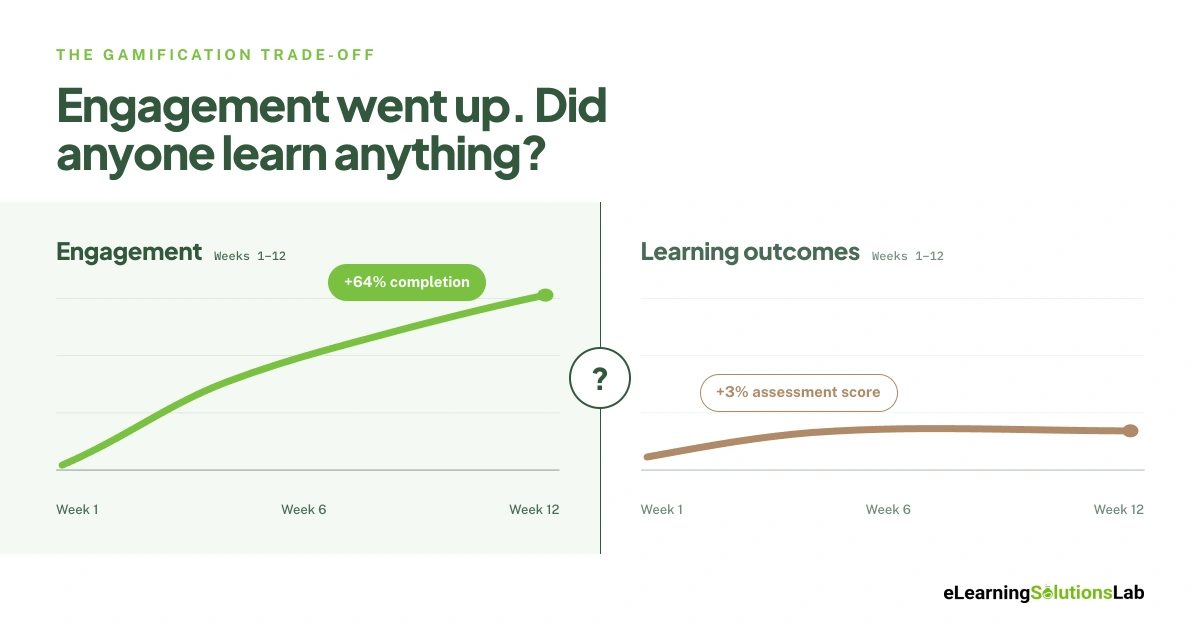 In this guide, we cover what gamification actually is, which mechanic maps to which motivation, when it’s actually the wrong solution entirely, six real examples with outcomes attached, and how to prove eLearning gamification moved your business priorities.
What Is Gamification in eLearning?
Definition
Gamification in eLearning is the use of game mechanics — points, badges, levels, leaderboards, streaks, and challenges — inside training content that isn’t itself a game. The goal is to increase motivation, practice frequency, and completion by giving learners feedback and progression signals borrowed from game design.
The goal of eLearning gamification is to increase motivation, practice frequency, and completion by giving learners actual feedback and progression signals that are borrowed from game design.
Gamification vs. Game-Based Learning vs. Serious Games
The quick test: if you can remove the points and the lesson still teaches, it’s gamification. If removing the game removes the lesson, it’s game-based learning.
The quick test: if you can remove the points and the lesson still teaches, it’s gamification. If removing the game removes the lesson, it’s game-based learning.
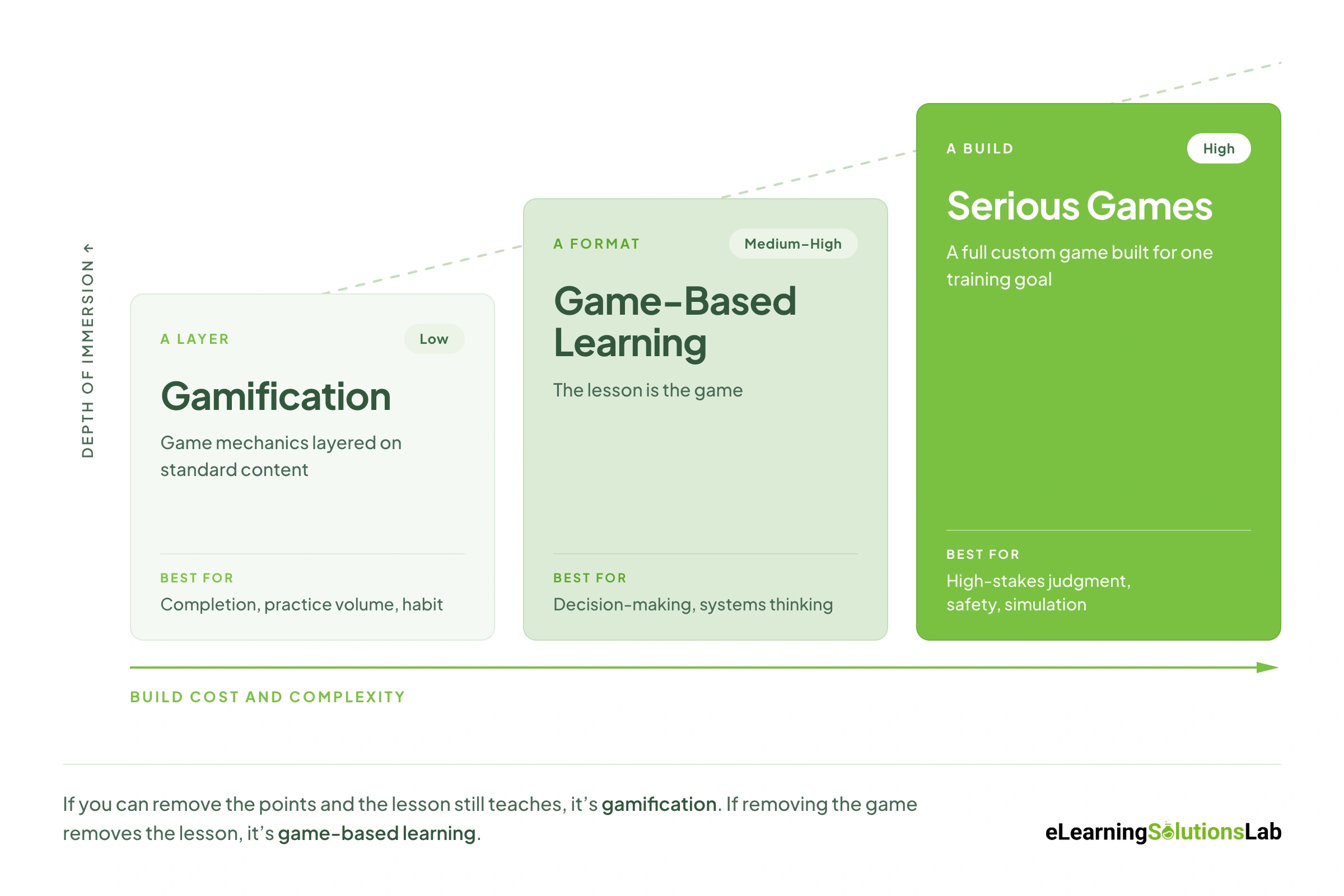 If you can remove points and a lesson that still teaches, it’s gamification. If removing the actual game removes the lesson, it’s game-based learning, and if the environment itself is the teaching mechanism, you’re closer to an eLearning simulation than to a gamified course.
Why eLearning Gamification Works (When It Works)
Self-determination theory can give you the clearest explanation here. Motivation holds when these three needs are met:
- Competence – visible progress, as points and levels are competence feedback.
- Autonomy – meaningful choice, given that unlockable paths and optional challenges can preserve it, and forced linear sequences destroy it.
- Relatedness – social connection: team scores and cohort challenges will satisfy this.
Mechanics that give learners information about their own progress tend to hold up over time. And mechanics that dangle external rewards will tend to decay once the novelty passes.
Core Mechanics and What Each One Actually Motivates
Each mechanical actually serves a different psychological need and carries a different failure mode – pick based on behaviors you’re trying to produce.
Mechanic → Motivation → Best use → Failure risk
Quick test: for each mechanic you’re considering, finish this sentence — “this exists so that learners will _____ more often.” If you can’t complete it with a specific behaviour, cut the mechanic.
How to Choose Your Core Mechanics?
Two rules cover most cases:
1. 1 or 2 mechanics
Every mechanic you’ll add will dilute the signal from others and add variables you can’t isolate when you review the data. Start with a single mechanic that maps to your gaps: practice-volume problem points to points or streaks.
Completion problem across a long program will point to levels or badges. Applicable problem points to scenario and probably not to gamification at all.
2. Match the mechanic to the cohort shape.
Leaderboards need peers of similar ability and enough of them to actually make middle feel live: a 12-person cohort of mixed seniority is a worst case here, given that ranking is stable and everyone knows exactly who is at the bottom.
Streaks need a reason to return daily. So if your course is a one-sitting module, a streak is meaningless, streaks only earn their place when content is already broken into short, repeatable sessions, which is why they pair naturally with microlearning services. Team-based scoring is a safer default in corporate settings given that it will satisfy relatedness without exposing individuals.
When Gamification Backfires
Gamification has real evidence, but it also has a well-documented set of failure modes. If you recognize your eLearning course in any of five patterns below, you can fix them through subtraction.
1. Leaderboards demotivate the people who need help most.
A leaderboard is motivating for roughly the top quartile. For everyone below the midpoint, it’s a public, persistent record of failing behind – and given that rank tends to stabilize after the first week, the gap reads as fixed rather than closeable.
The learners who most need to complete the training are the ones handled cleanest evidence that effort won’t change their position.
Three mitigations, in order of effectiveness:
- Switch to team scores – same competitive pull.
- Show a local window – five learners will immediately be around users.
- Rank on improvements, not absolute scores – learners who move from 40$ to 70% outrank one who sat at 85% throughout.
2. Extrinsic reward decay, what happens in month three.
External rewards will produce a fast, visible lift, then a slow decline. Then once novelty passes, reward becomes just the baseline expectation and performance settles back toward – sometimes below where it started.
The worst outcome is the crowding-out effect: learners who had some intrinsic interest in the material begin attributing their efforts to points; when points stop, so does the interest.
The pattern to watch for is a strong first-month engagement spike in your dashboard just followed by a quiet slide in month two.
Mechanics that will report progress (levels, completion maps, skill meters) will decay far more slowly than mechanics that grant prizes.
3. Rewarding activity instead of mastery
Points that get attached to what’s easy to measure. Examples would be modules opened, videos played, minutes logged, quizzes attempted. Learners will optimize for exactly what you score.
The predictable result is click-through farming: content skipped, videos backgrounded, quizzes brute-forced on retry until score lands.
The test here is whether your scoring can be gamed without learning. For instance, if a learner can max the leaderboard by opening every module and never just reading one. System is also measuring compliance and calling it engagement.
Score on assessment performance, first-attempt accuracy, or spaced-recall success – outcomes that can’t just be reached by clicking faster.
4. Badge fatigue and the credibility problem
Badges work as signals, and signals only hold value then they’re scarce. You can award one for finishing introduction, one for logging in, one for completing a two-minute video, and currency can devalue within a single program.
Learners will stop noticing them, and more damaging – the badges that do represent real competence stop meaning anything to managers reviewing them.
5. When the content is the problem, not engagement
This is the most common misuse. Completion rates are low, so gamification gets added to raise them, and often it does, briefly. However, if learners are dropping out given that content is irrelevant to their job, too long, poorly sequenced, or duplicating what they already know, gamification doesn’t solve that – that’s a design problem, and it gets fixed with instructional design services, not with points.
It only raises the metric while underlying failure stays intact, which is worse than leaving the number low, given that low number was the only signal you had.
Gamification Decision Checklist
Here are 8 checks to help catch cases where gamification is just a well-funded distraction. Score one point per yes.
Eight Checks
- Is there a defined performance gap, not just a low completion rate?
You can name what people are doing wrong on the job, not only what they’re failing to finish.
- Is the target behavior repeatable?
Gamification rewards frequency – if the skill is used once a year, mechanics have nothing to reinforce.
- Have you ruled out content as the cause?
You’ve checked drop-off points and abandonment isn’t just clustered at one specific module.
- Does the audience have a cohort?
Learners that are moving through at roughly the same time, at roughly similar ability. Solo self-paced learners can’t use social mechanics at all.
- Can you score something that can’t be faked?
Assessment accuracy, first-attempt success, spaced recall – not just modules opened or minutes logged.
- Do you have baseline data?
Current completion, current assessment averages, current on-the-job metric. Without a before, there’s no after – it’s that simple.
- Can you run a control group?
Even a rough one – one region gamified, one not. Or one cohort with, next without.
- Is anyone accountable for the number this should move?
A named business metric with a named owner. “Engagement” doesn’t really qualify.
Scoring
Two answers override the score. If you answered no to check 3 (content ruled out), fix the module first — gamifying weak content just produces higher completion of weak content. If you answered no to check 6 (baseline data), spend one cycle instrumenting before you build. That gap is the most common reason gamification projects can’t defend their budget at renewal.
How to Implement eLearning Gamification (5-Step Process)
Here is a five-step process to implement your eLearning gamification program.
Step 1: Map the performance gap, not engagement complaint
Translate any training request into a behavior: what are people doing on the job that they shouldn’t be, or not doing that they should?
You have to work backward from a business standpoint, metrics like error rate, escalation volume, time-to-competency, safety incidents, or quota attainment – to state examples.
Then identify specific behavior driving it, and only then can you ask whether that behavior fails from lack of knowledge, lack of practice, or lack of motivation.
Gamification can address motivation, and reinforce skills
Step 2: Profile your learners
Bartle’s player types map cleanly onto corporate cohorts, and the same mechanic can help you land very differently across them:
Why this matters: most corporate cohorts skew socializer and achiever, with competitors a visible minority. That’s exactly why leaderboards keep getting built — the competitors are the loudest voice in the room — and exactly why they underperform once they ship.
Most corporate cohorts skew socializers and achievers, with competitors a visible minority – which is why leaderboards have to be built (as competitors are loud), and then underperform (they’re outnumbered).
Step 3: Select one or two mechanics
You need to intersect the gap with the profile. For instance, a practice-frequency gap in an achiever-heavy cohort points to streaks plus any skill meter. A completion gap across a long program in a socializer cohort points to team progress and milestone badges.
Another one is a judgment gap; it points to scenario, and if scenario is the answer, what you actually need is scenario based elearning services rather than a badge layer – which is entirely a different budget conversation.
Step 4: Instrument before you build
Decide the metric first, then design backwards from it. Capture the baseline: current completion, current assessment average, current on-the-job number, before any single mechanic ships.
Then confirm your LMS and your authoring stack can actually export the events you need at the learner level. Tracking granularity varies widely across the best eLearning authoring tools, and if you need first-attempt accuracy rather than pass/fail, it’s worth reviewing how to create SCORM content that reports at that level before you build anything.
Step 5: Pilot on one module with a control group
One module, one cohort, one comparable cohort left ungamified. Run it long enough to clear the novelty window, like 8 to 12 weeks minimum, since a 30-day read will just show you spikes and none of the decay.
Watch for any decay curve: specifically comparing weeks 1 to 2 against weeks 7 to 8. Like a lift that can hold is a mechanic worth scaling, or a lift that fades is a novelty effect, and rolling that out program-wide will reproduce the fade at scale.
Start scaling only what survived the pilot.
How to Measure Whether Gamification in eLearning Worked
Kirkpatrick’s four levels of evaluation are the standard frame for evaluating gamified eLearning courses, with Level 4 being where you connect the mechanic to a business number and calculate eLearning ROI. Here’s a quick table to show you the bigger picture.
Measurement Table
If you can only measure one thing: assessment score delta against a control cohort, re-tested at 30 days. It’s the smallest measurement that survives a budget review — and the one that separates real learning from compliant clicking.
Metrics that prove least
Here are 3 numbers to dominate gamification reporting:
- Completion rate – sensitive to reminders, deadlines, and manager pressure – also rises when learners skim faster.
- Time on course – ambiguous in both directions as more time can mean deeper engagement or a confusing interface. Less time can mean efficient mastery or just skipping.
- Points and badges awarded – measures that your systems ran and I’d say the most common headline in gamification case studies, and the least informative.
Attribution
With a control group and clean baseline, you can claim a causal effect at level 2 with reasonable confidence. Levels 3 and 4 are mostly contaminated, as one manager, let’s say a change, a process update, or a product launch, can easily move the same numbers.
Two things keep the claim honest:
- Report the control comparison, not the raw before/after. “Gamified cohort 14 points ahead of control” is defensible; “Scores up 14 points” isn’t.
- Name the confounders yourself before someone else does. A stated limitation reads as rigor; a discovered one reads as spin.
Unlocking Your Gamification Strategy
Gamification only works when it reinforces a real, repeatable performance gap — and fails when it’s bolted onto weak content to lift a completion number that was never the problem.
If you’re still scoping partners, our breakdown of the top eLearning gamification companies covers how the main vendors differ on mechanics, measurement, and pricing.
eLearning Solutions Lab designs gamified courses built around a defined performance gap and a metric that can defend itself. Start with the checklist above, then talk to us about eLearning gamification services built for your cohort.
The Author

Book A Discovery Call
Our Learning Advisors are happy to walk you through your project step-by-step — content, timeline, and fixed pricing.
Get Your Free QuoteNo obligation — just a focused conversation. Proposal within 24 hours.
You may also like
Software for Training Companies: Best Tools and How to Choose (2026 Guide)
Short answer Training companies need a training management system (TMS) to…
How to Choose an LMS: A 7-Step Guide (With Free Scorecard)
Short answer To choose an LMS, define your goals and learners first, then…