


- Published
- Reading time
- 7 min
Filed under Instructional Design
Think about the best course you’ve ever taken, at work or anywhere else. It probably didn’t feel like a pile of slides. It felt clear, it moved at the right pace, it made you practice the hard parts, and you actually walked away able to do something new. That wasn’t luck. It was instructional design.
So here’s a plain-English guide to instructional design. You’ll get a simple definition, what instructional designers actually do, the process they follow, the models and theories behind good courses, a before-and-after example, and the skills and tools involved. You can also download a free instructional design checklist, no email needed.
Short on time? Jump to the definition, see the process or download the checklist.
Updated November 2026.
In This Article
What is Instructional Design?
Instructional design is the practice of planning and creating learning experiences so that people can gain specific knowledge and skills efficiently and effectively. It starts with what learners need to be able to do, then uses evidence about how people learn to decide what to teach, in what order, in what format, and how to check that it worked.
A few quick answers:
- Is instructional design the same as course creation? Not quite. Course creation is producing the content. Instructional design is deciding what the content should be and how it should work, so that people actually learn.
- Where is it used? Almost everywhere people learn. For instance, in corporate training, schools and universities, healthcare, government, the military, and anywhere people need to learn something specific.
- Where did it come from? It grew out of the large-scale training programs of World War II and developed through the work of researchers like Robert Gagné and Benjamin Bloom. The ADDIE model followed in the 1970s.
What Does an Instructional Designer Do?
An instructional designer’s job is typically to turn a learning need into a learning experience that works. In practice, that usually means:
- Analyzing needs – who the learners are, what they need to do, and why they can’t do it yet.
- Writing learning objectives – you have to know the destination first: clear, measurable statements of what learners will be able to do.
- Working with subject matter experts (SMEs) – pulling out what really matters from people who know the topic deeply.
- Designing the structure – sequence, activities, practice, examples and assessments.
- Writing storyboards and scripts – the blueprint for the course. See our eLearning storyboard template.
- Building or guiding development – in authoring tools, or alongside developers and designers.
- Evaluating and improving – checking results and refining the course.
Instructional Design Process
Most instructional designers follow some version of the same process. The most widely used is ADDIE:
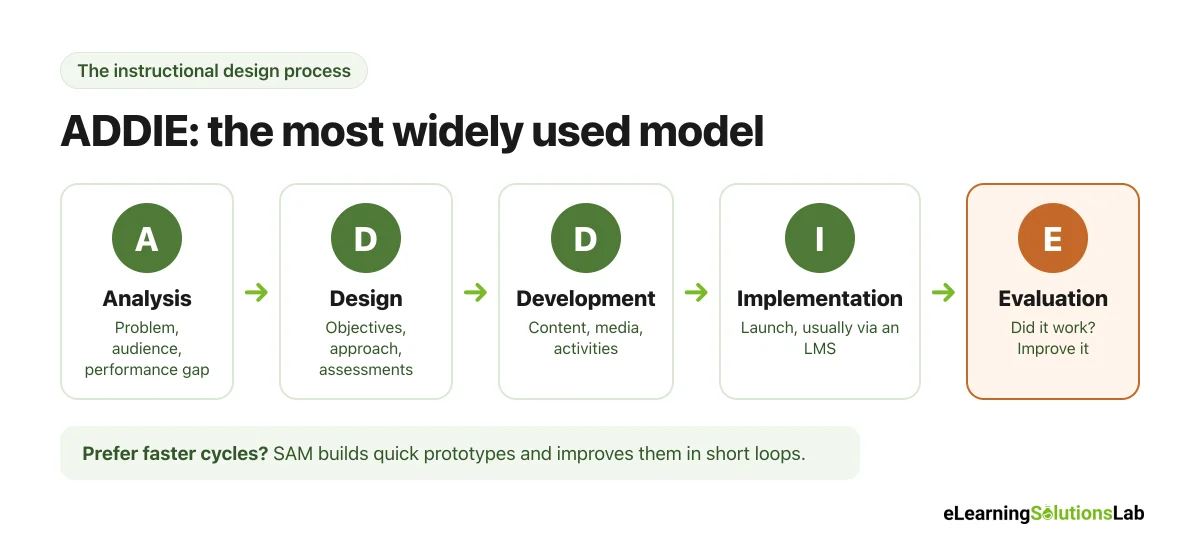
- Analysis – define the problem, the audience and the performance gap. A training needs assessment happens here.
- Design – set objectives, choose the approach, plan assessments and outline the structure.
- Development – build the content, media, activities and assessments.
- Implementation – launch it to learners, usually through an LMS.
- Evaluation – measure whether it worked, and improve it.
Many teams now use a more iterative approach, like SAM (the Successive Approximation Model), which builds quick prototypes and improves them in short cycles. Our guide on ADDIE vs. SAM compares the two on one example course, and our ADDIE model guide walks through each phase in depth.
Key Instructional Design Models and Theories
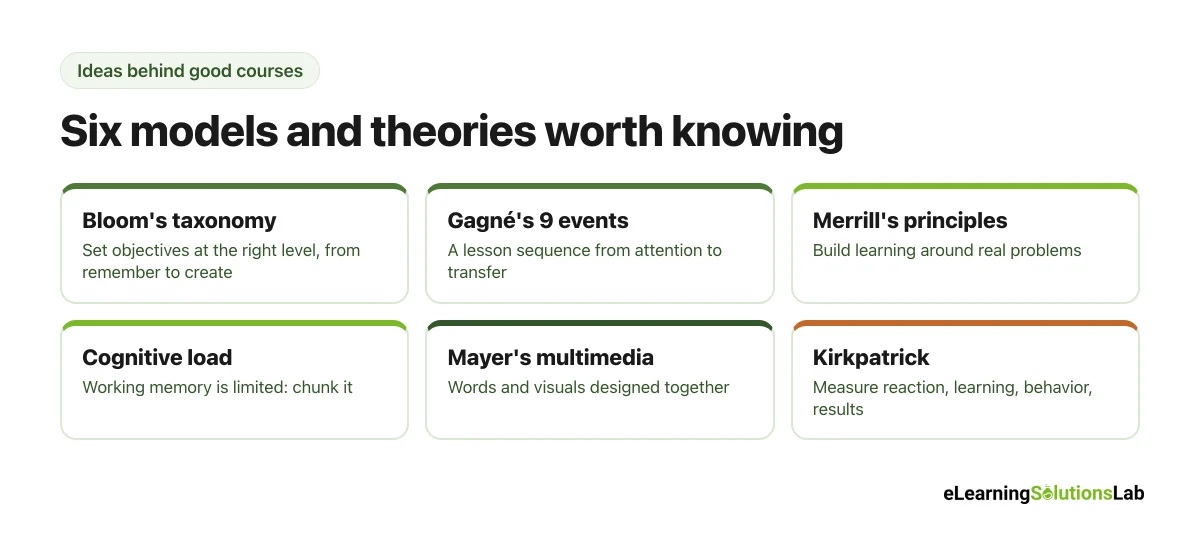
You don’t have to memorize every theory to design good learning, and you can start with just a few. But a few ideas come up again and again, given that they genuinely shape how good courses are built:
| Model or theory | The big idea | How it shows up in a course |
|---|---|---|
| ADDIE | Analyze, design, develop, implement, evaluate | A clear project process from need to results |
| Bloom’s taxonomy | Learning goals range from remembering to creating | Objectives and assessments at the right level |
| Gagné’s nine events of instruction | A sequence for effective lessons, from gaining attention to transfer | Hook, objectives, content, practice, feedback, assessment |
| Merrill’s first principles | Learning works best around real problems | Courses built on realistic tasks and scenarios |
| Cognitive load theory | Working memory is limited | Short chunks, less clutter, one idea at a time |
| Mayer’s multimedia principles | People learn better from words and visuals designed together | Relevant visuals, narration instead of on-screen walls of text |
| Kirkpatrick model | Evaluate reaction, learning, behavior and results | Measuring whether training changed anything |
Our guide to learning models goes deeper into the theories behind these.
Before and After: An Instructional Design Example
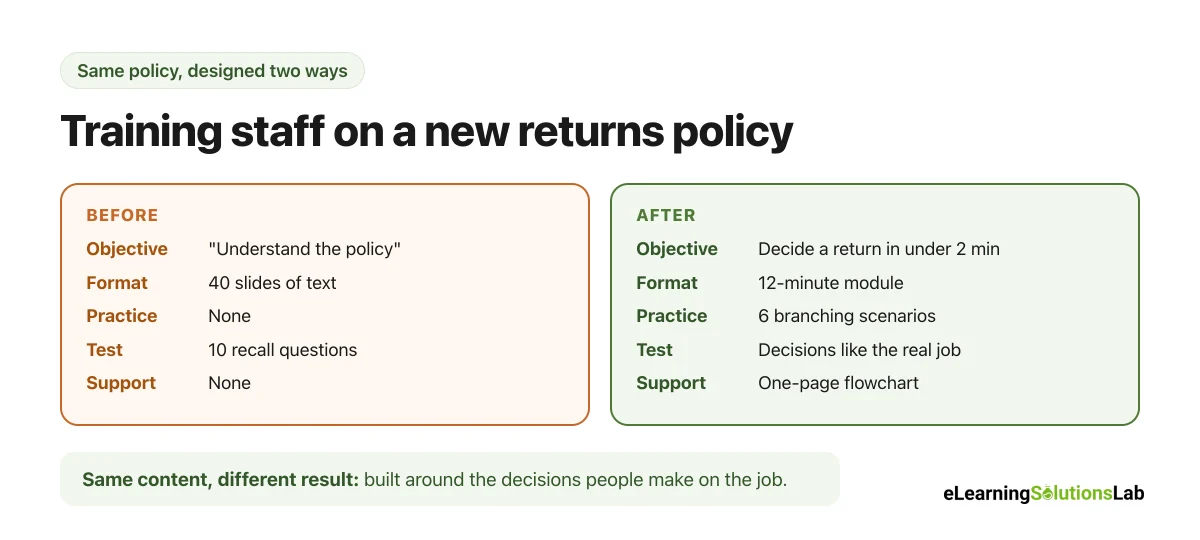
Here’s what instructional design actually changes. Imagine a company needs to train customer service staff on a new returns policy:
| Before (no design) | After (instructionally designed) | |
|---|---|---|
| Starting point | The full policy document | What staff need to decide at the counter |
| Objective | “Understand the returns policy” | “Decide correctly whether to approve a return in under 2 minutes” |
| Format | 40 slides of text | A 12-minute module with 6 branching scenarios |
| Practice | None | Realistic customer situations with feedback |
| Assessment | 10 recall questions | Scenario decisions that mirror the job |
| Support | None | A one-page decision flowchart for the counter |
The content is the same policy. But the redesigned version is built around what people truly need to do on the job, so that they practice the decisions they’ll actually face. That’s the difference instructional design makes.
Instructional Design vs. Related Roles
| Role | Main focus |
|---|---|
| Instructional designer | What and how people learn: objectives, structure, activities, assessment |
| Learning experience designer (LXD) | The whole learner journey and experience, often with UX methods |
| eLearning developer | Building the course in authoring tools |
| Graphic or multimedia designer | Visuals, video and animation |
| Subject matter expert (SME) | The knowledge itself |
| Trainer or facilitator | Delivering live sessions |
In smaller teams, one person often does several of these. Our guide to the learning experience designer role covers how LXD and instructional design overlap.
Instructional Design Skills and Tools
Core skills:
- Analysis and asking good questions
- Clear, concise writing
- Working with subject matter experts
- Learning science (how people learn and remember)
- Assessment design
- Visual and multimedia design basics
- Project management
Common tools: authoring tools like Articulate Storyline and Rise, Adobe Captivate and iSpring; an LMS for delivery; video and graphics tools; and increasingly, AI tools for drafting and research. Our guide to eLearning authoring tools compares the main options, and AI for instructional design covers where AI helps and where it doesn’t.
How do you get into instructional design? Many people come from teaching, training, writing or subject-matter roles. Usually the fastest route is to learn the basics (ADDIE, objectives, assessment, a main authoring tool), then build a small portfolio of two or three sample projects that show your thinking, not just your visuals.
To give you a concrete example, at eLearning Solutions Lab, we don’t simply turn a client’s slides into an online course. Our instructional designers start by asking what learners need to do differently on the job, then cut anything that doesn’t serve that, and rebuild the rest around scenarios and practice. So a 60-slide deck typically becomes a much shorter course that does far more.
Is Instructional Design a Good Career?
It’s one of the most common questions people ask about the field. For many people, the honest answer is yes, especially if you enjoy explaining things, solving problems and working with technology. Here’s what to weigh:
- Demand is broad. Companies, universities, healthcare, government and eLearning agencies all hire instructional designers.
- Remote work is common, given that most of the job happens on a computer.
- Many people come from other careers, such as teaching, training, writing or a subject specialty.
- It keeps changing. New tools and AI mean you have to keep learning, which some people love and others find tiring.
- Your portfolio matters more than your title. Employers want to see work samples.
Pay varies a lot by country, industry and experience, so check current salary data for your own location. To see the field from the employer’s side, read our guide on how to hire eLearning designers.
Free Instructional Design Checklist (PDF)
Free download – no email needed
Instructional Design Checklist
A printable PDF to check any course against the five ADDIE phases, with a learning objective builder, an SME interview guide and a final quality check before launch.
In one line: instructional design is the practice of building learning around what people need to be able to do, using what we know about how people learn, so that training actually changes performance.
Need instructional designers for your next project?
At eLearning Solutions Lab, our instructional designers turn subject matter into courses that people finish and actually use, from needs analysis to storyboard to final build.
See our instructional design services or custom eLearning development.
See instructional design servicesTalk to us about your course
Related Reading
- The ADDIE model – the five phases in depth.
- ADDIE vs. SAM – one course planned both ways.
- Learning experience designer – how LXD and ID compare.
- Training needs assessment – the analysis step done right.
- eLearning storyboard template – plan a course before you build it.
- How to create effective eLearning courses – from plan to launch.
The Author

Book A Discovery Call
Our Learning Advisors are happy to walk you through your project step-by-step — content, timeline, and fixed pricing.
Get Your Free QuoteNo obligation — just a focused conversation. Proposal within 24 hours.
You may also like
The Four Stages of Competence: Examples and How Training Moves People Forward
Think back to learning to drive. At first, you didn't know how much you didn't…
Learning Paths: Types, Examples and How to Build One People Finish
Give a new employee access to a library of 200 courses and say "take what you…