


- Published
- Reading time
- 7 min
Filed under Corporate TrainingInstructional Design
You run a great training session. People are engaged, the quiz scores look good, and everyone leaves confident. Then a month later, half of it seems to have disappeared. That’s not a sign your training was bad. It’s simply how memory works, and a German psychologist mapped it out more than 140 years ago.
So here’s a practical guide to the Ebbinghaus forgetting curve. You’ll get a plain definition, what Ebbinghaus actually found (with his real numbers), what the curve does and doesn’t mean, the formula, and the techniques that genuinely slow forgetting down. Then we’ll turn it into a reinforcement plan you can use for any course. You can also download a free spaced reinforcement planner, no email needed.
Short on time? Jump to the definition, see how to beat the curve or download the planner.
Updated November 2026.
In This Article
- What is the Ebbinghaus forgetting curve?
- What Ebbinghaus actually found
- What the curve does and doesn’t mean
- The forgetting curve formula
- What makes people forget faster
- How to beat the forgetting curve
- A reinforcement plan for any course
- How Much Do We Forget in 24 Hours? (And the 2-7-30 Rule)
- Free spaced reinforcement planner
What is the Ebbinghaus Forgetting Curve?
The Ebbinghaus forgetting curve shows how memory of newly learned information fades over time when there’s no attempt to review it. Forgetting is fastest in the first hours and days after learning, then slows down and levels off. It’s named after Hermann Ebbinghaus, who first measured it in experiments on himself, published in 1885.
The key idea is simple: most forgetting happens early. And every time you review or use what you learned, the curve resets and becomes flatter, so you forget more slowly next time. That second part is what makes the curve truly useful for training.
What Ebbinghaus Actually Found
Ebbinghaus memorized lists of nonsense syllables (like “DAX” or “BOK”) so that existing knowledge couldn’t help him. He learned each list until he could recite it perfectly, waited, then measured how much less time it took to relearn it. He called that the “savings”. Here are his original results:
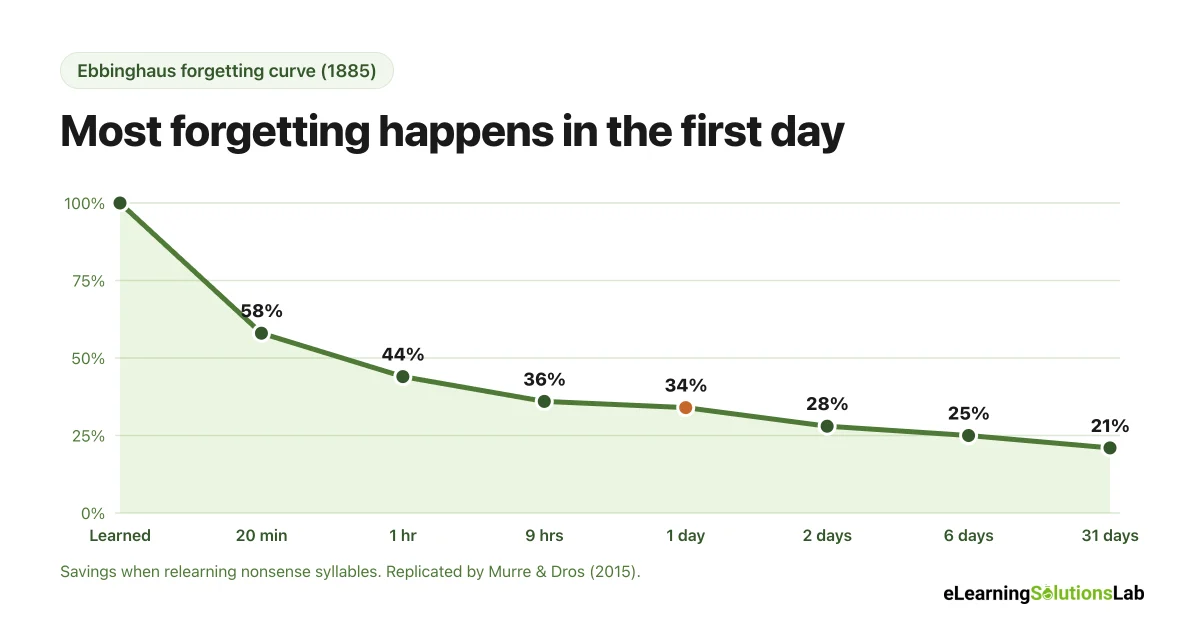
| Time after learning | Savings when relearning | What that suggests |
|---|---|---|
| 20 minutes | About 58% | A big drop already |
| 1 hour | About 44% | Forgetting is fastest early on |
| 9 hours | About 36% | Still falling, more slowly |
| 1 day | About 34% | The curve starts to flatten |
| 2 days | About 28% | |
| 6 days | About 25% | |
| 31 days | About 21% | Some memory lasts a long time |
In 2015, researchers Jaap Murre and Joeri Dros replicated the experiment, with one person spending 70 hours learning and relearning lists at the same intervals. Their results were very similar to Ebbinghaus’s, with one interesting difference: a small upward bump at the 24-hour mark, most likely because sleep helps consolidate memory.
What the Curve Does and Doesn’t Mean
You’ll often see claims like “people forget 70% of training within 24 hours” or “90% within a week”. Here’s why you have to be careful with those:
- Savings isn’t the same as remembering. Ebbinghaus measured how much faster he relearned a list, not how much he could recall. A 34% saving after one day doesn’t mean he remembered exactly 34%.
- Nonsense syllables are the worst case. He chose meaningless material on purpose. Meaningful, relevant information that connects to what people already know typically fades much more slowly.
- The exact numbers vary. How fast people forget depends on the material, the learner, how it was taught and whether it’s used. So the shape of the curve is reliable. The specific percentages aren’t a law.
In practice, the takeaway for L&D isn’t a scary statistic. It’s this: without reinforcement, a big share of what people learn will fade fast, and the first few days are when it matters most.
The Forgetting Curve Formula
The forgetting curve is commonly written as an exponential decay:
- R is retention, how much is still remembered.
- t is the time since learning.
- S is the strength of the memory. The stronger the memory, the slower it fades.
This is a simplification, given that Ebbinghaus himself fitted his data with a logarithmic formula, and later researchers often found power functions fit better. But the formula captures the useful point: you can’t stop time, so the way to keep more is to increase memory strength (S), which is exactly what review, practice and meaningful content do.
What Makes People Forget Faster
Forgetting isn’t random. For instance, the same person can really remember a hands-on workshop for months and lose most of a slide deck within a week. These factors typically make the difference:
| Factor | Why it speeds up forgetting |
|---|---|
| Meaningless or irrelevant content | Nothing to connect it to, and no reason to remember it |
| Too much at once | Long sessions overload working memory, so less gets stored |
| No practice or recall | Reading or watching alone builds weak memories |
| No chance to use it | Skills that aren’t applied on the job fade fastest |
| Poor sleep and stress | Both interfere with how memories are consolidated |
| Passive formats | Click-next slides ask very little of the learner’s brain |
How to Beat the Forgetting Curve
Decades of learning research point to a handful of techniques that genuinely work. Here’s what they look like in workplace training:

| Technique | What it means | In workplace training |
|---|---|---|
| Spaced repetition | Review at growing intervals instead of all at once | Short refreshers on day 1, day 3, week 1, week 3 |
| Retrieval practice | Recall from memory instead of re-reading | Quick quizzes and “what would you do?” questions |
| Make it meaningful | Connect content to real tasks and existing knowledge | Use real cases, tools and examples from their job |
| Microlearning | Small, focused pieces instead of long sessions | 3 to 7 minute modules on one idea each |
| Scenarios and practice | Apply knowledge in realistic situations | Branching scenarios, simulations, role-play |
| Job aids | Support at the moment of need | Checklists and quick guides they use on the job |
| Manager reinforcement | Follow-up from the people who see the work | Check-ins, coaching and feedback after training |
The first two are the big ones. Spacing out reviews and asking people to recall information (rather than just re-reading it) are among the most consistently supported findings in learning science. And they’re cheap to build into almost any course.
A Reinforcement Plan for Any Course
Here’s a simple schedule you can use after any course, live session or onboarding module. Each review is short, usually 3 to 10 minutes, and focused on recall and application:
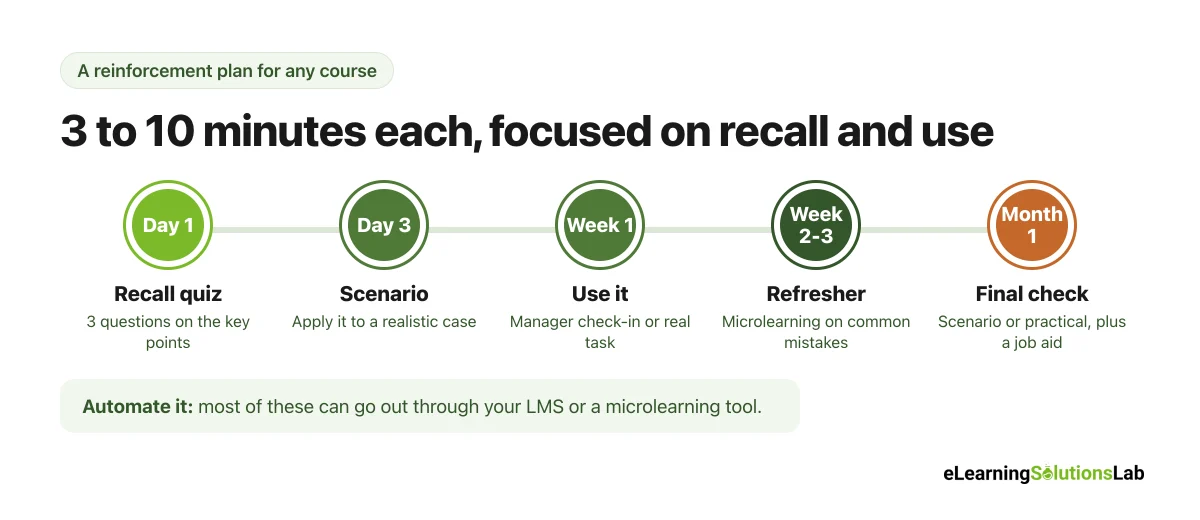
- Day 1: a 3-question recall quiz on the key points.
- Day 3: a short scenario that asks people to apply what they learned.
- Week 1: a manager check-in or a real task that uses the skill.
- Week 2 to 3: a microlearning refresher on the parts most people got wrong.
- Month 1: a final scenario or practical check, and a job aid they keep.
You can deliver most of this automatically through your LMS or a microlearning tool, so that it doesn’t add much admin work. Our microlearning examples show what these short refreshers can look like.
To give you a concrete example, at eLearning Solutions Lab, we don’t simply hand over a course and call it done. For most clients, we design the reinforcement at the same time as the course itself: short scenario-based refreshers, spaced quizzes drawn from the questions learners struggled with most, and a one-page job aid for the moment they actually need it on the job. So the course is the start of the learning, not the end.
How Much Do We Forget in 24 Hours? (And the 2-7-30 Rule)
In his own experiments with nonsense syllables, Ebbinghaus found that much of what he memorized was lost within the first day, and the loss slowed down after that. The exact percentages you’ll see quoted online come from those self-experiments, so they’re not a precise rule for workplace training, where material is usually far more meaningful. What really carries over is the shape: forgetting is fastest right after learning.
That’s where review schedules like the popular 2-7-30 rule come in: review new material about 2 days, 7 days and 30 days after learning it. It isn’t something Ebbinghaus proposed, but it’s a simple, practical form of spaced repetition. For instance, you can send a 3-question quiz two days after a course, a short scenario a week later, and a one-minute refresher at the end of the month.
Short microlearning pieces are ideal for these follow-ups.
Free Spaced Reinforcement Planner (PDF)
Free download – no email needed
Spaced Reinforcement Planner
A printable PDF to plan the reviews after any course: key points to keep, a day 1 to month 1 schedule, recall question ideas, and a checklist for making learning stick.
In one line: the Ebbinghaus forgetting curve shows that most forgetting happens in the first few days, and spaced, recall-based reinforcement is the most reliable way to flatten it.
Want training that people actually remember?
At eLearning Solutions Lab, we design courses and reinforcement together, with scenarios, spaced refreshers and job aids built in from day one.
See our microlearning services or our instructional design services.
Related Reading
- The learning curve – how fast people get better, the other side of the story.
- Microlearning examples – short refreshers that fight forgetting.
- Scenario-based eLearning – practice that sticks.
- Learning models – the theories behind good course design.
- Learning and development (L&D) – where reinforcement fits in the bigger picture.
The Author

Book A Discovery Call
Our Learning Advisors are happy to walk you through your project step-by-step — content, timeline, and fixed pricing.
Get Your Free QuoteNo obligation — just a focused conversation. Proposal within 24 hours.
You may also like
The Four Stages of Competence: Examples and How Training Moves People Forward
Think back to learning to drive. At first, you didn't know how much you didn't…
Learning Paths: Types, Examples and How to Build One People Finish
Give a new employee access to a library of 200 courses and say "take what you…