

Every organization essentially has to train employees on compliance. Very few do it well, and the difficulty grows when your workforce spans several states or countries.
For instance, a harassment course that satisfies California may not satisfy New York. Another would be that a data privacy module built around HIPAA won’t cover GDPR. And a course everyone clicks through in ten minutes may just produce a completion report without really changing how anyone behaves.
eLearning makes compliance training easier to scale, track, and audit. It also helps raise new questions: which topics are legally required where you operate, whether to buy ready-made courses or build your own, and how to genuinely tell if your training program actually works.
In this guide, we answer those questions without selling you a platform. It covers core US and international requirements, compares off-the-shelf, custom, and LMS-only approaches, and explains how you can measure results beyond just completion rates.
Short on time? Jump to the compliance requirements matrix.
Updated November 2026.
In This Article
- What is eLearning compliance training?
- Why compliance training matters
- Types of compliance training, with examples
- US vs. global compliance requirements
- How to make compliance eLearning engaging
- Tracking, audit trails, and certification renewals
- Free compliance training options
- How to roll out an eLearning compliance program
What is eLearning Compliance Training?
eLearning compliance training is an online training program that teaches employees laws, regulations, and company policies that apply to their jobs. It also records who completed each course, when they completed it, and how they scored, so that your organization can show auditors and regulators proof of that training.
It can cover the same subjects as classroom compliance training, like workplace safety, harassment prevention, data privacy, and anti-bribery. The difference is in how it’s delivered.
So instead of just scheduling sessions with a trainer, your employees can complete self-paced modules on a laptop or phone, usually through a learning management system (LMS). Then, your LMS will assign courses by role or location, send reminders, and keep a timestamped record of every completion.
Almost every organization would need some form of it. Regulated industries like healthcare, financial services, and manufacturing would have the heaviest requirements. But many of these general obligations, like harassment prevention in certain US states or data protection under GDPR, may apply to employers in any sector.
For teams that are spread across offices or countries, eLearning is often the only practical way to train everyone consistently and keep audit-ready records.
Why Compliance Training Matters
The most obvious reason is actually risk, as breaking regulations like HIPAA, GDPR, or OSHA standards can lead to fines, lawsuits, failed audits, and lasting damage to a company’s reputation.
Many of these violations aren’t deliberate, as they happen when an employee didn’t know the rule, didn’t recognize the situation, or didn’t know who to report it to. Having good training can close those gaps before they become incidents.
Training records also matter when something goes wrong, given that regulators and courts often look at whether an organization made a genuine effort to prevent misconduct.
In the US, for example, the Department of Justice’s guidance on evaluating corporate compliance programs asks whether training is tailored, effective, and tracked. And in harassment cases, documented training can form part of an employer’s defense. For instance, having a record that shows who was trained, on what, and when is evidence of that good-faith effort.
Beyond your legal side, compliance training can shape culture. When it’s done well, employees can help understand why rules exist, feel confident speaking up, and make better decisions in gray areas that no policy would fully cover.
eLearning makes all of this easier to achieve at scale. It can deliver the same message to every employee, whether there are 50 or 50,000, across offices and time zones. It will help adapt content by role or region, and it will produce the audit trail automatically.
Types of Compliance Training, with Examples
Compliance training can cover a wide range of topics, given that most organizations need several of them, which depend on industry, location, and the roles your employees hold.
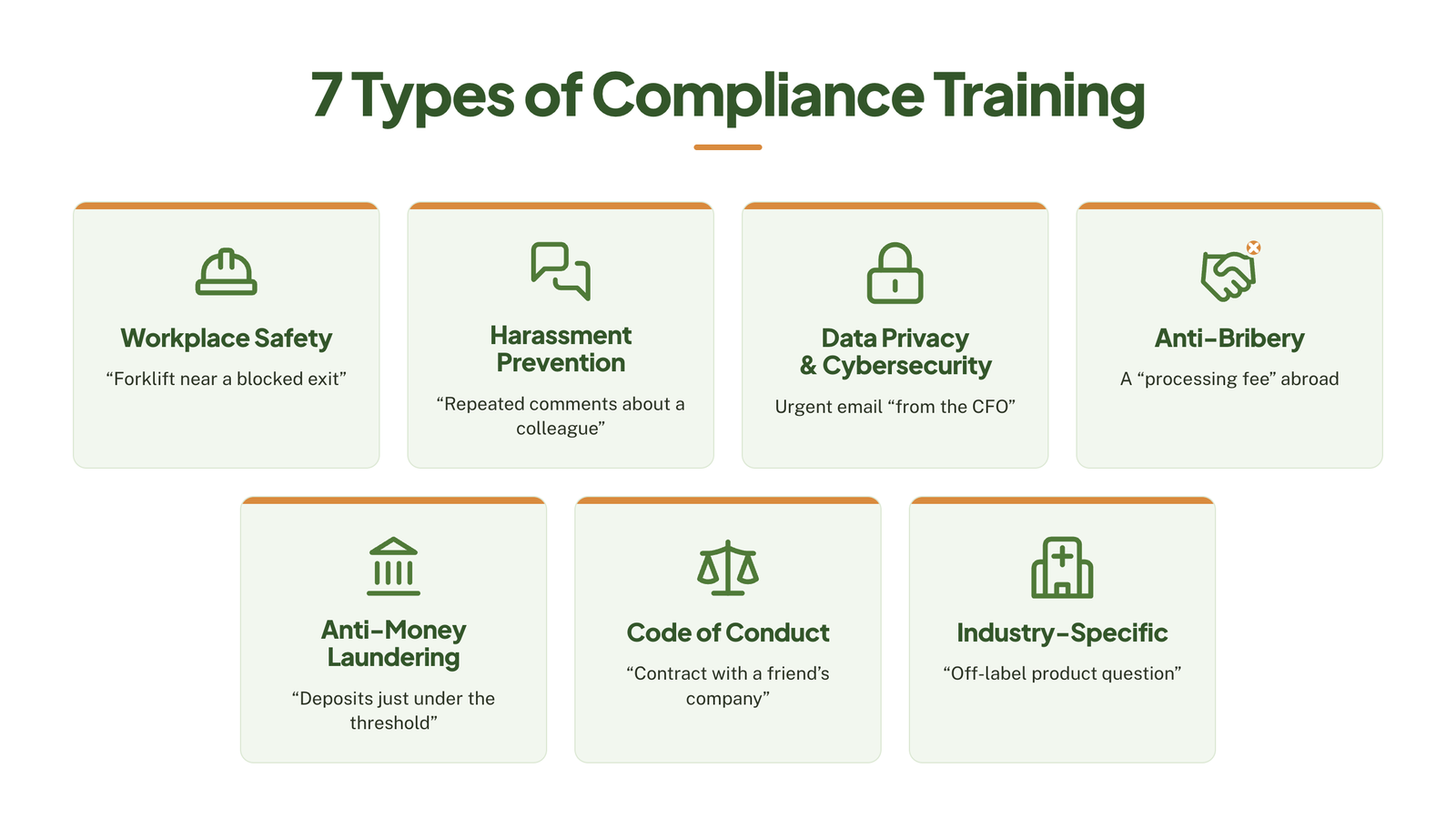
Here are the most common types, each with an example of what a really good module looks like in practice.
Workplace Safety
Safety training can teach your employees to recognize hazards, use equipment correctly, and respond to emergencies. In the US, many OSHA standards include specific training requirements, especially in construction, manufacturing, and warehousing.
Example: A warehouse worker can see a forklift being operated near a blocked emergency exit and choose what to do next.
Harassment and Discrimination Prevention
This type of training explains what counts as harassment, how to report it, and what bystanders can do. Several US states, including California, New York, and Illinois, would require employers to provide it on a regular schedule.
Example: A manager who hears a team member make repeated comments about a colleague’s appearance and decides how to respond.
Data Privacy and Cybersecurity
These courses would cover how to handle personal data and protect systems from threats, as they’re actually tied to laws like HIPAA, CCPA/CPRA, and GDPR, and usually include phishing awareness.
Example: An employee would receive an urgent email “from the CFO” asking for a list of customer records.
Anti-Bribery and Anti-Corruption
This training program would teach your employees to spot and refuse improper payments, gifts, and favors. It’s especially important for companies with international operations covered by the US FCPA or the UK Bribery Act.
Example: A sales rep abroad is told a contract will move faster if a “processing fee” is paid to an official’s relative.
Anti-Money Laundering (AML) and Financial Compliance
AML training would help staff identify suspicious transactions and report them correctly, given that financial institutions are generally required to train employees as part of their AML programs.
Example: A bank teller would notice a customer making several cash deposits just under the reporting threshold.
Code of Conduct and Ethics
This e-learning compliance training program translates your company values into everyday decisions, as it helps cover conflicts of interest, gifts, confidentiality, and how to raise concerns without fear of retaliation.
Example: An employee is asked to approve a contract with your supplier owned by a close friend.
Industry-Specific Training
Some industries have their own requirements on top of the general topics – these include healthcare, which covers patient privacy and infection control; financial services, which covers market conduct and suitability; and pharma, which covers marketing and drug safety reporting.
Example: A pharma sales rep is asked by a doctor about an off-label use of a product.
US vs. Global Compliance Requirements
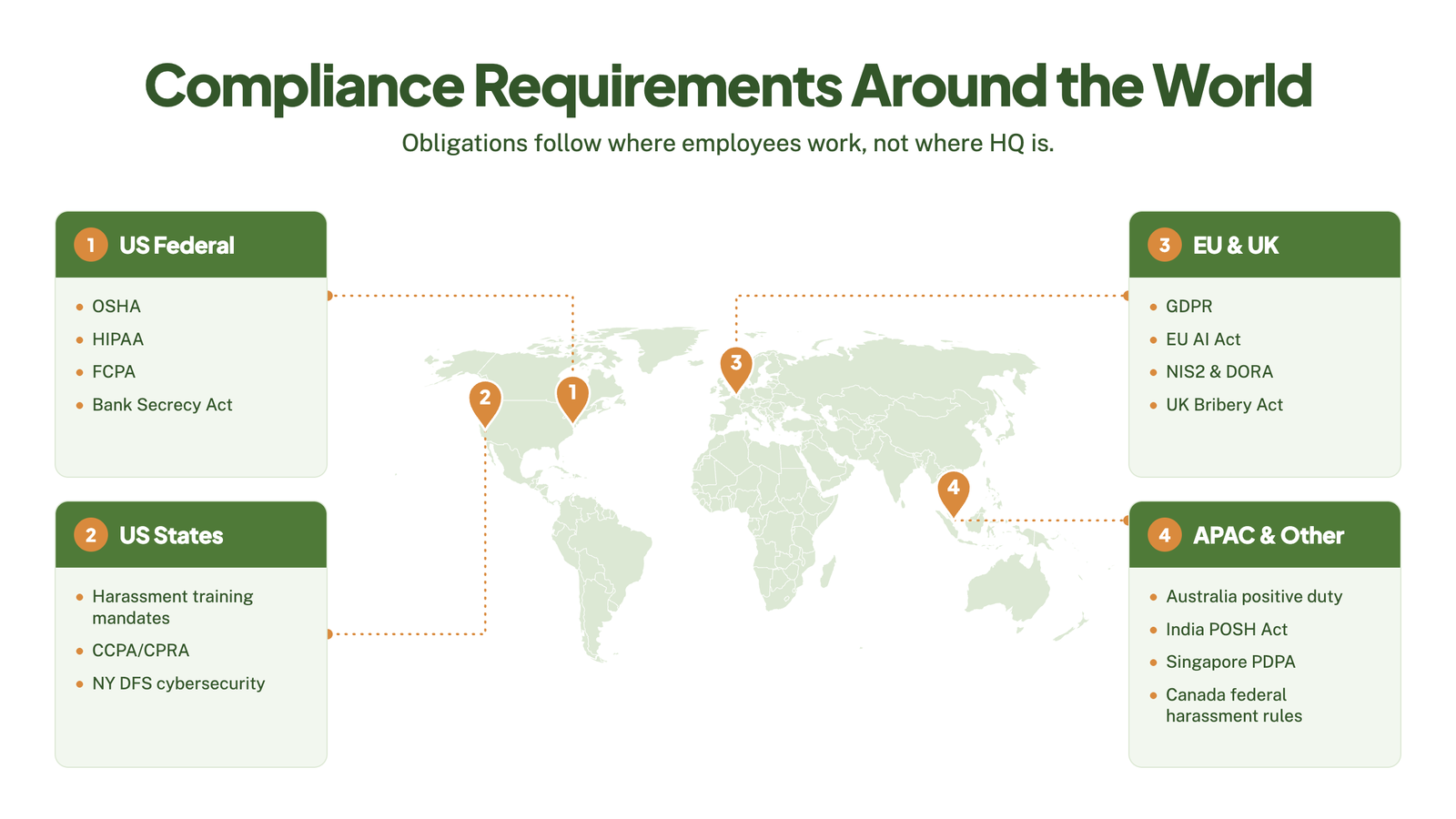
Compliance obligations depend on where your employees live and work, not where your company is headquartered. A US company with staff in London, Berlin, and Singapore has to meet the rules in each of those places, and they rarely line up neatly.
Note
Compliance laws change often. Treat this section as a starting point and confirm details with official government sources or legal counsel in each jurisdiction.
US Federal Requirements
There’s no single federal law that requires all compliance training. Instead, obligations come from specific laws and agencies:
- OSHA: Many standards carry their own training rules. For example, bloodborne pathogens training must be repeated annually, and forklift operators need a performance evaluation at least every three years.
- HIPAA: The Privacy Rule requires training for workforce members and retraining when policies change materially. The Security Rule requires an ongoing security awareness program for everyone, including management. HHS proposed a major Security Rule update in January 2025, but it hadn’t been finalized at the time of writing.
- FCPA: The law doesn’t mandate training directly, but the DOJ looks at training when it evaluates a company’s compliance program. The DOJ refocused its enforcement priorities in June 2025, but the law itself hasn’t changed.
- Harassment: There’s no federal training mandate, but the EEOC recommends regular training, and documented training supports an employer’s defense in harassment claims.
- Anti-money laundering: Under the Bank Secrecy Act, financial institutions’ AML programs must include ongoing employee training.
US State-Level Requirements
States add their own rules, and harassment prevention is where they differ most. Here are some of the states with mandatory training:
| State | Who must train | How often |
|---|---|---|
| California | Employers with 5+ employees (2 hours for supervisors, 1 hour for others) | Every 2 years |
| New York State | All employers; training must be interactive | Annually |
| Illinois | All employers | Annually |
| Connecticut | Employers with 3+ employees (2 hours) | Within 6 months of hire; refresher at least every 10 years |
| Delaware | Employers with 50+ employees | Within 1 year of hire, then every 2 years |
| Maine | Employers with 15+ employees | Within 1 year of hire |
Privacy is the other fast-moving area. The CCPA/CPRA requires that staff who handle consumer privacy requests understand the law, and a growing number of states have passed their own comprehensive privacy laws. In financial services, New York’s DFS cybersecurity regulation requires at least annual cybersecurity awareness training.
EU and UK Requirements
- GDPR and UK GDPR: There’s no single clause requiring every employee to be trained, but organizations must show they’ve taken appropriate measures to protect personal data, and regulators treat staff training as key evidence of that.
- EU AI Act: Since February 2025, organizations that provide or use AI systems have had an AI literacy obligation for their staff. The Digital Omnibus on AI softened the wording in July 2026, so companies now must take measures to support AI literacy rather than guarantee a set level, but the duty remains.
- NIS2 and DORA: NIS2 requires management bodies of in-scope organizations to complete cybersecurity training, and DORA requires financial entities to run security awareness and digital resilience training.
- EU Whistleblowing Directive: Employers must set up internal reporting channels, and staff need to know how to use them.
- UK Bribery Act: Companies can defend against the “failure to prevent bribery” offence by showing adequate procedures, and the government’s guidance names training as one of them. A similar “failure to prevent fraud” offence took effect in September 2025.
- UK harassment law: Since October 2024, UK employers have a duty to take reasonable steps to prevent sexual harassment of their workers, and training is one of the most common ways to show this.
APAC and Other Regions
- Australia: Employers have a positive duty to take reasonable and proportionate steps to eliminate sexual harassment, and work health and safety laws cover psychosocial hazards.
- India: The POSH Act requires employers to run regular awareness programs on sexual harassment prevention.
- Singapore: The PDPA requires organizations to develop data protection policies and communicate them to staff.
- Canada: Federally regulated employers must train employees on harassment and violence prevention within three months of hire and every three years after.
Localization and Translation
Translating a US course into German doesn’t make it compliant in Germany. Global compliance training usually needs three layers of adaptation:
- Language: Courses should be in the language employees work in. A policy they only half understand gives you weak evidence in an audit.
- Legal content: Definitions, reporting channels, and legal thresholds differ by country, so regional variants often need different scripts, not just different words.
- Cultural fit: Names, workplaces, and scenarios should feel familiar. A scenario built around a US sales conference may not land with a team in Jakarta.
A practical approach is to build one global core course and add short regional modules on top. Professional eLearning localization services can handle the regional versions, while multilingual eLearning keeps the experience consistent across languages, so an employee in Manila or Madrid gets the same quality training as one at head office.
Compliance Requirements Matrix by Region
Use this matrix to see which topics apply where you operate. The refresh cycle shows common practice, and legal minimums may be stricter or looser by jurisdiction.
| Topic | US federal | US state | EU / UK | APAC and other | Common refresh |
|---|---|---|---|---|---|
| Harassment prevention | Recommended by EEOC | Mandatory in CA, NY, IL, CT, DE, ME | UK preventive duty (2024) | Australia positive duty; India POSH; Canada federal rules | Every 1–2 years |
| Workplace safety | OSHA, by standard | State OSHA plans (e.g., Cal/OSHA) | EU OSH Framework Directive; UK Health and Safety at Work Act | Australia WHS laws | At hire, then per standard (often annual) |
| Data privacy | HIPAA (healthcare); GLBA (finance) | CCPA/CPRA and other state laws | GDPR / UK GDPR | Singapore PDPA; Australia Privacy Act; India DPDP Act | Annually and after policy changes |
| Cybersecurity awareness | HIPAA Security Rule; sector rules | NY DFS (financial services) | NIS2; DORA | Varies by country and sector | Annually, plus phishing simulations |
| Anti-bribery and fraud | FCPA | — | UK Bribery Act; UK failure to prevent fraud offence | National anti-corruption laws | Annually for high-risk roles |
| Anti-money laundering | Bank Secrecy Act | — | EU AML rules; UK Money Laundering Regulations | FATF-aligned national laws | Annually |
| Whistleblowing | SOX and Dodd-Frank protections | State whistleblower laws | EU Whistleblowing Directive | Varies | At hire, then with code of conduct |
| AI literacy | — | — | EU AI Act, Article 4 | — | When new AI tools or roles are introduced |
Tip: Map each employee group against this matrix by country and role. Most organizations find that a handful of core courses cover everyone, with a few regional or role-specific add-ons.
How to Make Compliance eLearning Engaging, with Evidence
Most of your employees would have sat through compliance courses that consist of clicking “Next” until a certificate appears. Practitioners actually know it too, as discussions among L&D professionals would regularly describe compliance training as checkbox exercises that nobody remembers a week later.
The fix here isn’t flashier design or more animation – it’s applying a few methods that learning research actually supports.
Scenario-Based Learning
Instead of just presenting rules, you can put employees in realistic situations where they actually make decisions and see consequences. This would help turn passive reading into active practice, which really matters.
A large meta-analysis by Freeman et al. (2014, PNAS) found that students in traditional lecture-based courses were 1.5 times more likely to fail than those in courses using active learning. Scenarios like this also force retrieval.
Research by Roediger and Karpicke (2006) also showed that practicing recall can lead to much better long-term retention than rereading material.
Microlearning and Spaced Refreshers
A single annual hour-long course works against how memory works, given that the spacing effect – one of the most replicated findings in psychology – shows that information is retained far better when practice is spread over time.
Cepeda et al. (2006) also confirmed this across hundreds of studies. And in practice, it means a core course followed by short refreshers, like a two-minute scenario or a three-question quiz, which is delivered every few weeks.
Role-Based Paths
For instance, a warehouse worker doesn’t need the same data privacy course as a payroll specialist. And irrelevant content adds cognitive load without adding learning, and adult learning research consistently finds that adults engage more when training connects to their own work. Assigning modules by role, location, and risk level would keep your courses shorter and more credible.
Gamification, and Where It Backfires
Points, badges, and leaderboards can help, but the real evidence is mixed. A meta-analysis by Sailer and Homner (2020) found small positive effects overall.
However, a study by Hanus and Fox (2015) found that a gamified course lowered students’ motivation and exam performance over time. Gamification works best when your game mechanics can reinforce real decisions, and worst when it is a reward layer on top of content people don’t value.
Tracking, Audit Trails, and Certification Renewals
In compliance training, the record is almost as important as the training itself. If an auditor, regulator, or court asks for proof, you need to show exactly who completed what, when, and which version of the course they saw.
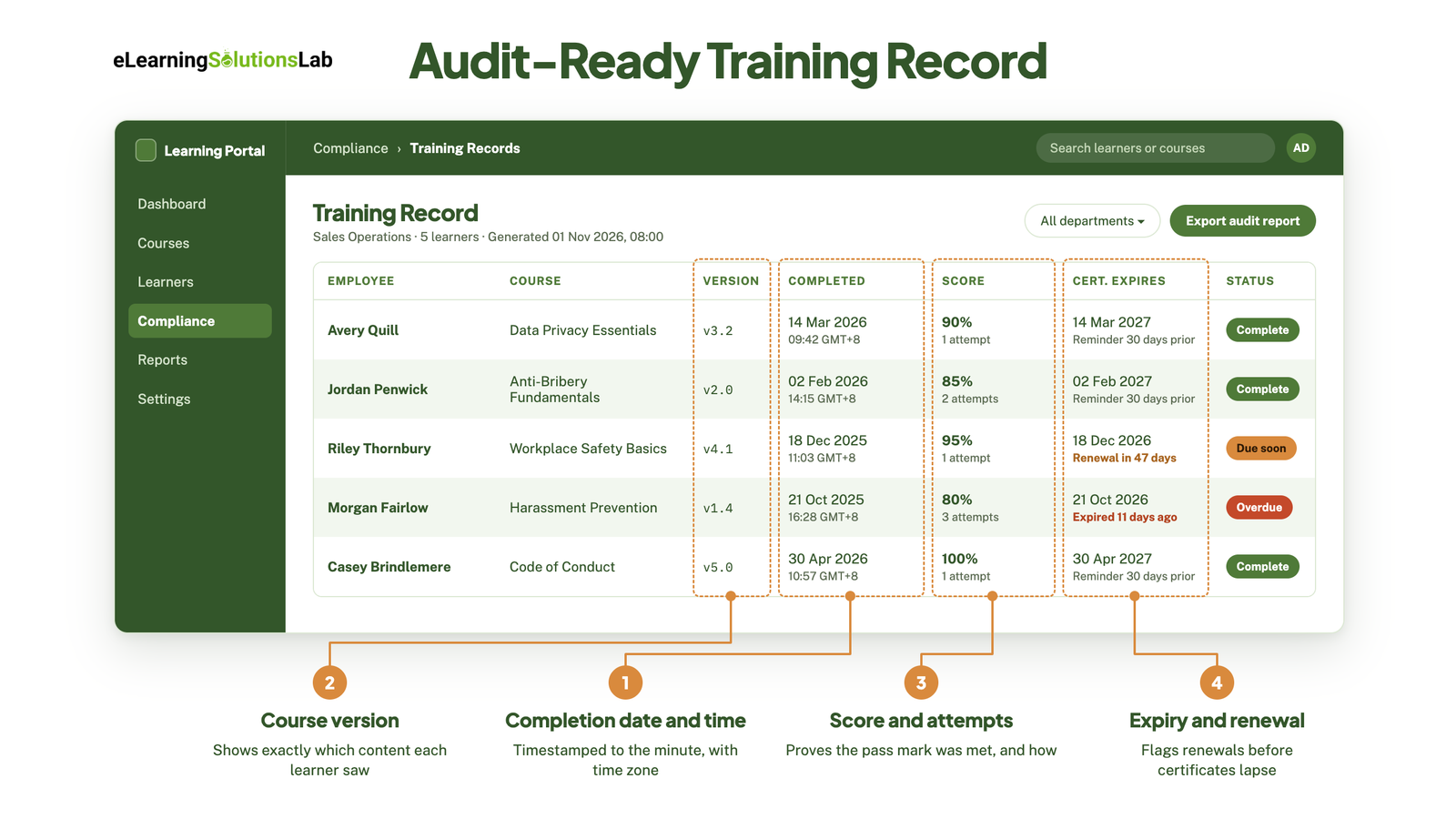
What Auditors Expect to See
| Record | Why it matters |
|---|---|
| Completion date and time | Proves training happened before or within a required deadline |
| Assessment score and attempts | Shows the employee understood the content, not just opened it |
| Course version | Confirms the employee saw the policy that applied at the time |
| Policy acknowledgment | Records that the employee read and accepted a specific policy |
| Certificate and expiry date | Shows when retraining is due |
| Overdue and exception reports | Shows you track gaps and follow up, not just successes |
Keep records for as long as the strictest applicable rule requires. HIPAA, for example, requires covered entities to keep required documentation for six years. Our guide on how to track employee training covers the metrics and reports worth capturing.
SCORM, xAPI, and cmi5
These standards control how a course talks to your LMS. SCORM is the most widely supported and reliably records completion, score, and time. xAPI and cmi5 can capture more detail, like individual choices in a scenario, which helps you spot where people get decisions wrong. Before you build or buy courses, check the SCORM compliance requirements for your LMS so completions are recorded correctly.
Automating Assignments and Renewals
Manual tracking in spreadsheets breaks down quickly once you have several courses, regions, and renewal cycles. A good LMS should handle:
- Automatic assignment by role, location, and hire date, so new hires get the right courses on day one
- Reminders and escalations to employees and their managers when deadlines approach
- Recertification windows that reassign courses before certificates expire
- Version control that reassigns a course to everyone affected when a policy changes
- Audit-ready reports you can export by team, region, or course in minutes
If you’re evaluating platforms, an LMS requirements checklist helps you confirm these features before you sign a contract.
Free Compliance Training Options
You can learn compliance online for free, and some free resources are genuinely useful. Here are the most reliable sources:
- OSHA: Free safety guides, fact sheets, and training materials on most workplace hazards. Note that OSHA Outreach 10-hour and 30-hour cards are delivered by authorized trainers and are usually paid.
- HHS: Free HIPAA guidance and educational materials for covered entities and business associates.
- State agencies: California’s Civil Rights Department offers free online harassment prevention courses, and New York State publishes free model training materials.
- CISA: Free cybersecurity awareness resources for organizations of any size.
- UK regulators: The ICO and HSE publish free guidance on data protection and workplace safety.
- MOOCs: Platforms like Coursera and edX let you audit many compliance and ethics courses for free.
Where Free Falls Short
Free resources are a good fit for small teams in a single jurisdiction, or as a supplement to a wider program. But they usually come with limits:
- No completion tracking in your own LMS, which weakens your audit trail
- Generic content that doesn’t reflect your policies, tools, or reporting channels
- Usually one language and one jurisdiction
- No control over updates when laws change
For organizations that need tracked, multi-region training, paid off-the-shelf eLearning libraries or custom courses are usually the next step.
How to Roll Out an eLearning Compliance Program: 6 Steps
1. Map Your Obligations by Region and Role
Use the matrix above to list every topic that applies to each employee group, along with the required frequency. This becomes the backbone of your compliance training plan.
2. Choose Your Delivery Model
Decide whether to license ready-made courses, build your own, or combine both. Many organizations use off-the-shelf courses for universal topics and custom modules for company-specific policies. Comparing the top compliance eLearning providers is a good starting point, and understanding typical eLearning development costs helps you budget for custom work.
3. Build or Buy the Content
Whichever route you take, review every course against your own policies. Make sure scenarios reflect real situations in your workplace, assessments test decisions rather than recall, and courses meet accessibility standards so every employee can complete them. Experienced instructional design services can turn dense legal requirements into short, practical modules.
4. Localize for Each Region
Translate courses into the languages your employees work in, and add regional modules where laws differ. Have local legal or HR contacts review each version before launch.
5. Launch, Track, and Remind
Assign courses automatically by role and location, set deadlines, and turn on reminders and manager escalations. Build compliance modules into your employee onboarding and training so new hires complete required courses in their first week.
6. Review Every Year, and When Laws Change
Set a fixed annual review for every course, and assign someone to monitor legal changes in each region you operate in. When a law or policy changes, update the course, record the new version, and reassign it to everyone affected.
In one line
Map what each region and role requires, build short scenario-based courses people remember, localize them properly, and keep records that prove every completion.
Ready to build compliance training people actually remember?
At eLearning Solutions Lab, we design and build scenario-based compliance courses for US and global teams, in the languages your employees work in. Our custom eLearning development services cover design, development, localization, and QA in one team.
Need somewhere to deliver and track it? Levantra LMS, our cloud based LMS, assigns compliance courses by role or location, automates reminders and renewals, and keeps audit-ready records for every completion.
See our custom eLearning development servicesBook a Levantra LMS demo
Related Reading
- Compliance training plan – making sure every employee completes required training on time.
- Top compliance eLearning providers – comparing vendors for ready-made and custom courses.
- eLearning localization services – adapting courses for global teams.
- SCORM compliance requirements – making sure your LMS records every completion.
- New hire checklist – fitting compliance training into the first 90 days.
The Author

Book A Discovery Call
Our Learning Advisors are happy to walk you through your project step-by-step — content, timeline, and fixed pricing.
Get Your Free QuoteNo obligation — just a focused conversation. Proposal within 24 hours.
You may also like
New Hire Checklist (US + Global): Free Template for 2027
Only 12% of employees strongly agree that their company does a great job of…
Employee Onboarding and Training: A Practical Guide (+ Free 90-Day Plan)
A new hire's first week usually sets the tone for everything that follows. And…