

Most corporate training fails for the same reason – it was built for everyone, so it fits no one. For instance, a generic compliance module or an off-the-shelf course on communication skills might check a box, but it would rarely reflect how your team actually works, the tools they use, and the outcomes your business needs.
That’s the problem bespoke eLearning is built to solve.
Bespoke eLearning is custom-built online training designed around a specific organization’s content, learners, and goals — rather than being purchased as a ready-made, one-size-fits-all course.
Instead of truly adapting your workflows to a template, the course is shaped around your processes, your context, your branding, your compliance requirements, and the exact behavior you want your learners to walk away with.
This guide shows you what bespoke eLearning is, how it compares to off-the-shelf, its development process, realistic US cost ranges, and a simple framework for deciding when it’s the right call for it.
Bespoke vs. Off-the-Shelf eLearning
The fastest way to truly understand bespoke eLearning is to put it next to its opposite: off-the-shelf eLearning courses.
Neither is better in the abstract of things; they actually solve different problems. So here’s how they compare across factors that matter most to L&D buyers:
| Factor | Bespoke eLearning | Off-the-Shelf eLearning |
|---|---|---|
| Upfront cost | Higher — you pay for design and build | Lower — shared across many buyers |
| Time to launch | Weeks (depends on complexity) | Immediate — available on purchase |
| Relevance | Built around your workflows, roles, and scenarios | Generic; covers broad, universal topics |
| Branding | Fully on-brand (visuals, tone, voice) | Vendor’s look and feel; limited or no customization |
| Compliance fit | Mapped to your exact policies and regulations | Covers general standards, not your specifics |
| Scalability | Modular source files you can update and reuse | Locked content; re-license to update |
| Ownership | You own the course and source files | You license access; vendor retains ownership |
| Maintenance | You control updates (or your provider does) | Vendor updates on their schedule, not yours |
| Best for | Role-specific, brand-critical, or behavior-change training | Generic skills, broad compliance, immediate needs |
The two aren’t strictly either/or. It’s the growing middle ground – often called rapid eLearning services or templated eLearning – that sits between them.
Here, existing content (slide decks, manuals, webinar recordings) is converted into a polished, interactive course using proven design frameworks rather than fully custom builds. You can check out our guide on eLearning development best practices.
So you get more relevance and branding than off-the-shelf, at a lower cost and faster turnaround than full bespoke development.
How Much Does Bespoke eLearning Cost?
This is the question most eLearning content providers dodge, and probably the biggest reason buyers leave search frustrated. The honest answer is that bespoke eLearning is priced in one of four ways – understanding each of the models matters more than any single number.
Four Common Pricing Models:
- Per finished hour of learning – it’s the traditional industry benchmark. So you pay for each hour of complete seat time; one finished hour can take around 100 to 300 development hours to build.
- Per course/module – a flat price for a defined deliverable (e.g., a 30-minute course). Much easier to budget against and increasingly common with providers who publish their pricing.
- Per project – a single scoped quote covering multiple courses or a full program
- Retainer/subscription – ongoing capacity for teams with a steady content pipeline.
Realistic US benchmark ranges (by interactivity level):
| Complexity | What It Includes | Typical US-Agency Range (per finished hour) |
|---|---|---|
| Basic | Linear content, simple quiz, light interactivity | ~$5,000–$15,000 |
| Moderate | Custom visuals, scenarios, branching, voiceover | ~$15,000–$35,000 |
| High | Simulations, heavy branching, custom media, gamification | ~$35,000–$60,000+ |
See our full breakdown of eLearning development costs.
Where the model changes the math: Those figures above reflect traditional US-agency overhead. So transparent, per-course providers can land far below them for comparable quality. For instance, at our eLearning solutions company, published rates can start around $1,500 for a 30-minute course with basic interactivity and one revision round, roughly $2,499 for a 45-minute course with moderate interactivity, custom visuals, and branding, and around $5,999 for a three-course bundle with rich branching and voiceover.
What drives cost up: custom media (video, animation, voiceover), branching scenarios and simulations, revision rounds, SME availability, accessibility compliance, and localization.
When to Choose Bespoke vs. Off-the-Shelf (Decision Framework)
Most L&D teams don’t need an either/or answer – they just need a way to decide per project.
Run each training need through this quick check. The more boxes you tick on one side, the clearer your answer will be.
A simple rule of thumb: If a training only works when it’s built around your organization, it’s a bespoke candidate. If a learner couldn’t tell whether it came from your company or any other, an off-the-shelf product will likely do the job.
And don’t simply overlook the middle path. When you have existing content (slides, manuals, recordings) that’s already relevant, but not course-ready, rapid or templated development often delivers most of the bespoke benefit at a fraction of the cost and time.
How to Choose a Bespoke eLearning Provider
Once you’ve decided bespoke is the right call, your risk shifts from what to build to who builds it, it helps to compare the top custom eLearning development companies before you commit. So the biggest predictor of a bad outcome isn’t price or geography – it’s an eLearning vendor who treats your project as one of fifty in a queue, with no real discovery, and no ownership of the result.
What to evaluate:
- Instructional design depth – do they lead with learning design (objectives, assessment, behavior change), or just visuals and interactivity?
- Relevant portfolio – have they built for your use case: compliance, onboarding, sales, leadership, and your kind of audience?
- Transparent pricing – published or clearly scoped pricing signals confidence.
- Defined process with checkpoints – look for storyboard approval before development and review stages mid-build – so you safeguard yourself against any expensive surprises at delivery.
- Accessibility as standard – WCAG 2.1 AA should be built into every eLearning course, not sold as a premium tier.
- LMS compatibility – confirm SCORM 1.2, SCORM 2004, or xAPI delivery, and test against your specific LMS.
- Source-file ownership – will you receive editable files so you can update content later without any full rebuild?
- Revision and maintenance terms – how many rounds are included? What do updates cost after launch?
RFP questions worth asking:
- What does your discovery and needs-analysis process look like?
- Who owns the course and source files on delivery?
- How do you handle scope changes and SME delays?
- What’s your typical turnaround for a 30-minute course?
- How do you measure whether the training worked?
How to Measure the ROI of Bespoke eLearning
Everyone today sells bespoke eLearning on ROI. But almost no one actually explains how to measure it, which is exactly why so many custom projects get approved on a promise and never proven.
So the fix is to stop treating ROI as a single number at the end and start tracking it as a chain of indicators that will move in sequence – from easy to measure to business critical.
One useful way to structure this is the ffour-levelKirkpatrick model, which is working from leading indicators (available early, easy to capture) to lagging ones (slower, but what your leadership team actually cares about):
| Level | What You Measure | Leading or Lagging | How to Capture It |
|---|---|---|---|
| 1. Reaction | Did learners find it relevant and worth their time? | Leading | Post-course survey, completion and drop-off rates |
| 2. Learning | Did knowledge or skill actually improve? | Leading | Pre/post assessment scores, scenario performance |
| 3. Behavior | Are they doing the job differently 30–90 days later? | Lagging | Manager observation, on-the-job checklists, system data |
| 4. Results | Did the target business metric move? | Lagging | The KPI the course was built to influence |
The mistake most L&D teams make here is stopping at Level 1 or 2. So, a 95% completion rate and a passing quiz score tell you the course was consummated, ot that anyone works differently or that the business gained anything.
The chain that actually proves ROI:
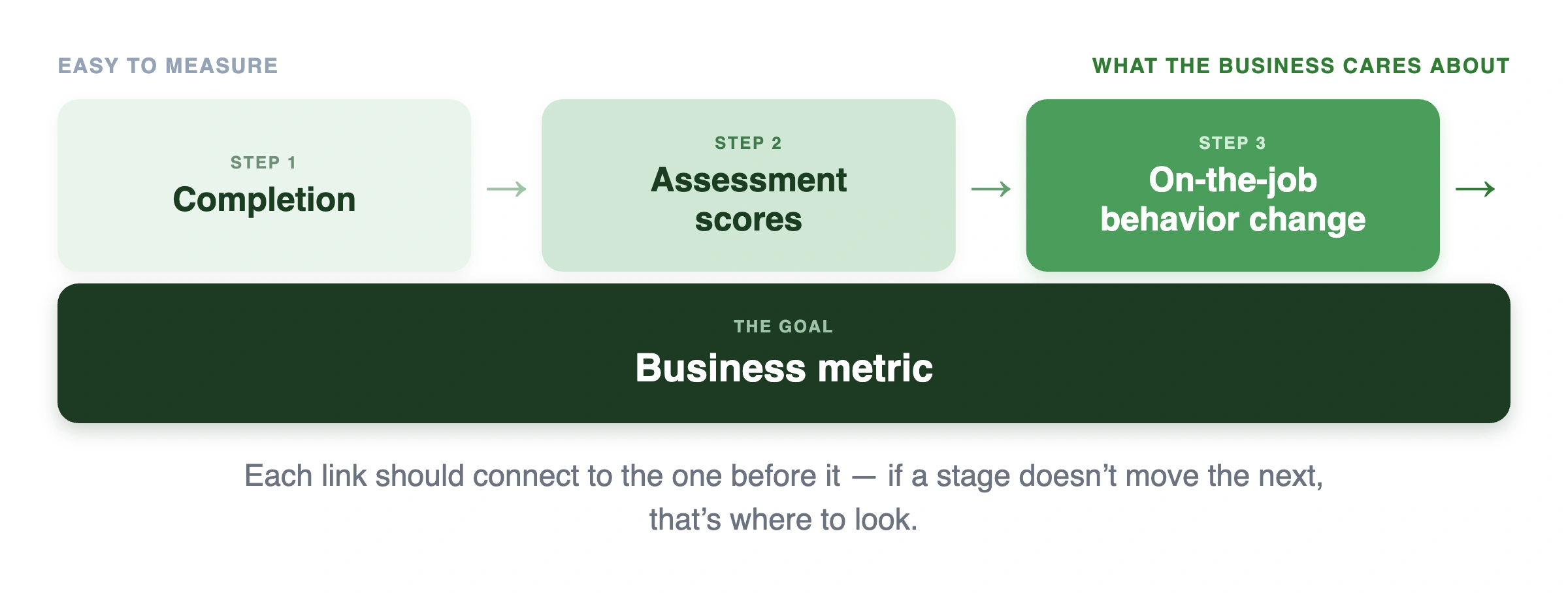 Each of the links above should connect to the one before it. So if completion is high, let’s say, but behavior doesn’t change, your problem is design, not delivery. If behavior changes for that matter, but the business metric doesn’t move, you measured the wrong outcome, which means the real ROI work here happens before the build, when you decide what success looks like.
Here’s an actionable strategy h
Make it measurable from day one:
- Define the Level 4 metric first – so before scoping the course, name the business result – it should influence outcomes like reduced safety incidents, faster ramp-to-quota, fewer compliance violations, or lower error rates. Given that this is where bespoke has a structural advantage over off-the-shelf, you can build content around a specific metric.
- Baseline before you launch – you can’t actually prove improvement without a “before” or set number – so you need to capture the current metric and current behavior first.
- Build the assessment to mirror the job, not the slides – scenario and decision-based questions, which is a natural fit for bespoke – measure applied judgment, which can predict behavior change far better than recall quizzes.
- Set a measurement window – behavior (Level 3) typically shows at 30 to 90 days; business results (Level 4) often will take a quarter or more
How eLearning Solutions Lab Approaches Bespoke eLearning
If you’ve worked through the framework above and see that bespoke looks like the right fit for your organization, here’s how we put these principles into practice.
At eLearning Solutions Lab, we build fully custom, role-specific courses end-to-end – from instructional design and storyboarding through development, QA, and LMS-ready packaging (SCORM 1.2, SCORM 2004, or xAPI, with WCAG 2.1 AA accessibility built into every eLearning course).
You can explore our full end-to-end approach on our custom eLearning development services or browse our complete range, including rapid eLearning, ILT to eLearning services, microlearning, and consulting on our eLearning development services overview.
If you’re currently weighing a specific project, the fastest next step is a short discovery call to pressure test whether bespoke is genuinely the right call for it.
The Author

Book A Discovery Call
Our Learning Advisors are happy to walk you through your project step-by-step — content, timeline, and fixed pricing.
Get Your Free QuoteNo obligation — just a focused conversation. Proposal within 24 hours.
You may also like
Staff Augmentation for L&D: Buyer’s Guide, Costs & Fit
L&D staff augmentation is a staffing model where an external eLearning…
How to Convert PowerPoint to eLearning (2026 Guide)
You have a 60-slide deck that worked pretty well in a live session. Now it…