

The biggest eLearning trends of 2026 will all point in the same direction: AI-powered personalization, microlearning, mobile-first delivery, immersive simulation, skills-based credentials, and AI-assisted content production are now reshaping how organizations build and deliver training – faster and at greater scale than ever before.
Let’s look at the 9 eLearning trends that actually matter for 2026 – that’s paired with the one thing the winning teams have that everyone else doesn’t: not fastest adoption, but a disciplined, governed way of using AI where speed and quality scale together.
9 eLearning Trends Shaping in 2026
Most of these won’t surprise you as an L&D manager, but what follows each one of them is how to actually apply it.
1. AI-Powered Personalization & Adaptive Learning
Platforms that use AI to really adjust what each learner sees in real time, like changing difficulty, recommending next steps, and reshaping the path based on actual performance, instead of just marching everyone through one fixed course.
It matters given that, let’s say, a single instructor can’t tailor a path for 5,000 learners – but AI can. For large or varied audiences, adaptive pathways can close skill gaps faster given that no one wastes time on what they already know. Based on a study by Synthesia, around a third of L&D teams will plan to roll out personalized learning pathways in the next 12 to 18 months – so this is really moving from pilot to mainstream.
To apply this, start narrow. Pick one high-volume course with a wide skill spread — customer onboarding training is ideal here – add a diagnostic pre-check, and branch learners into “needs the basics” vs. “skip ahead” tracks before investing in a full adaptive platform. You have to prove the lift on one course before scaling.
For example, an adaptive compliance course quizzes a learner up front, can detect weak spots on data-handling rules, and will serve extra practice only on those, like cutting seat time for people who already know the rest.
2. Microlearning
Microlearning is short, focused learning units, like three to seven minutes, each built around a single objective, delivered when the learner needs it rather than just in a two-hour block.
It matters when attention and time are the scarcest resources in corporate learning. Microlearning will fit into the gap in the workday and work far better for reinforcement, where spaced repetition can beat one long session for long-term retention.
To apply microlearning, don’t just chop a long course into fragments – that’s slicing, not designing. Well-built microlearning services build each micro-unit to stand alone with its own objective and takeaways, then sequence them as a reinforcement drip in the weeks after the main training.
An example of this is after a live sales-methodology workshop, elearning sales training can give reps one 4-minute refresher every few days: scenario, quick decision, instant feedback – so that the method sticks instead of just fading by Friday.
An example of this is after a live sales-methodology workshop, sales reps can get one 4-minute refresher every few days: scenario, quick decision, instant feedback – so that the method sticks instead of just fading by Friday.
3. Mobile-First and Learning in the Flow of Work
Designing training so that it works on a phone first and can reach the learner inside the tools and moments where the work actually happens – not really parked in an LMS, they have to remember to visit.
Deskless and distributed workforces can’t really stop to sit at a computer. Meeting them where they are can drive completion, and it’s a measurable productivity play – AI-powered mobile learning and subtitling have been linked to a productivity gain of over 40%.
You can audit your existing courses on an actual phone before anything else: as most responsive content just fails on small screens. Then prioritize just-in-time formats like job aids, searchable how-tos, over long modules for anything that performed on the job.
For example, a field technician can pull up a 90-second “how to reset this unit” video on their phone at the job site, instead of just recalling it from an onboarding course taken months ago.
4. Gamification
Gamification is applying game mechanics like challenges, progress, feedback loops, and stakes to actual learning – not just to make it fun, but to really drive motivation and behavior change.
Gamification is done as an instructional strategy rather than just decoration – gamification can lift engagement and completion, especially for soft skills and repetitive but critical training where learners can tune out fast.
You can apply it by tying the mechanics to the objective, which is exactly what strong elearning gamification services do. Points and badges alone wear off, but meaningful choices with consequences – scenario based elearning services where a wrong call plays out – can build actual judgment. You need to ask “what decision am I rehearsing?” before “what game do I bolt on?”.
An example of this is a quiz-board game format for an awareness program turning dry policy content into a series of decisions with immediate consequences – learners complete, but they’re rehearsing real judgment calls as they go.
5. Immersive Learning (VR, AR and Simulation)
Immersive learning are high-fidelity practice environments, from full VR to lighter branched simulations, that will let learners rehearse real tasks safely before actually doing them for real.
So for high-stakes, hard-to-practice, or dangerous scenarios, elearning simulation is the closest thing to on-the-job experience without the actual risks. Retention from just doing far outpaces watching.
An example of this is new warehouse staff practicing a hazardous-equipment shutdown — a natural fit for elearning safety training services — in a simulation where mistakes are visible and consequence-free, then just repeat until the sequence becomes automatic.
Don’t just lead with the headset. Reserve full VR for genuinely high-stakes or high-repetition tasks where the real ROI justifies it. And for everything else, a well-built branched scenario or 360° walkthrough can deliver most of the benefit at a fraction of the cost.
An example of this is a new warehouse staff practicing a hazardous-equipment shutdown in a simulation where mistakes are visible and consequence-free, then just repeat until the sequence becomes automatic.
6. AI-Assisted Content Production
Using AI to build itself, like drafting storyboards, generating assessments, producing voiceover, translating and localizing to compress development timelines dramatically – the engine behind rapid elearning services.
Start treating AI for instructional design as a thinking partner that drafts, not just a machine that finishes the entire production line.
It matters where AI has landed hardest and fastest so that teams use it most for voice generation, content, and quiz drafting, video creation, and translation – the production line, sped up really.
The catch here, though, is that speed only becomes scale if quality holds, and that’s exactly where most L&D teams are struggling.
Start treating AI as a thinking partner that drafts, not just a machine that finishes the entire production line. Use it to generate options, first drafts, and alternatives – then keep a human owning every consequential decision. How you structure that handoff really is the difference between faster and just messier.
An example of this is a desigenr uses AI to draft a storyboard and generate a first-pass voiceover in an afternoon – work that actually used to take a week to finish – then spends that reclaimed time on the judgment calls AI can’t make.
7. Skills-Based Learning and Micro-Credentials
When you shift the unit of learning from “courses completed” to capability building and skills demonstrated, it’s often backed by verifiable micro-credentials or digital badges that are tied to specific capabilities.
It matters as employers and learners both want proof of capability, not just attendance. 61% of corporate L&D professionals name closing skill gaps as their top training goal, and 81% of executives say micro-credentials make hiring decisions easier.
Start mapping your training to a skills taxonomy before building anything, so that every course ladders up to a defined capability. Then attach credentials only where the skill is verifiable – which is simply a badge that doesn’t require demonstrated competence eroding trust in all of them.
As an example, instead of a “Completed Cybersecurity 101” certificate, a learner earns a “Phishing Response” credential only after correctly handling a set of live simulated attacks.
8. Learning Experience Platforms (LXP) and Learning Analytics
LXPs curate and recommend content (Netflix-style discovery) rather than just hosting and tracking it like a traditional LMS, while learning analytics turn activity data into insight about what’s working.
It matters given that it’s a differentiator not in delivering content, but in proving impact – ultimately the elearning ROI that justifies the budget. Analytics let L&D speak in business outcomes, and the gap here is real: production has raced ahead while measurement really has lagged badly behind.
Start deciding what you’ll measure before you buy the platform. Define two or three outcome metrics that will connect learning to performance (time-to-productivity, error rates, competency scores) so that the analytics answer a business question rather than just reporting click counts.
For instance, rather tha nreporting “500 completions,” an L&D team will show that reps who finished the new onboarding path hit quota a month sooner than those who didn’t.
9. Multilingual and Multi-Region Delivery at Speed
Producing and localizing training across dozens of languages and regions fast while using AI for translation and localization stacks — the backbone of modern elearning localization services — to hit every audience close to simultaneously.
An example of this is a 10-module compliance suite that will ship to three regions at once, each version AI-translated in days — the kind of output top elearning translation companies now deliver — but signed off by a regional reviewer who can catch the local regulatory nuances the model missed.
Global rollouts used to mean the home region that just got training months before everyone else. AI can collapse that lag – but literal translation without cultural and contextual adaptation is where quality quietly breaks.
Start designing for localization from the start: keep text out of images, leave room for languages that will run longer, and build a source that’s easy to adapt. Then keep a human reviewer per region for context and compliance. AI will draft the translation; a native reviewer owns whether it actually lands.
The Trend Under the Trends: Discipline Beats Adoption Speed
Underneath every trend above is the tool that is no longer the hard part.
AI can already draft a storyboard, generate a full assessment bank, produce voiceover, and localize a course into a dozen languages – faster than any team could have imagined three years ago.
And the reason they’re stuck is almost never a shortage of tools – there are hundreds of them. It’s actually a shortage of discipline around them – the elearning development best practices that turn raw tool access into consistent output.
Walk into a typical L&D team, and you’ll find one instructional designer drafting with ChatGPT, another generating images in Midjourney, a third using a different tool for voiceover – and the quality standards, review steps, and sign-offs just sitting exactly where they were before any of it arrived.
It only produces a very specific failure mode: output that’s faster but wildly inconsistent from one person to the next – one project to the next.
Roughly 87% of L&D teams now use AI in some form, but only about 36% are actually running inside a defined workflow, and just 9% have scaled it across the organization. So the gap between those figures is the entire problem – as nearly everyone has tools.
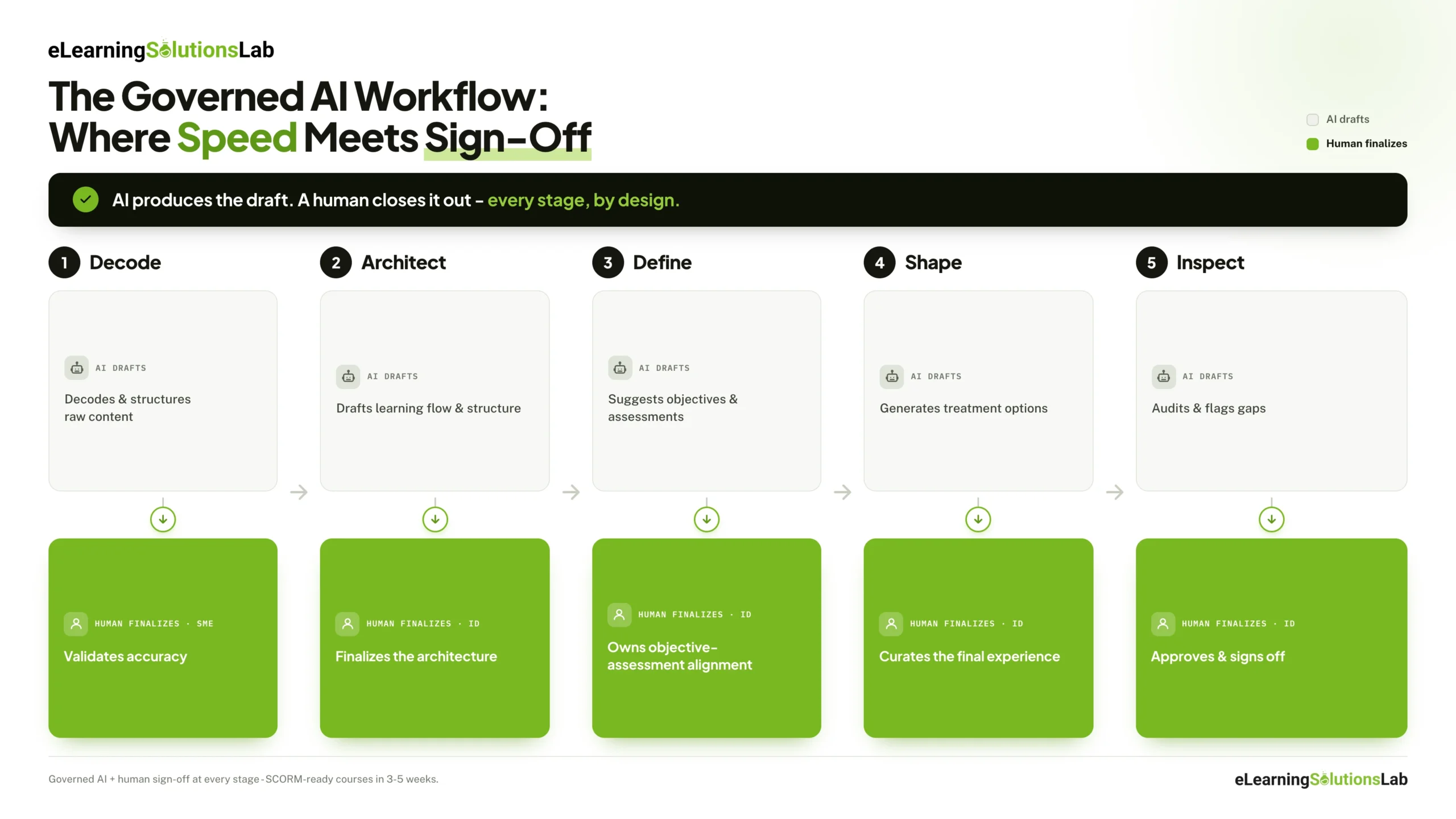 AI accelerates; humans own.
The teams that are pulling ahead have all made the same move – they treat AI as a thinking partner – something that can generate options, drafts, and critiques, while a human owns every decision that will actually determine whether the training works.
That division of labor is the whole game:
- AI accelerates the parts that are about speed and volume: first drafts, alternative explanations, structural options, flagging gaps and inconsistencies – that are all producing the tenth version so that a human can choose the best one.
- Humans own the parts that are about judgment – what the real performance gap is, what the learner needs to do differently, and whether the instructional approach fits the audience- and final sign-off on accuracy and objective-assessment alignment.
- It’s the handoff, not the output.
Most L&D teams worried about AI quality are watching the wrong thing. They’re just scrutinizing the AI’s output – it’s the draft that’s good enough, is the voiceover natural, is the translation pretty accurate?
But when AI-assisted production breaks, it’s rarely the AI output that fails. It’s the handoff: the moment where AI’s draft is supposed to pass to a human who reviews, corrects, and finalizes it, and instead of just getting published because everyone assumed someone else checked.
What a Governed Workflow Actually Looks Like
The principle here is simple: AI produces the draft, a human closes it out. The hard part really is knowing exactly where in the process that handoff sits – given that “review it at the end” is how quality really breaks.
A governed workflow defines the handoff at every stage. Here’s what that looks like across five stages of building a course.
Stage 1: Decode the source content
You start with raw materials: an SME’s brain-dump, a policy document, a product spec, a recorded interview. Someone has to turn that into something structured enough to build from:
- AI accelerates: decoding the raw content — much like legacy content conversion services do — summarizing, extracting key points, and organizing a wall of source materials into workable structures
- Human owns: the SME validates that nothing critical was lost, misread, or invested. So accuracy of the source is non-negotiable, and it’s a human call.
Stage 2: Architect the learning flow
Now the content needs a shape: logical sequence, module structure, and a path through the materials that make sense for how people actually learn it.
- AI accelerates drafting a proposed flow like module breakdown, sequence options, and a first-pass structure to react to.
- Human owns: the instructional designer will finalize the architecture — the core of professional instructional design services. Whether the flow fits the audience and objective is a judgment AI can suggest.
Stage 3: Define objectives and evidence
Every course needs clear objectives and a way to truly prove they were met. This is the stage where most L&D teams rush – and the one that most determines whether the training works.
- AI accelerates suggesting learning objectives and possible assessment approaches that are tied to the content.
- Humans own: the ID refines the objectives and critically owns the alignment between each objective and assessment that can measure it. Objective- evidence alignment is the quality bar of the entire course, and it stays human.
Stage 4: Shape the learning treatment
This is the build: turning structure and objectives into actual experience – scenarios, interactions, examples, media, and tone.
- AI accelerates and generates treatment options: scenario drafts, interaction ideas, example variations, first-pass copy in a defined tone for a defined audience.
- Human owns: the ID curates and AI produces ten options, the designer chooses the one that fits, cuts the nine that don’t, and shapes the final experience.
Stage 5: Inspect and audit
Before anything ships, it has to go through a final pass: checking for gaps, inconsistencies, and misalignments between what was promised and what was built.
- AI accelerates audits in the near-final course as a devil’s advocate, flagging gaps between objectives and assessments, surfacing inconsistencies, and catching what a tired human reviewer might miss.
- Human owns: the ID approves, as AI can flag – only a human can decide what’s actually a problem and sign off that the course is ready.
AI does the drafting so humans will have time and attention for judgment – and that judgment is what protects quality when you’re moving fast.
The Author

Book A Discovery Call
Our Learning Advisors are happy to walk you through your project step-by-step — content, timeline, and fixed pricing.
Get Your Free QuoteNo obligation — just a focused conversation. Proposal within 24 hours.
You may also like
Staff Augmentation for L&D: Buyer’s Guide, Costs & Fit
L&D staff augmentation is a staffing model where an external eLearning…

How to Convert PowerPoint to eLearning (2026 Guide)
You have a 60-slide deck that worked pretty well in a live session. Now it…