

Sales skills have a very short shelf life – and reps often forget most of what they learn from a classroom training within weeks, and sometimes the old playbook – fly everyone in for a two-day workshop and hope it sticks – doesn’t really scale across regions, time zones, or a team that’s constantly hiring.
A sales training program that changes behavior needs the right curriculum, right formats, and a way to prove it really worked.
This guide walks you through all of it: what eLearning sales training is, modules a strong program must include, how to build one step by step, and how to measure results and its ROI. It’s actually written for L&D and sales enablement teams who are building (or fixing) a program in 2026.
What is eLearning sales training?
Definition
eLearning sales training is self-paced or blended online instruction that builds practical selling skills — prospecting, discovery, objection handling, and closing — through modules, videos, scenario practice, and assessments delivered in a learning platform (LMS).
The format spans a spectrum. So on one end is fully self-paced eLearning: reps move through modules on their own schedule. On the other hand, there is instructor-led training (ILT), whether in a room or over video, which actually offers live interaction but doesn’t really scale and is hard to repeat consistently.
Most effective sales programs land in the middle: blended learning that pairs self-paced modules for knowledge (product facts, process steps, frameworks) with live sessions or coaching for skills that actually need practice and feedback.
The distinction really matters here, given that each approach fits a different job:
Who is eLearning sales training for?
eLearning sales training isn’t just for new hires, though onboarding is the most common use case.
A well-built sales training program can serve several audiences at once: SDRs and BDRs who are getting up to speed on outreach and qualification, as well as AEs who are ramping and learning the full sales cycle, channel and partner sellers who actually need consistent messaging without sitting in your office, and tenured reps who just need ongoing reinforcement as products, buyers, and competitors shift.
Benefits of eLearning for Sales Training
Here’s what eLearning actually does for a sales organization, and why each benefit holds up.
1. Faster, more consistent onboarding.
Ramp time is one of the most expensive variables in a sales organization – so every week a sales rep isn’t just as productive is a week of carried cost with no return.
Self-paced modules that will let new hires start on day one instead of just waiting for the next scheduled cohort, and every sales rep gets the same version of that pitch, process, and product story. So that consistency is really hard to guarantee when onboarding depends on whichever manager happens to be free.
2. Retention that survives past week one.
The problem with a two-day workshop, sometimes, isn’t the content – it’s actually the forgetting curve. So people will lose the majority of new information within days unless it’s really reinforced. eLearning can solve this structurally through microlearning (short, focused units) and spaced repetition (revisiting concepts over time) so that skills are reinforced rather than just dumped once and abandoned.
3. Scale without pulling reps off the floor.
Training a global team the traditional way means traveling, scheduling around time zones, and talking sellers out of the pipeline. So online training can remove all three constraints – so a sales rep in another region completes the same sales training programs on their own schedule, and adding the hundredth learner can cost roughly the same as adding the list.
4. Built-in reinforcement and coaching loops.
Classroom training can end when everyone leaves the room. E-learning can run continuously like drop campaigns, refreshers that are tied to new product launches, and manager-led coaching prompts that are triggered by assessment results. So this is an ongoing cadence where the actual behavior change actually happens, and it’s nearly impossible to sustain while live-only training.
5. It’s measurable.
You can’t just improve what you can’t see. Online delivery captures completion, assessment scores, and activity data automatically and will help connect to downstream metrics like ramp time and win rate. Classroom training rarely will give you more than just an attendance sheet and a smile sheet.
Core Curriculum: Modules of a Strong eLearning Sales Training Program
Below is a complete module map that you can adapt – that’s organized in the sequence a sales rep should actually move through it, with a rough time budget for each.
Think of it in two layers: foundational modules that every sales rep completes during onboarding and skill modules that require practice, reinforcement, and revisits – beyond just the first 90 days of training.
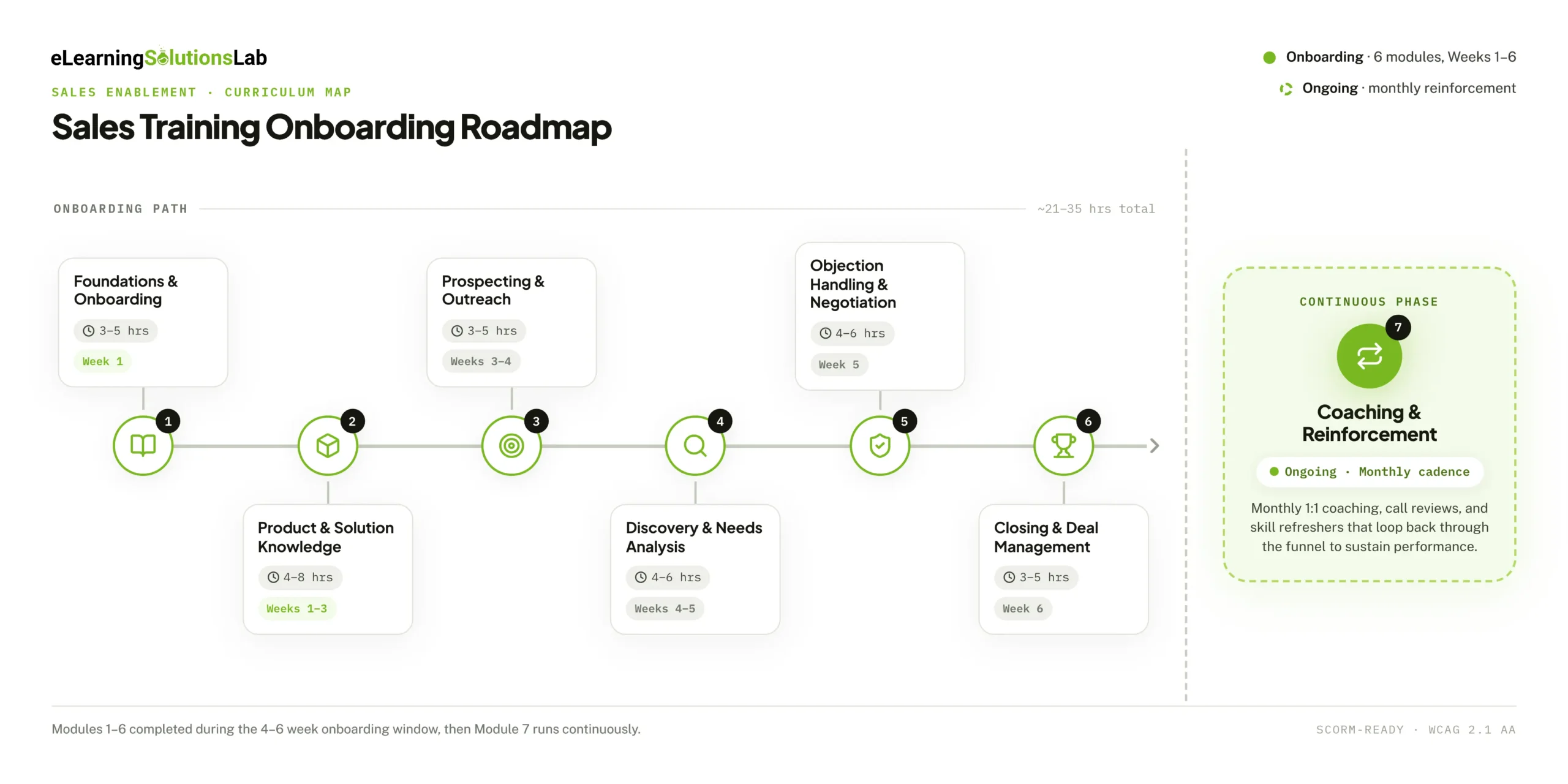
Foundations and Onboarding
This is the orientation layer. So before any sales rep can sell, they need to understand what they’re selling and to whom. So this module can cover the company story, the ideal customer profile (ICP), the value proposition, and a walkthrough of your sales process and CRM.
Suggested time: 3 to 5 hours, first week.
Product and Solution Knowledge
What the product does, the problem it solves, and how it stacks up against alternatives. So the goal isn’t feature memorization – it’s the ability to connect a capability to a buyer’s pain. Now, assessments here should really test application – for instance, “which feature can address this objection?”, rather than just recall.
Suggested time: 4 to 8 hours, spread across weeks 1 to 3.
Prospecting and Outreach
When you build a pipeline, you identify targets, multi-channel sequencing (email, phone, and social), and write outreach that will get replies. So this will be a high-practice territory – so pair those modules with real templates sales reps can adapt and submit for feedback.
Suggested time: 3 to 5 hours, plus ongoing practice.
Discovery and Needs Analysis
Arguably the highest leverage skill in the whole program. These include questioning frameworks, active listening, and uncovering the business problem beneath every stated request. This is best taught through recorded call examples and scenario practice – not just slides.
Suggested time: 4 to 6 hours, with recurring reinforcement.
Objection Handling and Negotiation
How to respond to price pushback, stalls, and late-stage negotiation – this is the module that benefits enormously from role-play and elearning simulation, given that the skill only sticks when sales reps have rehearsed the responses out loud.
Suggested time: 4 to 6 hours, revisited quarterly.
Closing and Deal Management
Advancing and closing, like reading buying signals, mutual action plans, managing a multi-stakeholder deal, and clean handoffs – this will tie directly to your actual sales stages so that it maps to what sales reps see in the CRM.
Suggested time: 3 to 5 hours
Coaching and Reinforcement (Ongoing)
Not just a one-time module – but a permanent layer. These include manager-led coaching, refreshers that are triggered by new launches or losses, and periodic skill re-assessments. This is what truly separates a program that changes behavior from a library that nobody revisits after onboarding.
Suggested time: Ongoing, monthly cadence
How often should sales teams be retrained?
Onboarding is the start, not the finish. Effective sales training programs run continuous reinforcement, including monthly coaching, refreshers triggered by product launches or lost deals, and quarterly revisits of high-decay skills like objection handling.
Rather Skip the Build?
We build your eLearning sales training end to end
From instructional design and custom course development to AI role-play simulations, gamification, and LMS-ready SCORM packages — our team handles the whole program so your reps get training that actually changes behavior.
Formats and Technology that make it stick
Format is how and is usually the difference between a program sales reps can compete in and one they can actually learn from. So the same objection-handling content will land very differently as a 40-slide deck versus a five-minute simulated call.
Here are the formats that are worth building around.
Microlearning
Short, single-focus units of roughly 5 to 10 minutes. Microlearning services truly work given that they match how sales reps can actually have time to learn – between calls, not just in a blocked-off afternoon – and given that breaking content into small pieces can support spaced repetition that will drive more retention. As a rule, if a module can’t be explained in one sitting, it’s probably two modules.
Scenario-based Learning
Instead of just telling sales reps what to do, you can drop them into a realistic situation and let them make decisions with consequences. For instance, a branching scenario can teach judgment in a way that a bulleted list of tips can’t. This is where scenario-based elearning services shine – they’re the workhorse format for any type of skill that involves reading a situation.
AI role-play and Conversation Simulators
AI-powered simulators will let a sales rep hold a live, unscripted practice conversation with a virtual buyer, like handling objections, running discovery, adjusting in real time – and getting that instant feedback on what truly worked. So it solves role-play’s biggest bottleneck: you no longer just need a manager’s calendar to get sales reps meaningful reps. Practice, essentially, becomes available on demand – as often as needed.
Gamification
Leaderboards, badges, points, and challenges that can be used deliberately. Elearning gamification services work best when applied to behaviors you really want to repeat (completing refreshers, logging practice reps, hitting activity streaks) rather than just one-time completions. So the goal here is sustained engagement – not just a novelty that fades in two weeks.
Video and Interactive Assessments
Video for demonstration including recorded top rep calls, product walkthroughs, expert breakdownas and assessments that will test application rather than just recall. So it’s a good assessment that will ask a sales rep to choose the right move in a situation, not only to remember a definition.
LMS or Enablement Platform Layer
All of the above-mentioned needs somewhere to live, track, and connect – and that’s where a learning management system comes in (or a dedicated sales enablement platform) to host content, record completion and scores, automate reinforcement, and critically feed the data you’ll use to measure results. So when choosing one, always remember to weigh reporting depth and CRM integration as heavily as the content library.
How to Build an eLearning Sales Training Program
An eLearning sales program that changes behavior isn’t just built content-first – it’s built outcome-first. Here’s the sequence you can follow:
1. Define the performance gap and business outcome.
Before designing anything, you have to name the problem in business terms. Is ramp time too long? Win rates, for instance, are slipping against a specific competitor. Discovery calls going shallow? You have to pin down what sales reps aren’t doing on the job, not just what they don’t know, given that’s what training has to change. So if there’s no measurable outcome attached, you’re actually building a course, not solving a problem.
2. Write measurable learning objectives.
You need to translate the gap into specific, observable objectives: For instance, “By the end of this module, a sales rep will handle a price objection using the X framework in a simulated call.” Objectives that use vague verbs like understand or know can’t be assessed effectively – this is exactly the kind of rigor good instructional design services bring, building objectives on action verbs like handle, qualify, respond, close.
3. Map the curriculum and sequence.
Using the module map form earlier, you can select what this audience actually needs and put them in order. For instance, a new SDR and a tenured AE don’t simply get the same path. Sequence for them builds up – context and product before prospecting, discovery before objection handling.
4. Choose format and platform.
You need to match each objective to a format (knowledge → microlearning; live skill → simulation) and pick the right LMS or enablement platform that will host it. So you need to decide between build vs buy here.
5. Build or source the content.
You can create content in-house through custom elearning development services, license it from a provider, or blend both (a common approach is licensed methodology content plus in-house product and process modules). Whatever the source, you can tie every content piece back to specific objectives. So if your content doesn’t serve an objective, simply cut it.
6. Pilot with one team.
Don’t simply roll out company-wide on day one. You can run the program with a single team or cohort, gather feedback, check whether assessments actually predict on-the-job performance, and fix what breaks. A pilot will surface problems cheaply.
7. Roll out with a reinforcement and coaching cadence.
You can launch the full program with an ongoing layer built in from the start – scheduled refreshers, manager coaching prompts, periodic re-assessments. So a launch without any reinforcement plan will decay into an unused content library within a quarter.
8. Measure and iterate.
You can treat programs as living – watch metrics, see which modules move on the job behavior, and which don’t, and revise. The first version of this is a hypothesis – data will tell you what to keep.
How to Measure Results and Prove ROI
Nobody’s quota was ever hit given that a training module was marked complete – to really prove a program that works, you have to connect it to behavior and results, and the cleanest framework for that is Kirkpatrick’s Four Levels of Evaluation.
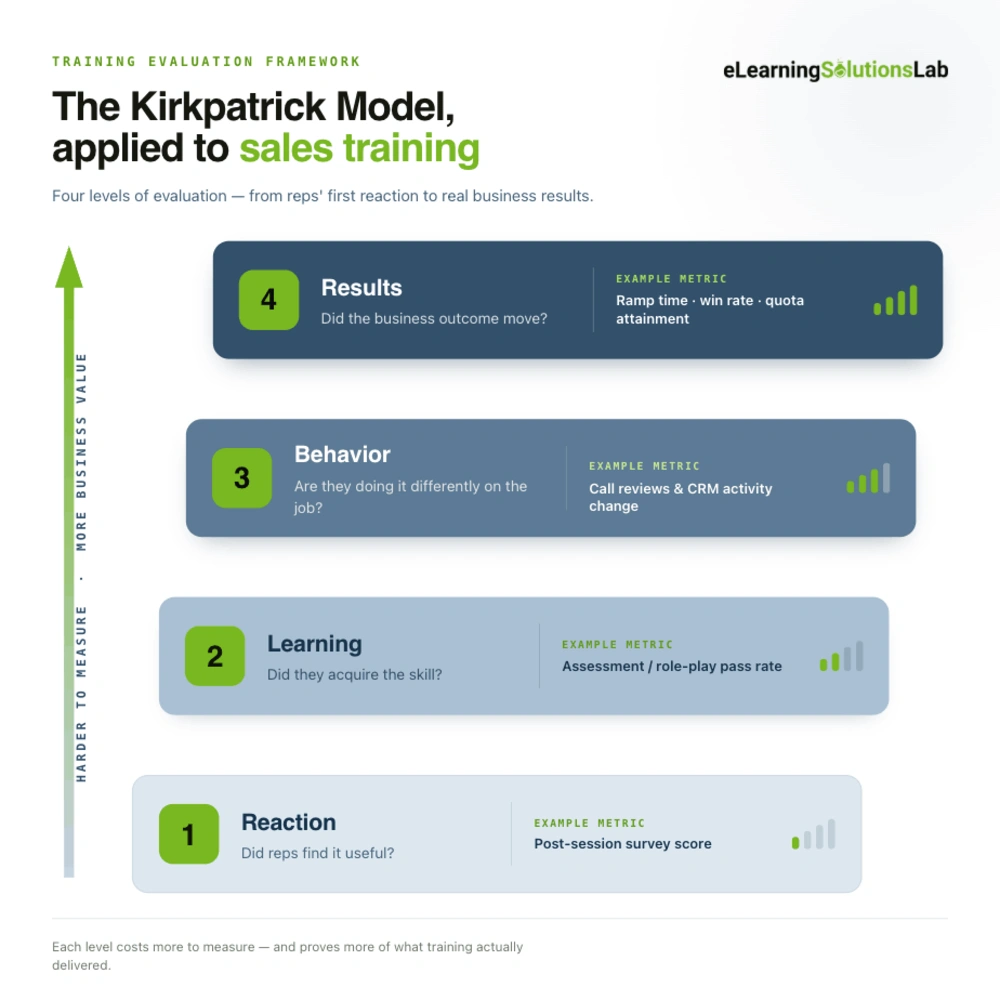
Level 1: Reaction: Did reps find it useful?
This is actually the lightest signal – post-module surveys and satisfaction scores tell you whether the training was truly engaging and relevant. It’s actually useful for catching a module everyone hates – but on its own, it proves nothing about learning.
Level 2: Learning: Did they actually acquire the skill?
Assessments, scenario scores, and simulation performance – this is where application-based testing will pay off – if the assessment mirrors the real tasks (“respond to this objection”), a passing score is meaningful evidence that the sales rep can do it. You can compare pre- and post-training scores to isolate what the program added.
Level 3: Behavior: Are they doing it differently on the job?
Are discovery calls actually deeper? Are sales reps using the objection framework in live deals? They are measured through call reviews, CRM activity data, and manager observation. Behavior change is the whole point of training – so nothing changes – and where Level 1 and Level 2 here don’t matter.
Level 4: Results: Did the business outcome move?
These are actual metrics leadership cares about: ramp time, win rate, quota attainment, average deal size, average deal size, cycle length. This is where you can close the loop back to the performance gap – you defined in step one. So if you set out to shorten ramp time, this is where you prove you did.
A simple way to frame ROI
You don’t actually need a complex model. At its most basic:
ROI = (value gained − program cost) ÷ program cost
You need to quantify the gain, so tie it to a single, defensible metric. If sales reps ramp two weeks faster, that’s two additional weeks of productive selling per hire, multiplied by hire count and average weekly revenue contribution.
So if your win rate climbs even a couple of points on a known pipeline volume, that delta is your return if you want to pick the one outcome most directly linked to your original gap and build that case around it rather than simply trying to capture everything.
Leading vs. Lagging Indicators
Simply watch both. Leading indicators can be completion, assessment scores, and activity changes, and will show up in weeks, and will tell you the program is on track. Lagging indicators – such as win rate, quota attainment, ramp time – take a quarter or more but are what actually prove impact.
Report leading indicators early to maintain confidence – you can hold leadership accountable for the lagging ones.
So the discipline that matters: you can decide which metrics you’ll track before launch, not after. Measurement is actually built in from the start, which is credible. Metrics reverse-engineered to justify a program after the fact are not.
Build vs. Buy: Choosing a Provider or Platform
Once the design is pretty clear, one decision remains: you can create the program in-house, license it from a provider, or just combine both. It really depends on your resources, how specialized your sales motion is, your capabilities, and how fast you really need to launch.
When to build in-house
When you know that building in-house makes sense is when your sales process, product, or buyer is distinctive enough that generic content won’t really fit – and when you have L&D capacity to produce and maintain it. In-house content is fully tailored to your process, CRM, and messaging, and you own it outright. The trade-offs will be time, cost, and upkeep – someone has to keep it current as products and playbooks will change, or it will go stale fast.
When to buy
Licensing from a sales training provider makes sense when you need a proven methodology, or you want to launch quickly with rapid elearning services, or you don’t have a team to build from scratch.
You get established frameworks and professionally produced content on day one. The trade-off here is fit – off-the-shelf elearning programs can teach a general methodology, not your specific process, and customization is often limited or costs extra.
Common answer: blend
Most mature sales training programs do both. They can license a methodology or skill library from one of the top elearning content providers for the universal selling skills – discovery, objection handling, negotiation — and build in-house modules for the company-specific layers: product knowledge, ICP, sales process, and CRM.
What to evaluate, whichever route you take
It is best to evaluate options against the criteria that will determine whether a program actually works:
The Author

Book A Discovery Call
Our Learning Advisors are happy to walk you through your project step-by-step — content, timeline, and fixed pricing.
Get Your Free QuoteNo obligation — just a focused conversation. Proposal within 24 hours.
You may also like
Staff Augmentation for L&D: Buyer’s Guide, Costs & Fit
L&D staff augmentation is a staffing model where an external eLearning…
How to Convert PowerPoint to eLearning (2026 Guide)
You have a 60-slide deck that worked pretty well in a live session. Now it…