

Blended eLearning is a training approach that combines instructor-led teaching with self-paced digital larening – all mixing live sessions, online modules, and hands-on practice into one program.
So instead of choosign between the classroom and screen, blended learning allows you to use both: giving your learners flexibility while actually keeping the structure and human connections that’s required that fully online training often loses.
Hybrid and distributed workforces have made in-person only training impractical while having purely self-paced courses may have struggles with completion and engagement.
So a well-designed blend has become the default today rather than any exception for organizations that simply want results without the cost of getting everyone in the room.
This guide covers nine core appraoches that make blended learning work, compontents to deliver them effectively, and top blended eLearning solutions to watch out for to help you build with in 2026.
What Counts as a “Blended eLearning Solution”?
A blended eLearning solution is a combination of a learning model, the technology that delivers it, the content learners work through, and the way live and self-paced elements are sequenced together.
Two organizations can both run blended learning and almost have nothing in common: one might flip its classroom with pre-reading and in-person workshops, while another will run live virtual sessions that are backed by an on-demand course library.
Both actually are valid blends – and the solution is the whole system, not just one piee.
Here’s to help you see the distinction to choose the right appoach later:
The simplest way to keep them straight: hybrid is about where people are, while blended is about how learning is actually delivered.
Top Blended eLearning Approaches
These nine approaches are building blocks of most blended programs. Few organizations will just use one – the real skill is actually combining two or three to fit your audience, goals, and budget. So here’s how each works and when to reach for it.
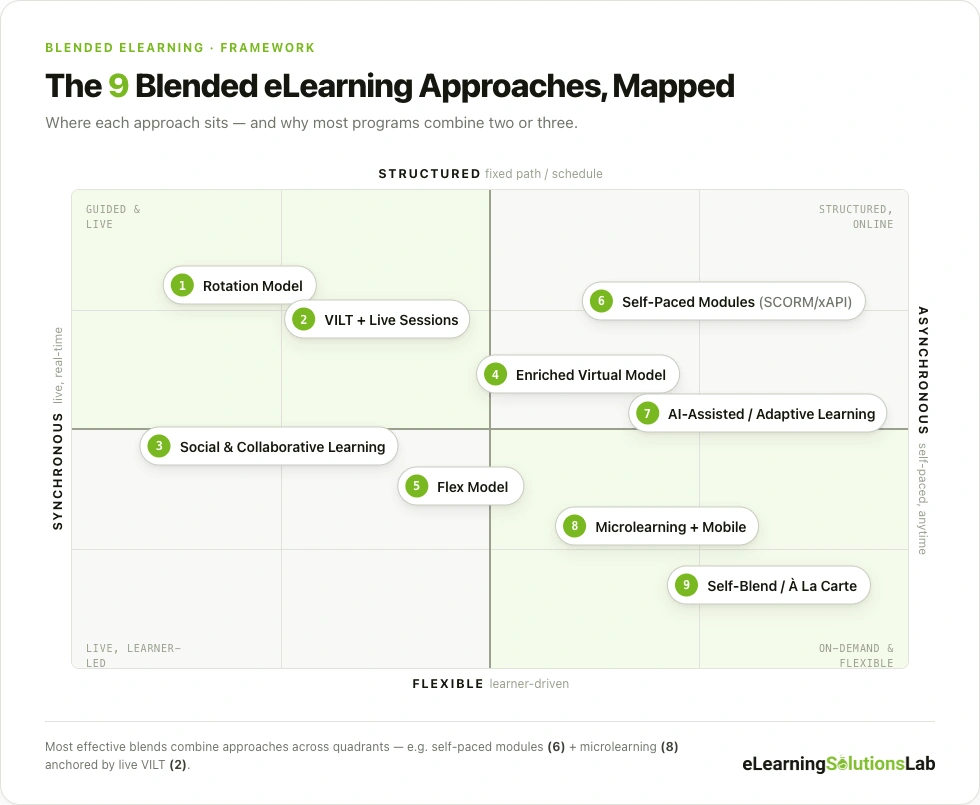
1. Rotation Model
Learners move on a fixed schedule between different learning models and typically have online self-study, instructor-led sessions, and group or hands on work. It’s the most structured blend and includes well-known variants like station rotation, lab rotation, and flipped classroom.
For instance, in a flipped classrom, learners will watch lecture content online beforehand, then spend live time applying it through discussions or practice rather than just passively listening. So a sales team might complete product e-modules on their own, then use the live session purely for role-play.
Best for: Structured programs with a clear curriculum, onboarding cohorts, and teams that will benefit from predictable rhythm.
2. Flex Model
Self-paced online learning can form the backbone, wiht instructors available for on-demand support rather than just scheduled sessions. Learners largely set their own pace and can pull in help when they hit a wall.
For instance, a coding bootcamp where learners will work through modules independently but can book a mentor whenever theyr’e stuck is a classic flex setup.
Best for: Self-motivated learners, varied skill levels in one gropu, and content where people can genuinely move at different speeds.
3. Self-Blend or À La Carte
Learners take a required core program and supplement it with optional online courses they can choose themselves. So the “blend” here comes from the learner curating their own extra learning on top of the standard track.
For instance, an employee completing mandatory compliance training then adding a couple of self-selected leadership courses from the company’s library, is considered self-blending.
Best for: Upskilling and career development, where the real motivation is high and interests differ widely across the audience.
4. Enriched Virtual Model
Most learning happens online, with only occasional required in-person (or live virtual) sessions to anchor the entire experience. So it’s nearly fully online, but keeping a deliberate face to face touchpoint.
An example of this is a certification program delivered almost entirely online, with a single in-person assessment day.
Best for: Distributed or remote teams, global audiences, and programs where travel is costsly but some live contact still adds value.
5. Virtual Instructor-Led Training (VILT) plus Live Sessions
This is a synchronous backbone of a blend: real-time teaching delivered over video: webinars, virtual classrooms, and live workshops – all are usually paired with self-paced materials before or after.
VILT recreates much of the energy and accountability of a physical classroom without the room.
For instance, a company rolling out a new system might run live VILT walkthroughs, then leave recorded sessions and job aids on-demand for reference.
Best for: Complex topics that will benefit from real-time Q&A, geographically spread teams, and anything where live interaction can drive more engagement.
6. Self-Paced eLearning Modules (SCORM/xAPI)
The asynchronous backbone: structured online courses that learners can complete on their own time. These are typically built to standards like SCORM or xAPI, which can simply mean that the cotnent can be loaded into most learning platforms and will reliably track progress, completion, and scores.
Think of interactive modules with videos, knowledge checks, and a final quizk – all the kind of course that lives inside an LMS and reports who finished what.
Best for: Scalable, consistent training that must reach a lot of people, plus anything requires completion tracking for compliance or certification.
7. Microlearning plus Mobile Delivery
Learning is broken into short, focused bursts – these are five-minute videos, a single concept, a quick scenario – usually delivered to mobile devices so that people can learn in the flow of work. It can pair naturally with longer blended programs as reinforcement.
For instance, a frontline retail team who gets a daily two-minute product tip on their phones is using microlearning.
Best for: Deskless and on-the-go workforces, just-in-time knowledge, and global teams in different time zones that are reinforcing earlier training.
8. Social and Collaborative Learning
Learning that happens through people including cohorts, peer discussion, forums, group projects, and mentoring that’s layered into the program. It can turn training from a solo activity into a shared one and tends to lift both engagement and retention.
For instance, a leadership program where participants can progress as a cohort, discuss case studies in a shared space, and learn as much from each other as fro mthe content is collaborative learning in action.
Best for: Soft-skills and leadership development, culture building, and anywhere peer accountability that will keep people engaged.
9. AI-Assisted or Adaptive Learning
The newest layer of the blend: platforms that will use AI to personalize what each learner sees – adjusting difficulty, recommendign next steps and adapting pathways that are based on performance in real time.
Instead of just one fixed route, every learner gets a path that’s shaped to their gaps.
For instance, an adaptive platform that quizzes a learner, identifies weak spots, and automatically serves more practice on exactly those areas is doing the work a single instructor who never could at scale.
Best for: Large or varied audiences, skills-based programs, and organizations that are ready to use learning data to drive personalization in 2026 and beyond.
Core Components Every Blended Solution Needs
Most blended solutions are asseembled from this same short list of building blocks and knowing what each one does wil make choosing tools and proivders far less overwhelming.
Learning Management System (LMS)
LMS is the hub that ties everything together – it hosts your courses, enrolls learners, tracks progress, and completion, and reports on results. So for a blend specifically, you want an LMS that can hanlde both self-paced content and live or instructor-led sessions – including scheduling, attendance, and reporting on in-person or virtual classroom side – not just any online modules.
That said, you don’t strictly need a full LMS to run a light blend – a mix of video calls, a shared drive, and email can carry a small program. But once you need to enroll learners at scale, track progress and completion, or produce compliance and certification reporting, an LMS quickly becomes essential rather than optional.
Virtual Classroom or Live Session Tools
This is the technology behind your synchronous layer which includes video conferencing, webinars, screen sharing, breakout rooms, polls and recording. Given that some LMS platforms include this natively – others integrate with tools like Zoom or Microsoft TEams. And this is what truly makes VILT possible.
Authoring and Content Tools
What you actually use to build the self-paced material which includes interactive modules, videos, quizzes, and scenarios. These authoring tools that will let you create content once and publish them in a standard format that will drop cleanly into your LMS. This is where a lot of the design effort and quality of a blend lives.
Assessments and Analytics
The feedback layer is here: quizzes, knowledge checks, practical assessments, and reporting that will tell you whether any of truly worked. Good learning analytics are what espartes a blend you can prove that’s effective from the one you just hope it is.
The digital modules are where most blends live or die. Send us your PowerPoints, PDFs, or webinar recordings and our instructional designers turn them into tested, SCORM-ready courses — WCAG 2.1 AA accessible and ready to drop into your LMS.
Top Blended eLearning Solution Providers for 2026
“Provider” actually means two different things in this industry – given that some providers will just give you a platform to run your own blend on, while others are agencies that can design and build the learning for you. Whichever you need will depend on whether you have the in-house capability to create content or just the budget to have it created.
Here are some notable names in each for 2026:
Platform vs. content provider – which do you need? If you have the right people who can build and run training and you mainly just need the tech stack, look at platforms. But if you need someone to actually design the actual courses, simulations ,or strategy, you can look at content and service providers.
Blended Learning Platforms (LMS and Delivery)
These platforms wil give you the software backbone including hosting, delivery, live sessions, or tracking so that your team can run the blend itself.
- TalentLMS – it’s an easy-to-use platform that’s built for both synchronous and asychronous training, and that’s popular with everyone from startups to large corporations. Pricing of TalentLMS starts at $89 per month for the Core tier and up to 40 tiers.
- iSpring – a digital learning platform that supports online and in-person training which combines eLearning courses authoring with live trainign support, webinars, gamification, and reporting on classroom activities – a strong tool if you both want authoring and delivery at the same time.
- Docebo – an enterprise-focused platform that’s aimed at corporate training at scale, and if often chosen by larger organizations who need robust customization and analytics.
- Absorb LMS – it’s tailord to employee development and upskilling with SCORM and xAPI compliance and integrations into HRIS, CRM, and productivity tools like Salesforce, Slack, and Microsoft Teams.
- Moodle – the leading open-source option, and known for flexibility and customization with an extensive plugin ecosystem and SCORM/H5P support across both education and corporate settings.
- LearnWorlds – a SCORM-compliant platform that is strong on hosting and selling both live and self-paced courses, with over 400 templates and a drag and drop builder.
- Cloud Assess – tool built for hands-on, practical training with log books, evidence portfolios, skills matrices, and offline functionality that will suit frontline and deskless workers and VET providers.
- Adobe Learning Manager – it supports face to face and online delivery with synchronous and asychronous learning, plus AI_driven recommendations and built-in video conferencing and webinar features.
- Canvas – widely adopted across K-12 and higher education, and with a professional-education platform for employee training and development.
Blended Learning Content and Service Providers
These eLearning development agencies will design and buid the learning itself: custom courses, simulations, branching scenarios, straetgy, and often the blend around them.
- eLearning Solutions Lab – a custom eLearning ocmpany that can turn your existing PowerPoints, PDfs, and webinar recordings into SCORM-ready courses – that are all built by instructional designers. They act as an on-demand extension of your in-house L&D teams who can handle instructional design, development, and QA across services like custom course development, ILT to eLearning conversion, rapid eLearning, microlearning, gamification, and localization (for over 35+ languages). Every course they ship is WCAG 2.1 AA accessible and supports SCORM 1.2, SCORM 2004, and xAPI – a strong fit for L&D teams with a training backlog and is needing a professional build fast without agency-scale budgets.
- Allen Interactions – one of the oldest custom providers in the US (founded 1993, Minneapolis), and is recognized for its M3 framework (Meaningful, Memorable, and Motivational) – focusing on games, microlearning, simulations, and blended learning.
- ELB Learning – combins broad learning technology and custom development which offers everything from course development to VR training, gamification, video coaching, AI services, and LMS support.
- Mindtools Kineo – it pairs bespoke learning design with leadership development, onboarding, compliance, learning platforms, and consulting – all suited to L&D buyers tying learning to workforce capabilities.
- eWyse – a Croatia-based agency that’s founded in 2017 and is built around its 360 methodology, mixing microlearning, instructional design, and gamification to European standards.
- Learning Pool and Liberate – global learning transformation partners that work alongside L&D leaders to scale capability and drive measurable performance outcomes.
Benefits of a Blended Approach
Blended learning today has become the default as it captures the strengths of both live and digital learning while offsetting some of the weaknesses of each. So the advantages here is what learners get from the approach and what the organization captures.
For learners:
- Flexibility and accessibility – self-paced elements that will let people learn when and where it actually suits them, while live sesisons will provide structure and accountability. And learners in different time zones, roles, or schedules can all reach the same outcome without being forced into one rigid format.
- Better engagement and retention – variety really keeps attention – so mixing live interaction, self-paced modules, microlearning, and peer discussion will give concepts more than just one chance to land – and learners will tend to retain more when they encounter materials in multiple formats and actually apply it – rather than just passively sitting through a single lecture.
- Personalization – blended programs can actually meet people where they are – as faster learners will move ahead, and those who need more time get it, and adaptive or self-blended elements that will let individuals shape their own path instead of just marching through one fixed route.
For the organization:
- Cost and scalability – once built, there’s a self-paced content that can reach thousands of learners at little extra cost while reserving expensive instructor time for moments where it truly need it (practice, Q&A, coaching) – stretching L&D budgets much further than classroom-only training.
- Consistency at scale – it delivers the core cotnent the same way to everyone, every time – which is essential for compliance, onboarding, and certification, where uneven training can create real risk.
- Data and measurable results – given that the digital layer is tracked, you can see completion rates, assessment scores, and where learners actually struggle – which can turn training from an act of faith into something you can really measure, prove, and improve.
Common Challenges and How to Avoid Them
While blended eLearning can be all glitters, there are also challenges that can trip most of the programs, and here’s how to avoid them.
1. Technology and access barriers.
A blend only works if the learner can actually reach both halves of it – so unreliable internet, outdated devides, or unfamiliar platforms that can quietly lock people out – and it’s often the learners who really need the training who get left behind.
The fix here is to audit your audience’s real world access before you assign and build in low-bandwidth and mobile-friendly options so that no one is exclusded by their setup.
2. Instructor readiness.
When you teach live online or faciltate a flipped session where learners drive, it’s a different skill all throughout from lecturing ina room. Any drop unprepared instructors into VILT and engagement collapses no matter how good the content is.
You can fix this challenge by training and supporting your facilitators on virtual delivery and blended facilitation before any launch, not just after the first session flops.
3. Content design effort.
Blended learning programs ask more of designers, not less – since you’re building self-paced modules and live sessions and the connective tissues between them. If you underestimate this – you’re likely to end up with a recorded lecture dumped online, which engages no one.
The fix here is to design each mode for what it does best: self-paced for content delivery, live time for practice and discussion, rather than just duplicating the same material in two formats.
4. Measuring effectiveness.
Many eLearning programs track completions and call it a day – never learning whether training changed any behavior. Without real measurement, you know as an L&D practitioner that you can’t really tell what’s working or justify the investment.
Start by defining success metrics upfront (knowledge gains, on the job behavior, business outcomes) and use your analytics to find and fix weak spots over time.
The Author

Book A Discovery Call
Our Learning Advisors are happy to walk you through your project step-by-step — content, timeline, and fixed pricing.
Get Your Free QuoteNo obligation — just a focused conversation. Proposal within 24 hours.
You may also like
Staff Augmentation for L&D: Buyer’s Guide, Costs & Fit
L&D staff augmentation is a staffing model where an external eLearning…
How to Convert PowerPoint to eLearning (2026 Guide)
You have a 60-slide deck that worked pretty well in a live session. Now it…