

Online Module Development Services Philippines
We help L&D teams, program managers, and training companies with our online module development services in the Philippines. Send us your decks, manuals, SOPs, legacy content, or webinar recordings. You'll receive SCORM-ready, WCAG-accessible learning modules in 5 to 7 weeks, with the source files.
CONTACT FOR A FREE QUOTE - WITHIN 3 BUSINESS HOURS
Get Your Free Proposal
Send a message or book a 30-minute discovery call directly below. We'll introduce you to a Learning Advisor with experience in your industry - no obligation, just mutual fact-finding to confirm we can help.
What To Expect
Fill out the form
Share your project scope and a Learning Advisor will be in touch within 3 business hours.
30-minute discovery call
We align on learner profile, content, module count and timeline - no sales pressure.
Proposal in 24 hours
You receive a fixed-price proposal with a committed delivery window - no hidden fees, no surprises.
NDA before files move
We sign a mutual NDA before you send a single source file. Encrypted transfer as standard.
No time works for you? Email venchito@rainmakermastery.com and we’ll arrange a schedule.
What does "module development" mean in training?
A learning module is a self-contained unit of online training, usually 30 to 60 minutes of seat time, that’s built around one performance objective, with content, practice, knowledge check, and completion tracking that reports into your LMS. So your people open it on a laptop or phone, can work through it at their own pace, and their score and completion must land in your system automatically.
Search for module development in the Philippines and most of what you’ll find are web agencies building CMS plugins and software components. That’s a different trade entirely. Online module development in a training context means instructional design, storyboarding, authoring, accessibility QA, and SCORM or xAPI packaging – work done by instructional designers and eLearning developers, not web developers.
Here’s the difference, side by side.
| Learning module (what we build) | Website module (what we don’t) |
|---|---|
| Self-paced training for your staff | Code component for a website or app |
| Delivered as a SCORM or xAPI package | Delivered as a plugin, theme, or repo |
| Runs inside your LMS | Runs inside your CMS |
| Built by instructional designers | Built by web developers |
| Tracks completion, scores, and progress | Tracks nothing about learners |
| Storyline 360, Rise 360, Captivate | WordPress, Drupal, React |
Types of Online Modules We Develop
Our online module development services cover every module type a Philippine L&D team actually needs - from a single compliance refresher to a full multi-module curriculum. Here's what we build, and when each one is the right call.
Custom Training Modules
Built from scratch around one performance objective, your brand, your systems, and your policies. Scenarios use your real job roles and your real tools, not generic stock situations. This is the right choice when the training has to reflect how your organization actually operates.
PowerPoint & PDF to Module
Your existing decks, SOPs, and manuals rebuilt as interactive, trackable modules. We restructure the content around objectives instead of just adding a Next button to your slides, then package it as SCORM so completion reports cleanly in your LMS.
ILT to Online Module
Classroom sessions, facilitator guides, and webinar recordings converted into self-paced modules your teams can take on any shift, in any site. Ideal when you're running the same live session over and over for new cohorts.
Microlearning Modules
Bite-sized modules of 5 to 10 minutes, built for learning in the flow of work. Best for refreshers, product updates, and frontline teams who can't step away for an hour. Delivered as a series so you can sequence and space the reinforcement.
Scenario & Simulation Modules
Branching decision modules and guided software simulations where learners practise before the real thing. Used for sales conversations, customer complaints, safety procedures, and system training where getting it wrong on the job is expensive.
Legacy Module Rebuilds
Dead Flash courses, old SCORM 1.2 packages, and modules built in deprecated tools rebuilt as responsive HTML5. Same knowledge, modern delivery - and re-packaged to the standard your current LMS expects.
What's Included
Every Module Ships With All Of This
No tiers on deliverables. Whether it's one module or twenty, the package below is the same - the only thing that changes between price tiers is how deep the interactivity goes.
Storyboard, approved first
You see the full structure screen by screen, with the assessment mapped, and sign off before a single slide is produced. No surprises at delivery.
SCORM or xAPI package
SCORM 1.2, SCORM 2004, or xAPI with cmi5 where your LMS supports it. Packaged, uploaded, and tested in your environment before we call it done.
Your source files
Every Storyline .story file and Rise 360 link, handed over on delivery. Update a policy next year without coming back to us, and without paying anyone to rebuild it.
WCAG 2.1 AA accessibility
Captions, transcripts, keyboard navigation, contrast, and screen-reader testing with NVDA and VoiceOver. A conformance summary is available for procurement.
Assessment mapped to objectives
Knowledge checks written against what the learner must actually be able to do, not filler questions dropped in at the end. Feedback explains why a wrong answer is wrong.
Voiceover, AI or human
AI narration in 35+ languages included, Filipino among them. Upgrade to human voice talent on any tier if the audience or the subject calls for it.
Two review checkpoints
One after the storyboard, one on the first working build. You steer the module while it's still cheap to change, not after it's finished.
Mobile-first and responsive
Works on a laptop, a shared floor terminal, or a phone during a shift break. Tested across desktop, tablet, and mobile before handover.
Nothing on this list is an add-on, and nothing is quoted separately.
The Process
From Your Files To Your LMS In 5 To 7 Weeks
We build to ADDIE, the instructional design standard, with two points where you approve before we continue. Here's what each week actually looks like, and what we need from you to hold the timeline.
Week 1 - Analyze
A 30-minute discovery call with your Learning Advisor. We agree who the learners are, what they must be able to do differently afterwards, and how you'll know it worked. You send whatever you have - decks, SOPs, manuals, recordings, or just a topic. What you do: join one call and send your content.
Weeks 1 to 2 - Design
We turn that into a storyboard: every screen, the flow, the scenarios, and the assessment mapped to your objectives. You read it and mark it up. This is Checkpoint 1 - nothing gets built until you approve the storyboard. What you do: review and approve within 5 working days.
Weeks 2 to 5 - Develop
The build itself, in Storyline 360 or Rise 360 - interactions, visuals, voiceover, animation. You see a working first build partway through, not a finished module at the end. This is Checkpoint 2, where you review the live module and we revise. What you do: consolidate feedback within 5 working days.
Week 6 - Implement
Accessibility QA against WCAG 2.1 AA, SCORM or xAPI packaging, then upload testing in your LMS. We confirm the module loads, tracks, and reports correctly before we hand it over. What you do: give us a test account in your LMS.
Post-launch - Evaluate
Completion and score data starts landing in your LMS from day one. We review the first cohort's results with you and flag anything the numbers say should change. What you do: share the data after your first cohort runs.
What actually causes delays
It isn't the build. In almost every project that slips, it's approval sitting in someone's inbox. Two checkpoints, five working days each - that's the deal that holds 5 to 7 weeks. Tell us upfront if your subject-matter expert is hard to pin down and we'll schedule around it instead of discovering it in week 3.
Standards & Compatibility
The Standards Your LMS And Legal Team Care About
LMS-ready only means something if the module speaks the right technical language. Here's exactly what we package to, what it gives you, and where it fits.
| Standard | What it gives you | When you need it |
|---|---|---|
| SCORM 1.2 | Completion, score, and pass or fail reporting in virtually any LMS built in the last twenty years. | The safe default. Use it unless your LMS team asks for something else. |
| SCORM 2004 | Sequencing rules, richer status reporting, and control over how learners move between modules. | Multi-module curricula where order and prerequisites matter. |
| xAPI (Tin Can) | Granular interaction data stored in a Learning Record Store, including activity outside the LMS. | When you need to prove behaviour change, not just course completion. |
| cmi5 | xAPI flexibility inside a structured LMS launch and completion flow. | Modern platforms that support it and want both tracking depth and LMS control. |
| AICC | Legacy compatibility for older enterprise systems still running on it. | Rare, but supported when your platform requires it. |
| WCAG 2.1 AA | Captions, transcripts, keyboard navigation, contrast, and screen-reader support on every screen. | Always. Standard on every module, never an upsell. |
| Data Privacy Act | Learner-data handling aligned to RA 10173 and GDPR-style consent principles. | Any module collecting learner names, scores, or identifiers. |
Every module is tested in your actual LMS before handover. We’ve deployed into Moodle, Canvas, TalentLMS, Docebo, Totara, Cornerstone, SAP SuccessFactors, and a fair number of in-house platforms. If yours isn’t on that list, we’ll test against it during the build rather than guess.
Online Modules Philippine Organizations Ask Us For
These are the module briefs that come through most often from Philippine organizations. If yours isn't listed, it almost certainly still fits - these are just the patterns we see week to week.
BPO Onboarding & Account Training
High-volume new-hire ramp that has to run again every wave without burning trainer hours. We build role-specific modules for product knowledge, tools, and account-specific process, so classroom time goes to practice instead of information transfer.
Compliance & Regulatory
Data Privacy Act (RA 10173), Safe Spaces Act and anti-sexual harassment, AMLA for financial services, and internal code-of-conduct training. Trackable, audit-ready, and easy to refresh when the rules move.
Occupational Safety & Health
Safety orientation and hazard-specific modules aligned to DOLE OSH requirements under RA 11058. Scenario-driven rather than policy-recital, because procedures only stick when people have practised the decision.
Healthcare & Clinical
Patient-safety, infection-control, and continuing-education modules for hospitals, clinics, and health networks. Built to hold up under audit and to work on shared ward terminals as well as personal phones.
Logistics & Supply Chain
Route planning, warehouse process, client-advisory frameworks, and consultant onboarding for logistics and supply-chain firms. Decision-heavy work, which is why these briefs usually land at Level 3 interactivity.
Training Providers & Institutions
Training and consulting firms productizing their curriculum, plus institutions converting classroom courses into self-paced online modules. You keep the source files and the IP - we build, you own and resell.
Modules In Filipino, Bisaya, And 35+ Other Languages
Plenty of Philippine training is written in English and delivered to a workforce that thinks in something else. Comprehension drops, completion rates look fine, and nothing changes on the floor. We localize modules properly instead of running a script through a translation tool.
That means bilingual English and Filipino modules for frontline and provincial teams, Cebuano, Ilocano, or Hiligaynon where the audience needs it, and scenario rewriting rather than literal translation – because a workplace situation written for one culture rarely transfers word for word. Voiceover comes in AI narration as standard, with human voice talent available on any tier.
If you’re a regional headquarters running the same program across the Philippines and the rest of Southeast Asia, we build the master module once and roll out language variants from the same source, so an update in one place propagates everywhere instead of forking into five versions.
How We Know The Module Worked
A module that looks good but changes nothing is wasted budget. We design every build to be measured against the four Kirkpatrick levels, so you can prove impact rather than assume it.
Reaction. Did learners find it relevant? Captured through completion rates and in-module feedback.
Learning. Did knowledge actually improve? Measured with pre and post knowledge checks scored against your objectives.
Behavior. Are people working differently? Supported with scenario practice and, where your LMS allows, xAPI statements that track on-the-job application.
Results. Did a business metric move? We tie objectives to what you care about – fewer safety incidents, faster new-hire ramp, lower error rates, higher conversion.
The assessment strategy is built during the design stage, not bolted on at the end, so the data you need exists from day one.
Module Sample
A Real Module We Built
Most vendors ask you to book a call before you see anything. Here's a real build instead - a Level 3 interactivity module developed for a logistics consulting client. Client content is blurred for confidentiality, but the structure, interaction design, and screen treatment are exactly as delivered.
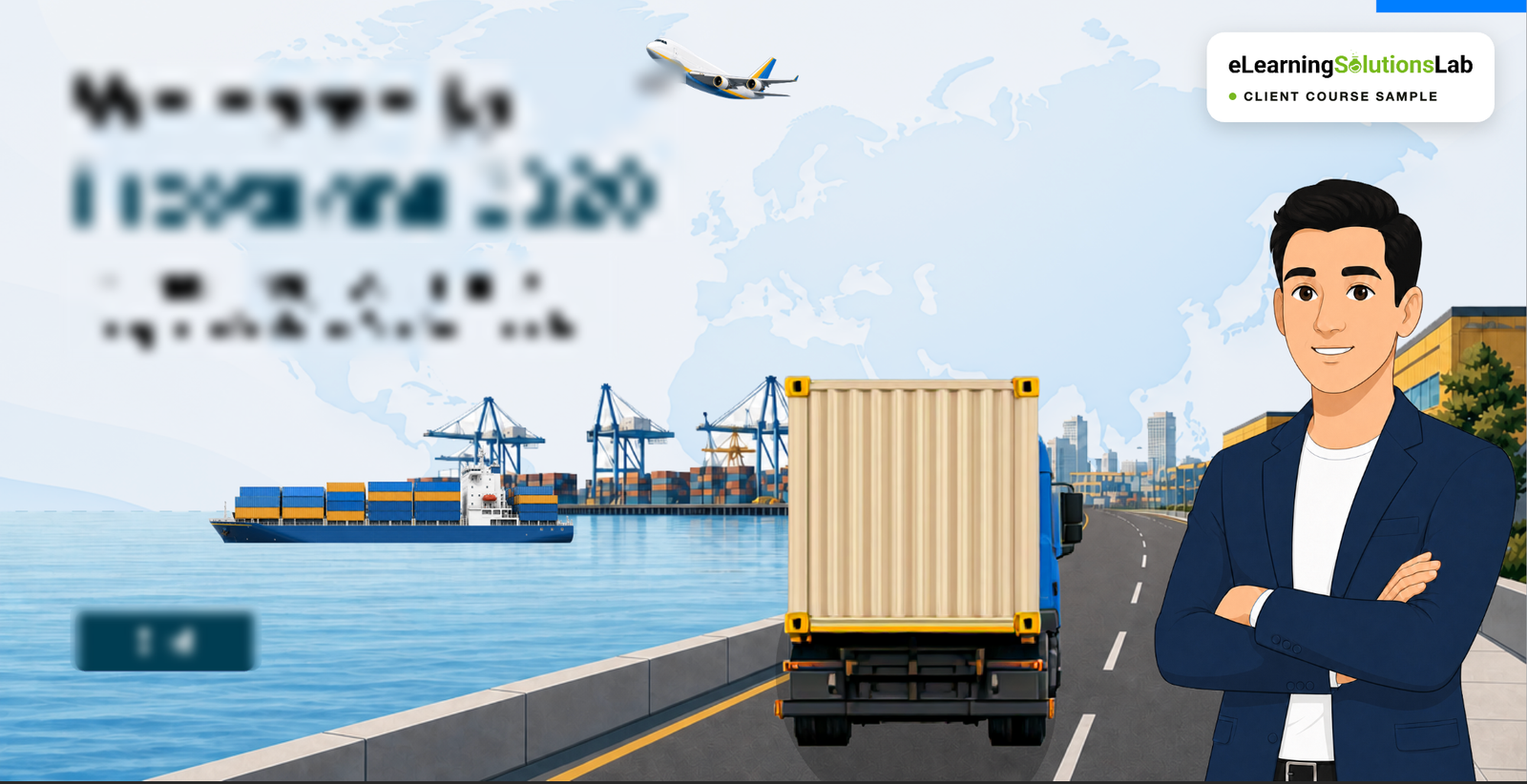
Logistics consulting module – Level 3 interactivity. Client content blurred for confidentiality.
Logistics Consulting Module
Client advisory and process training for a logistics consulting firm, built as a decision-driven module rather than a slide deck with a Next button.
| Industry | Logistics consulting |
| Interactivity | Level 3 |
| Seat time | 30 to 60 minutes |
| Built in | Articulate Storyline 360 |
| Packaged as | SCORM 1.2, LMS-tested |
| Accessibility | WCAG 2.1 AA |
What Level 3 means
Level 3 is complex interactivity - branching scenarios where choices carry consequences, custom-built interactions, animated sequences, and simulated tasks. Learners make the call before they're told the answer, then find out what it cost. Levels 1 and 2 are page-turning and simple click-to-reveal by comparison.
Why this brief needed it
Logistics consulting is judgment work. A consultant doesn't fail because they can't recite a framework - they fail in the room, on a client call, choosing the wrong recommendation under pressure. The module puts them in those conversations repeatedly, where a bad call is free.
Feedback that teaches
Every decision path returns an explanation, not just a score. Wrong answers show the downstream consequence - the delayed shipment, the margin lost, the client that pushed back - so the knowledge check becomes the lesson rather than a gate at the end.
Why eSL
Why L&D Teams Choose Us For Module Development
Plenty of vendors will quote you for online module development. Here's what's actually different when you hand the brief to eLearning Solutions Lab.
Published Pricing, In Pesos
You know the cost before you book a call. Fixed price per module, fixed timeline, no hourly billing and no scope creep. Almost nobody in this market publishes a number at all - our full price table is on this page, further down.
5 To 7 Weeks, Every Module
Backlogs don't have to sit another quarter. One healthcare client had six compliance courses stuck as PowerPoint files for eight months - we converted all of them in under six weeks.
Accessibility Built In
WCAG 2.1 AA on every module, every time, no exceptions. It isn't an upsell and it isn't a premium tier, so you're never handed a remediation bill after delivery.
A Philippine Team, Your Time Zone
Same working day, same holidays, same context. Approvals turn around in hours instead of overnight, and the people who scope your module are the people who build it - no account layer in between.
You Own The Source Files
Storyline .story files and Rise 360 links are handed over on delivery, with documentation. We don't lock your content to our tools or hold source files hostage for paid edits later.
AI Speed, Human Judgment
We use AI across drafting, narration, visuals, and video to cut production time and cost. Every AI-assisted asset then passes instructional and accessibility QA by a human ID. AI does the lifting, our designers own the outcome.
Pricing
Simple. Transparent. No surprises.
Fixed pricing. Fixed timelines. Every price is per module (30 to 60 minutes of seat time). You always know exactly what you're getting before you commit.
Rapid Build
Clean, guided modules for essential knowledge
₱170,000
per module
• 30-60 min seat time
• Limited interactivity – click-to-reveal, tabs, drag-and-drop, scored quizzes
• Custom, on-brand visuals
• AI / Human voiceover
• SCORM 1.2 / 2004 or xAPI / cmi5
• Kirkpatrick L1-2 built in
• 5-7 week delivery
Recommended
Professional Build
Full interactivity with a named on-screen facilitator
₱255,000
per module
• 30-60 min seat time
• Full interactivity – branching scenarios with real consequences
• Custom animation + named on-screen facilitator
• Feedback that teaches after every decision
• AI / Human voiceover
• SCORM 1.2 / 2004 or xAPI / cmi5
• Priority project manager
Enterprise Build
Maximum depth - simulation and fully custom design
₱425,000
per module
• 30-60 min seat time
• Simulation – adaptive branching + software / process sims
• Fully custom design + motion graphics
• Named facilitator + scenario storytelling
• AI / Human voiceover
• SCORM + xAPI / cmi5
• Priority project manager
Peso figures are indicative and billed against the prevailing rate. Multi-module programs are quoted at a per-module discount – tell us how many and we’ll price the set. A one-time blueprint and design-system setup is available for larger programs, quoted on request.
Which tier do most clients pick?
Professional Build, for anything a learner has to do rather than just know - safety procedures, sales conversations, handling a customer complaint. Rapid Build is the right call for policy acknowledgement, product facts, and annual compliance refreshers where the goal is accurate recall and a clean audit trail. Enterprise Build is for systems training, where people need to practise in a safe copy of the real thing.
Online Module Development FAQs
Quick answers to the questions L&D teams, program managers, and training providers ask us most before starting an online module development project.
Online Module Development FAQs
Pricing is fixed and quoted per module of 30 to 60 minutes of seat time. Rapid Build is ₱170,000 for clean, guided modules with limited interactivity and scored quizzes. Professional Build is ₱255,000 for full interactivity, branching scenarios, custom animation, and a named on-screen facilitator. Enterprise Build is ₱425,000 for simulation, adaptive branching, and fully custom design. Peso figures are indicative and billed against the prevailing rate. Multi-module programs are quoted at a per-module discount, and a one-time blueprint or design-system setup is available for larger programs on request.
A learning module is a self-contained unit of online training, usually 30 to 60 minutes of seat time, built around one performance objective. It contains the content, practice activities, a knowledge check, and completion tracking that reports into your LMS. Learners open it on a laptop or phone, work through it at their own pace, and their score and completion land in your system automatically.
Level 1 is passive – text, images, and narration with a Next button. Level 2 is limited interactivity such as click-to-reveal, tabs, drag-and-drop, and scored quizzes. Level 3 is complex interactivity: branching scenarios with consequences, custom interactions, animation, and simulated tasks. Level 4 adds full simulation, adaptive paths, and advanced media. Our Rapid Build sits at Level 2, Professional Build at Level 3, and Enterprise Build at Level 3 to 4 depending on the brief.
A module is one unit built around one objective. A course is usually several modules sequenced together into a program. We price and build per module, so you can start with a single high-priority topic and add more later rather than committing to a whole curriculum upfront. If you already know you need a full program, we scope the module map first and quote the set.
Most modules are delivered in 5 to 7 weeks. Depending on tier, interactivity, and how quickly content and approvals come back from your side, timelines run 5 to 10 weeks. Phases overlap by design – storyboarding starts while content review wraps, and QA overlaps development – so nothing sits in a queue. Multi-module programs run in parallel batches rather than one after another.
Whatever you already have – PowerPoint decks, PDFs, Word documents, SOPs, manuals, facilitator guides, webinar recordings, or just a topic and a subject-matter expert we can interview. We handle the instructional design, development, and quality assurance from there, with two review checkpoints so you stay in control throughout.
Yes. We deliver SCORM 1.2, SCORM 2004, and xAPI with cmi5 where supported, so your module is LMS-ready and tested before delivery. We’ve deployed into Moodle, Canvas, TalentLMS, Docebo, Totara, Cornerstone, SAP SuccessFactors, and various in-house platforms. If yours isn’t on that list, we test against it during the build rather than assume.
That’s a common situation and it’s not a blocker. We can deliver the module as a self-hosted HTML5 web package that runs from a link, so you can launch now and migrate to an LMS later. If you’re evaluating platforms, our eLearning consulting engagement covers LMS selection alongside your content roadmap.
Yes – WCAG 2.1 AA on every module, every time, never an add-on. That means captions and transcripts, full keyboard navigation, sufficient colour contrast, and screen-reader testing with NVDA and VoiceOver. A VPAT-style accessibility conformance summary is available on request for compliance-sensitive programs and procurement reviews.
Yes. We localize and translate modules into 35+ languages including Filipino, Cebuano, Ilocano, and Hiligaynon, with AI narration as standard and human voiceover available on any tier. Localization goes beyond translation – scenarios and examples are adapted so the situation still makes sense to the learner rather than reading like a converted script.
Every module includes two structured review checkpoints during the build – one at storyboard, one on the first working build – so you shape the module as it comes together rather than only at the end. Additional post-delivery revision rounds are available as an add-on, quoted on request.
You do. On delivery you receive the finished package plus the source files – every Storyline .story file and the Rise 360 link – along with documentation. Future updates stay entirely in your hands. We don’t lock content to our tools or hold source files for paid edits later.
Yes. We use AI to accelerate drafting, narration, visuals, and video, which is part of how builds stay fast and prices stay competitive. Every AI-assisted asset is reviewed by an instructional designer against your objectives and passes accessibility QA before delivery. Human voiceover talent is available on any tier if you prefer it.
We do, alongside local Philippine organizations. We’re a Philippines-based team serving clients across time zones, with 35+ languages supported for localization. Local clients get same-day approval turnaround and shared working hours; overseas clients get agency-grade quality without US or UK studio rates.
Get Your Free Proposal
When you fill out this form, we’ll introduce you to your personally selected Learning Advisor with experience in your industry, who will book a meeting with you to discuss your potential module development project.
There’s no obligation – just mutual fact-finding and information gathering to ensure there is mutual fit and that we can help you. That’s where the conversation starts.
We will get back to you within 3 business hours.
No time works for you? Email venchito@rainmakermastery.com and we’ll arrange a schedule.