

What is an eLearning Consultant?
An eLearning consultant is a specialist who helps organizations plan, prioritize, and design their digital training before any course gets built. Rather than producing content on request, they audit existing programs, diagnose learning gaps, and define a training roadmap that ties each course to a measurable business outcome.
The distinction here – strategy before production is what truly separates an eLearning consultant from an eLearning developer or vendor. An eLearning developer takes a brief and builds it. An eLearning consultant tells you whether the brief is the right one in the first place.
In practice, an eLearning consultant typically helps you:
- Audit your existing content library – identify what’s outdated, redundant, or behaviorally inert (i.e., information dense, but not actually changing how people work).
- Diagnose the real gap – distinguish a genuine skill or knowledge gap from a motivation or process problem that no eLearning course can fix.
- Define learning objectives and success metrics – so that the training is measured by behavior change and on-the-job performance, not just completion records.
- Prioritize the backlogs – sequence what gets built first based on risk, compliance exposure, and business impact.
- Recommend the right format and modality – custom development, rapid eLearning, microlearning, or ILT to eLearning conversion – that are all matched to the outcome and budget.
- Specify the technical requirements – SCORM 1.2, SCORM 2004, or xAPI packaging, LMS compatibility, and WCAG 2.1 AA accessibility standards.
The deliverables from a solid eLearning consulting engagement aren’t a course. It’s the clarity, a documented roadmap that will tell you what to build, in what order, in what format, and why, so the entire production work that follows with it is aimed at the right target.
eLearning Consultant vs. Developer vs. Agency vs. Freelancer
An eLearning consultant gets used loosely. People reach for it when they truly mean a developer, an agency, or a freelancer – and these four roles can solve genuinely different problems.
Hiring the wrong one is the most common reason a training project stalls: you bring a builder when you actually need a strategist, or pay agency rates for a job a freelancer could finish in a week.
Here’s how the four break down:
The practical way to read this table: an eLearning consultant decides, an eLearning developer builds, an eLearning agency scales, and an eLearning freelancer fills a gap. Most L&D teams actually need two of these at different points: strategy to set the direction, then production to execute it.
What Does an eLearning Consultant Actually Do? (Engagement Walkthrough)
The word “consulting” may sound abstract for many, like you’re just paying for advice and a slide deck. In practice, an eLearning consulting engagement is a sequence of concrete steps that will move you from “we have a training problem somewhere” to “here is exactly what to build, in what order, in what format, and how we’ll know it worked”.
Here’s what that sequence looks like.
1. Content Audit
The starting point is what you already have. An eLearning consultant reviews your existing course library, facilitator guides, onboarding materials, and compliance modules to map what already exists, what’s current, and what’s quietly out of date.
The goal here is to separate three categories: content that still works, content that needs refreshing, and content that’s behaviorally inert – these are informationally dense but not actually changing how people work.
So most libraries carry more of that third category than anyone can expect, and you can’t prioritize what you haven’t inventoried.
2. Gap Diagnosis
This is the step that truly justifies the entire engagement. For each performance problem on the table, the eLearning consultant asks whether it’s genuinely a training gap.
People aren’t just following the process – given that they don’t know how (a knowledge gap a course can close) or because of a tool that’s clunky, incentives are misaligned, or expectations were never set in the first place (problems no course will fix).
So building training for a non-training problem is the most expensive mistake in L&D, as diagnosing the distinction up front is what separates a consultant from an eLearning vendor who simply just builds whatever you order.
3. Roadmap and Prioritization
Once the real gaps are identified, it’s time for the eLearning consultant to sequence them, not by who asked loudest, but by the risk, compliance exposure, learner volume, and business impact.
So the output is a documented roadmap including which courses get built first, which can wait, which shouldn’t be built at all, and how each one can tie to a measurable outcome, rather than just a completion date. So the core deliverable really is a clarity you can take to leadership and defend.
4. Modality Recommendation
Every item on the roadmap then gets matched to the right format, given that not everything should be a 45-minute course – of course. An eLearning consultant specifies the modality based on the outcome and constraints.
- Rapid eLearning services are the right call when usable source content already exists and priority is speed. Convert powerpoint to elearning services turn slides, PDFs, or webinar recordings into structured, SCORM-ready courses quickly.
- Custom elearning development services – when the program actually needs to be built from a performance goal up, delivered through scenario based elearning services with branching and interactivity designed around your specific workflows and compliance context.
- Microlearning for performance support, compliance reinforcement, and onboarding touchpoints that don’t warrant an hour of seat time.
- ILT to elearning services work when classroom or webinar material can carry real instructional value, but it doesn’t scale.
Matching modality to business outcome is where budgets get protected, so you stop paying custom build prices for content that a rapid build would have handled.
5. Technical Specification
Finally, the eLearning consultant defines the technical requirements so that eLearning production doesn’t hit surprises at the finish line: SCORM 1.2, SCORM 2004, or xAPI packaging, depending on your LMS.
It also includes compatibility testing for your specific platform and WCAG 2.1 AA accessibility as a baseline, not an upsell. So getting this specified before any development can mean the finished course actually uploads, tracks, and runs in your environment instead of just breaking on launch.
Taking all these together, those five steps can turn a vague sense of “we’re behind on training” into an executable plan. So the eLearning audit tells you what you have, the diagnosis tells you what’s real: roadmap tells you the order, modality recommendation will tell you the format, and the technical spec makes sure it runs.
So everything downstream – actual course production will depend on getting these decisions right first
Signs Your L&D Team Needs an eLearning Consultant
Most L&D teams don’t decide to hire an eLearning consultant; they just hit a wall and realize they should have. So here are signs that tend to appear quietly and compound.
Backlog is compounding, not clearing.
One delayed eLearning course became three. New requests keep arriving while existing builds are still in production. You’re spending more time triaging what’s urgent than actually finishing anything. So when the queue grows faster than you can rank it, the missing part here isn’t capacity, it’s the system for deciding what matters most.
Your SMEs have become the bottleneck.
Every eLearning project that routes through the same overloaded subject matter experts to actually write storyboards, review prototypes, production slows, and the courses that come out are dense with information but light on actual learning design. So if progress depends on whoever’s least busy that week, you will need a repeatable structure that doesn’t bottleneck on individuals.
Nobody can say what to build first.
Everything feels equally urgent, so prioritization defaults to whoever asked loudest or whichever deadline is closest. So there’s really no shared logic typing the queue to risk, compliance exposure, or business impact – this means you’re as likely to build the wrong thing first as the first one. So uncertainty about sequence is one of the clearest signals that you actually need a roadmap before you need more builds.
Completion is high, but nothing changes on the job.
Your L&D reports show strong completion rates, yet managers still report the same performance gaps. That’s not a delivery problem – it’s a design problem. So courses built purely as information dumps with a quiz at the end produce completion records, not really behavior change. So if you can’t tell whether your existing library actually moves performance, an eLearning consultant can diagnose that before you fund more of the same.
You keep outsourcing reactively, not strategically.
When your internal capacity breaks, something gets handed off – usually in a rush, to whichever vendor is available, with no real discovery or instructional strategy behind it. The result is, of course, courses that will technically ship but don’t have any outcome, and you spend as much time managing one of the top elearning vendors as you saved by hiring one. So reactive elearning outsourcing is a symptom of missing strategy – not a substitute for it.
Internal vs. External eLearning Consultant – Which Makes Sense?
Once you’ve decided you need eLearning consulting expertise, your next question is where it should come: from a permanent full-time hire on your team or an external eLearning partner brought in per project.
The right answer here depends less on budget size and more on the shape of your training demand – whether it’s steady and predictable, or cyclical and uneven.
The case with hiring internally is actually strongest when training is core to how your organization runs and the workload is continuous. So an in-house eLearning consultant or learning strategist lives inside your context: they know the politics, stakeholders, product, and history of what’s been tried before.
So there’s no ramp-up on each eLearning project, and institutional knowledge stays in the building. If you’re consistently producing enough training to keep a strategiest fully occupied year-round, a permanent hire usually pays for itself.
Why hiring a full production team often isn’t the answer?
Standing up an internal build capability means a full-time instructional designer, an eLearning developer, and often an LMS administrator – all these three roles, each with salary, benefits, onboarding time, and management overhead.
For an organization with cyclical or project-based training demand, that kind of investment rarely maps cleanly to actual output. So you ned up overstaffed during slow stretches and still underwater during peaks, given that permandent headcount is sized to average demand while real demand arrives in spikes.
Whereas the case for an external consultant – the kind you’ll find among the top elearning consulting firms – is strongest when demand is uneven, when you actually need strategy and production capacity without permanent overhead, or when you simply lack a specific skill in-house.
An external eLearning partner scales with your roadmap – engaged when there’s work, idle on your payroll when there isn’t. So you get eLearning expertise (instructional design, accessibility, and SCORM/LMS technical depth) without absorbing it as a fixed cost.
So the trade-off here is that an external eLearning partner starts with less context, so the quality of the engagement depends heavily on their discovery process and how well they document their reasoning.
Here’s a practical way to decide:
For a lot of mid-size organizations, the realistic answer to this is a hybrid: keep strategic ownership in-house – someone who sets direction, manages stakeholders, and holds the relationships, and outsource the consulting plus production capacity for specific initiatives.
That will keep your fixed costs lean while still giving you a partner who can take a roadmap from diagnosis through to a finished, LMS-ready course. The key here is choosing an external partner who can reduce your management load rather than adding to it.
How an eLearning Consulting Engagement Works
Good eLearning consulting isn’t a mysterious black box you can pay into and hope something useful comes out. It’s a defined sequence with a checkpoint at every stage, so you always know where the eLearning project stands and what comes next.
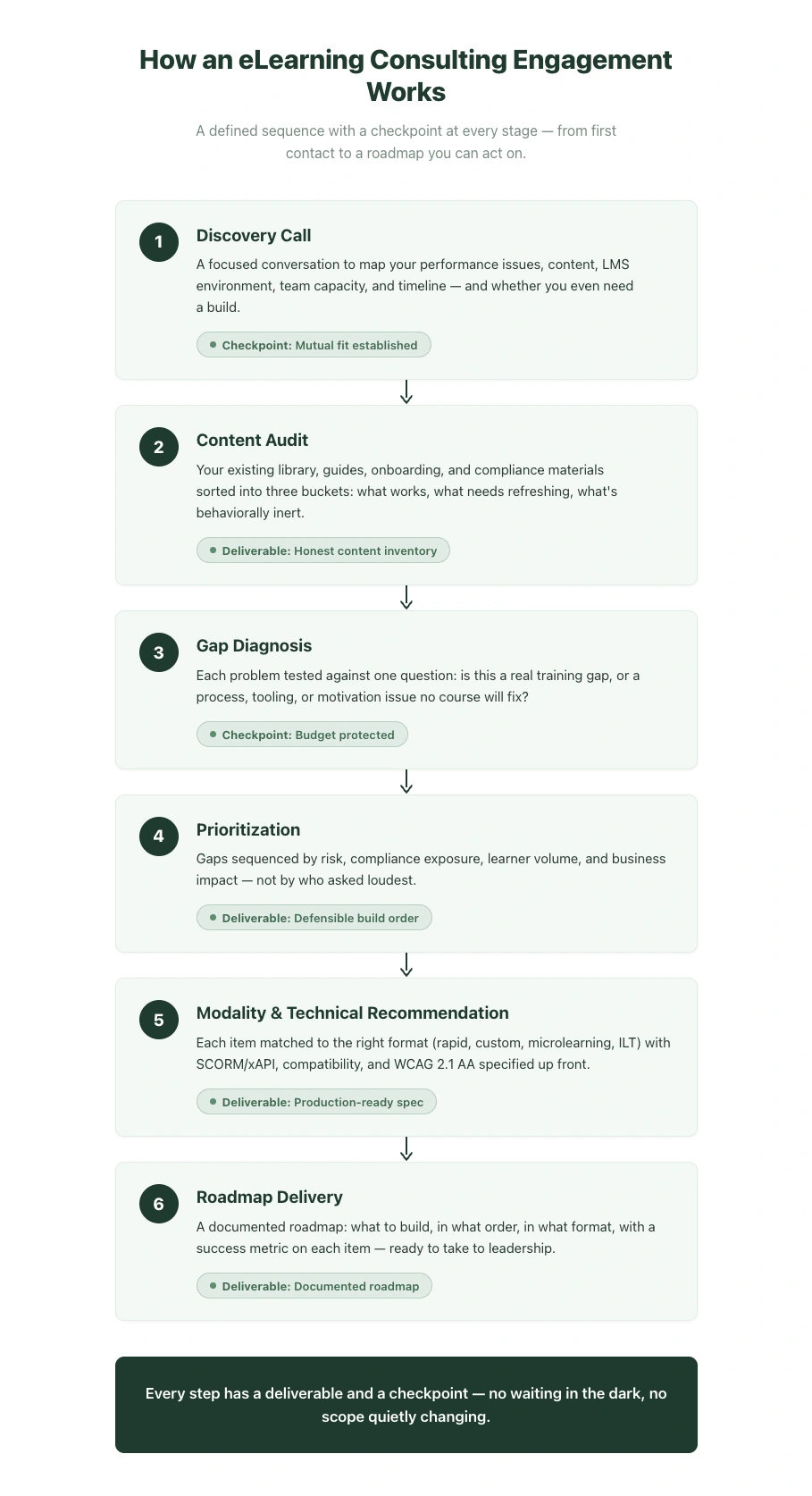 Here’s what a transparent engagement actually looks like, from first contact to a roadmap you can act on.
Step 1: Discovery Call
A focused conversation around your organization’s learning environment to better understand your situation: performance issues on the table, existing content, your LMS environment, your team’s capacity, and your timeline.
The goal here isn’t to pitch the build – it’s to figure out whether you even need one, and where the real friction is. This is also where mutual fit gets established. A good eLearning consultant will tell you early if a course isn’t the right fit.
Step 2: Content Audit
The eLearning consultant reviews what you already have: your course library, facilitator guides, onboarding, and compliance materials – and maps them into three buckets: what still works, what needs refreshing, and what’s behaviorally inert.
So you come out of this with an honest inventory – often the first time that anyone has looked at the whole library at once.
Step 3: Gap Diagnosis
Each performance problem gets tested against one question: Is this genuinely a training gap, or a process, tooling, or motivation problem that no course will solve? This is the step that can protect your budget, given that it stops you from funding courses that were never going to fix the underlying issue.
Step 4: Prioritization
The real performance gaps get sequenced: by risk, compliance exposure, learner volume, and business impact – not by who asked loudest. You get a defensible order of operations: what to build first, what can wait, and what shouldn’t be built at all.
Step 5: Modality and Technical Recommendation
Each prioritized item is matched to the right format: rapid, custom, microlearning, or ILT conversion – and the technical requirements get specified up front: SCORM or xAPI packaging for your LMS, compatibility, and WCAG 2.1 AA accessibility. This is where the eLearning strategy turns into something a production team can actually execute without guessing.
Step 6: Roadmap delivery.
The eLearning engagement ends with a documented roadmap: what to build, in what order, in what format, and with what success metric is attached to each item. It’s a plan that you can take to leadership and define it – and the bridge into production, whether you want to execute in-house or with the same partner who can run the diagnosis.
What really ties these six steps together is that each one has a deliverable and a checkpoint. You’re never waiting in the dark, wondering what’s happening, and you never reach the end and discover the scope quietly changed. So that structure – defined steps, scheduled reviews, and clear deliverables – is what truly separates a real eLearning consulting engagement from a vendor who collects your brief, disappears, and just resurfaces with an invoice.
How Much Does an eLearning Consultant Cost?
One-time audit and roadmap is the entry point – a fixed-fee diagnostic for L&D teams that aren’t sure what to build first or whether to build at all. So you get a full audit of your existing content and LMS usage, a behavior-gap diagnosis (is this actually a training problem?), a prioritized backlog, and a documented roadmap you actually own.
At eLearning Solutions Lab, this is the Learning Audit & Roadmap at $1,500 per engagement, including a findings and recommendations call. For most L&D teams, this is the highest leverage spend in the entire process, given that it will prevent far more expensive mistakes of building the wrong courses.
Ongoing L&D augmentation suit best for L&D teams with a backlog and no bandwidth to clear it. So instead of a single deliverable, you get a dedicated Learning Advisor acting as an extension of your team: talking briefs, driving builds, and managing instructional quality across projects with enough capacity that can scale up or down as demand shifts. This is the L&D Augmentation tier at $3,000 per month – structured so you’re not carrying a permanent hire through your slow periods.
A strategic retainer fits organizations that want to scale faster than their L&D teams can produce – multiple advisors across concurrent projects, ongoing roadmap ownership, quarterly strategy reviews, and a measurement plan with 30/60/90-day outcome tracking.
That’s the Strategic L&D Partner tier, from $9,980, with a single point of accountability for program-level results.
Frequently Asked Questions
Can an eLearning consultant also build the courses, or do they only advise?
Both depend on the partner. Some eLearning consultants are advisory-only and will hand you a roadmap to execute elsewhere. Others run the diagnosis straight through to production.
So the advantage of one partner doing both is continuity: the L&D team that diagnosed the gap is the same L&D team that can build the solution, so nothing degrades in a handoff to a vendor who never sat in on the strategy.
At eLearning Solutions Lab, many L&D teams will start with a consulting engagement to set direction, then actually move into development or ongoing augmentation once the roadmap is clear, but you can also engage the advisory work alone and build it in-house.
What qualifications or background should an eLearning consultant have?
Look for genuine instructional design grounding: learner analysis, behavioral objectives, assessment alignment – not just fluency with the best elearning authoring tools. Anyone can learn Articulate Storyline, far fewer can actually tell you whether a course will actually change behavior.
Strong signals may include experience in your specific use cases (compliance, onboarding, sales, leadership), technical fluency with SCORM/xAPI and LMS platforms, and a good track record of measuring learning outcomes rather than just completions.
Certifications can also help, but matter less than whether they can walk you through how they’ve diagnosed and solved a real performance problem.
Do I need an eLearning consultant if I already have an instructional designer on staff?
Not necessarily, but the two roles can solve different problems. An in-house instructional designer is usually focused on building specific courses well. An eLearning consultant works one level up: deciding which courses to build, in what order, and whether an eLearning course is even the right fix.
L&D teams often bring in a consultant precisely when their eLearning designer is excellent but buried – strategy and prioritization are the bottleneck, not production skill. So if your eLearning designer already owns prioritization and roadmap decisions, and they’re working, you likely don’t need outside help.
What’s the difference between an eLearning consultant and an instructional designer?
An instructional designer designs and builds learning experiences – structing content, writing objectives, creating interactions, and assessments. An eLearning consultant operates earlier and more broadly: auditing the whole program, diagnosing whether the problem is a training problem at all, prioritizing the backlog, and defining the roadmap and success metrics.
To put it simply, the eLearning consultant decides what should be built and why, and the instructional designer makes sure it’s built well. Many eLearning consultants have an ID background, but the consulting role is about strategy and direction – not production.
Will an eLearning consultant work with my existing LMS and tools?
A good eLearning consultant starts from your stack rather than pushing you toward theirs. That means specifying deliverables in the SCORM 1.2, SCORM 2004, or xAPI format your LMS requires and testing compatibility with your specific platform, and making recommendations based on what fits your environment – not on what earns them a reseller commission.
The Author

Book A Discovery Call
Our Learning Advisors are happy to walk you through your project step-by-step — content, timeline, and fixed pricing.
Get Your Free QuoteNo obligation — just a focused conversation. Proposal within 24 hours.
You may also like
Software for Training Companies: Best Tools and How to Choose (2026 Guide)
Short answer Training companies need a training management system (TMS) to…
How to Choose an LMS: A 7-Step Guide (With Free Scorecard)
Short answer To choose an LMS, define your goals and learners first, then…